Original Story
A Machine Learning Algorithm Just Found 10,000 Alien Planets Nobody Had Seen Before. They Were Hidden in Data We Already Had.
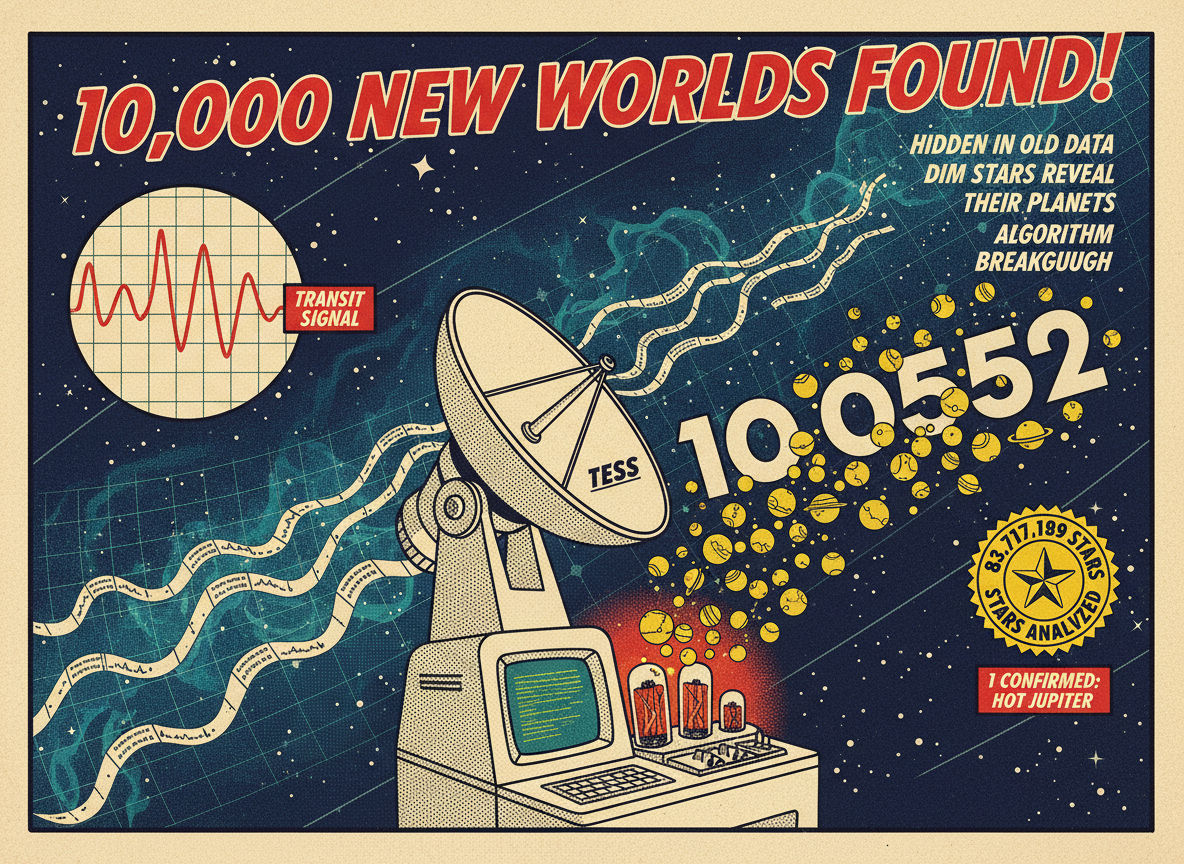
The current official count of confirmed exoplanets — planets orbiting stars other than our sun — sits at roughly 6,300. It took 30 years to build that list, starting with the first confirmed discovery around a sun-like star in 1995. A new study published in The Astrophysical Journal Supplement Series by a team led by Joshua Roth at Princeton University has just identified 10,052 additional exoplanet candidates in a single sweep — a number that, if even a fraction of them are confirmed, would come close to tripling the total known count. None of them were found with a new telescope or a new mission. They were hiding in data that already existed, from a NASA satellite that has been in orbit since 2018, waiting for someone to look at the right stars in the right way.
The satellite in question is called TESS — the Transiting Exoplanet Survey Satellite. TESS was launched by NASA in April 2018 specifically to hunt for exoplanets using a technique called the transit method. Here is how that works.
When a planet orbits a star, it periodically passes in front of the star from our line of sight. As it does, it blocks a tiny fraction of the star’s light — so tiny that even a Jupiter-sized planet crossing a sun-like star dims the light by only about one percent. For an Earth-sized planet, the dimming is less than 0.01 percent. TESS monitors millions of stars and looks for these tiny, repeating dips in brightness. When a dip occurs on a predictable schedule — once every X days, reliably — it is a strong signal that a planet is orbiting at a distance that produces transits every X days.
TESS has already confirmed 882 exoplanets this way, representing roughly 14 percent of all known exoplanets. That is a significant contribution. But TESS photographs enormous swaths of sky, capturing the light curves of vastly more stars than researchers have had the capacity to analyze in depth. Most teams prioritize the brightest stars, where the transit signal is clearest and easiest to confirm. The faint stars in the background of TESS images — the dim ones, harder to analyze, producing weaker signals — have mostly been left untouched.
What the Algorithm Found in the Dim Stars
Roth and his colleagues built a machine learning algorithm specifically designed to extract transit signals from faint star light curves. Machine learning, in this context, means a computer system trained to recognize patterns — the shape, timing, and repetition of a transit signature — without needing a human to hand-analyze each individual star. The algorithm processed the light curves of precisely 83,717,159 stars from TESS’s first year of data.
The result: 11,554 exoplanet candidates total, of which 10,052 had never been identified before. Around 87 percent of those candidates transited their stars twice or more in the dataset, allowing the researchers to calculate orbital periods ranging from 0.5 to 27 days.
The fact that the orbital periods cluster at the short end is significant and sobering. Planets that transit twice within TESS’s observation window — which typically covers a region of sky for about 27 days before moving on — must orbit close to their stars. Very close. Planets orbiting at that distance are almost certainly too hot to support liquid water, which is the baseline requirement for life as we know it. Most of the 10,052 newly identified candidates appear to be hot Jupiters — gas giants hugging their stars — or similarly close-in planets.
“There have been predictions that there were thousands of planets still lurking in the TESS data,” Roth said in interviews accompanying the study’s release. “It just hadn’t been searched yet.”
The Confirmation Test
To validate that the algorithm’s method actually works, the team attempted to confirm one of the new candidates using ground-based follow-up observations. They pointed one of the Magellan telescopes — a 6.5-meter instrument in Chile’s Atacama Desert — at a candidate called TIC 183374187 b, a hot Jupiter predicted to orbit a star approximately 3,950 light-years from Earth. The telescope confirmed the planet’s existence at the location and orbital parameters the algorithm had predicted.
One confirmed out of 10,052 candidates is not a statistically significant sample. What it does demonstrate is that the algorithm is not just generating noise — it is finding real signals. Jessie Christiansen of the NASA Exoplanet Science Institute welcomed the expanded dataset for the statistical power it creates: “I want as many exoplanets as possible so that I can start slicing and dicing things. How are they different? What kinds of different Jupiters do different stars make? These are all questions you can ask when you have a big sample.”
The galaxy, it keeps turning out, is far more crowded with worlds than we knew. We just needed to look at the dim stars.
Sources: [The Astrophysical Journal Supplement Series — Roth et al., The T16 Planet Hunt: 10,000 New Planet Candidates from TESS Cycle 1 and the Confirmation of a Hot Jupiter around TIC 183374187 (2026). DOI: 10.3847/1538-4365/ae5b6c] — Live Science — Scientists Identify 10,000 Impossible Exoplanet Candidates, Potentially Tripling the Number of Known Alien Worlds (May 2, 2026) — Daily Galaxy — NASA Telescope Data Reveals More Than 10,000 New Planet Candidates in a Single Sweep (April 28, 2026) — KXAN / Nexstar — Scientists Uncover 10,000 New Exoplanet Candidates in NASA TESS Data (May 2026)
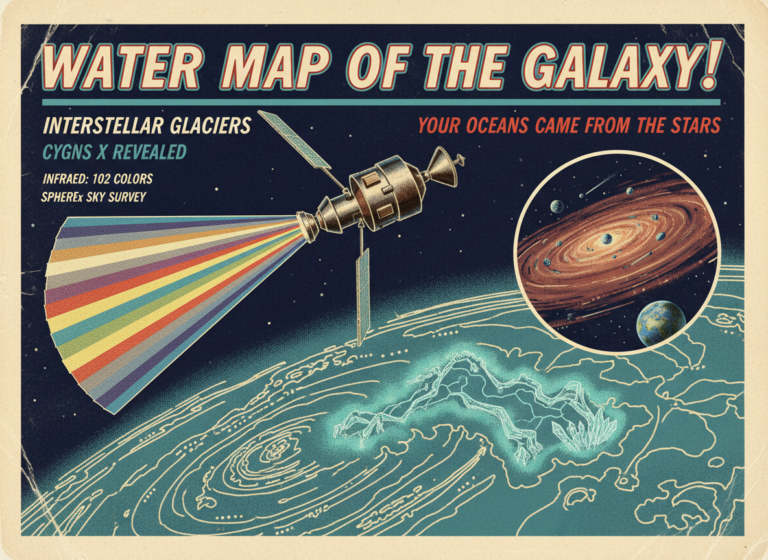
NASA Has Mapped the Water in the Galaxy. The Ocean Beneath Your Feet Came From Out There.
A study published in The Astrophysical Journal on April 15, 2026, based on data from NASA's SPHEREx mission, has produced the first…

Every Time You Tighten Your Core, Your Brain Gently Swishes Around. That Might Be Keeping You Sane.
When you tighten your abdominal muscles — whether you are walking, standing up from a chair, or doing anything that engages your…
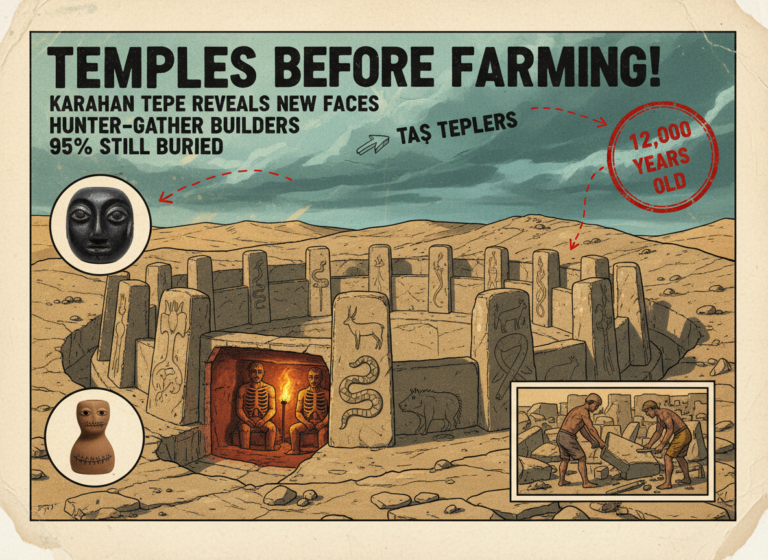
They Built a Temple Complex Before They Had Farming, Writing, or Pottery. New Finds at Karahan Tepe Just Made the Mystery Bigger.
Fresh discoveries at a 12,000-year-old site in Turkey called Karahan Tepe, the possible earliest village in human history, have uncovered more carved…
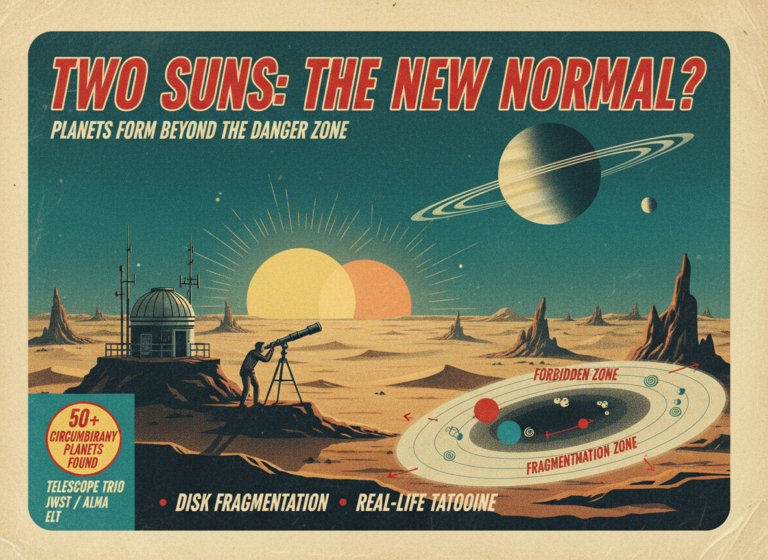
Star Wars Got It Right. Planets With Two Suns May Actually Be the Norm, Not the Exception.
For most of the history of astronomy, the assumption was that solar systems like ours — one star, one collection of orbiting…