Original Story
NASA Has Mapped the Water in the Galaxy. The Ocean Beneath Your Feet Came From Out There.
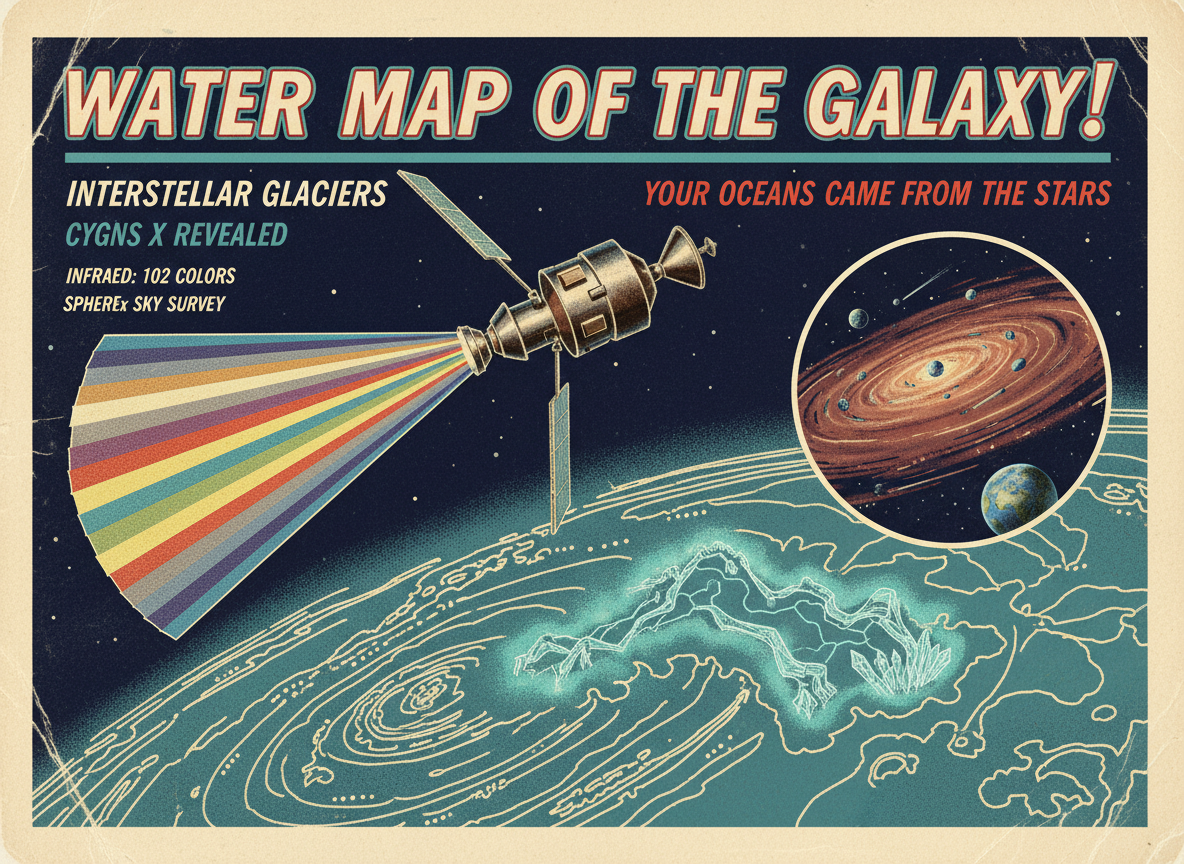
A study published in The Astrophysical Journal on April 15, 2026, based on data from NASA’s SPHEREx mission, has produced the first large-scale map of water ice across vast regions of the Milky Way galaxy. The findings are not subtle: the star-forming regions of our galaxy are laced with enormous reservoirs of frozen water, far more widespread than previous observations had suggested. The implications run from the practical to the philosophical. On the practical end: the water in Earth’s oceans, and in the ice that makes up comets and the polar caps of other worlds in our solar system, was almost certainly assembled in a region like the one SPHEREx just mapped, millions of years before the Sun even existed. On the philosophical end: if water is this abundant, this widespread, and this naturally produced wherever stars are born, then the ingredient most commonly associated with the possibility of life is not rare. It is the default.
SPHEREx stands for Spectro-Photometer for the History of the Universe, Epoch of Reionization, and Ices Explorer — a name long enough that the acronym is doing considerable heavy lifting. NASA launched it on March 11, 2025, aboard a SpaceX Falcon 9 from Vandenberg Space Force Base in California. It is a survey telescope, meaning its job is not to stare deeply at individual targets but to sweep the entire sky systematically, collecting infrared light from hundreds of millions of stars and building the largest infrared map of the cosmos ever made.
Its particular superpower relevant to this study is the ability to see in 102 colors simultaneously — 102 different wavelengths of infrared light, each encoding different information about what lies between the telescope and the source of the light. Molecules like water, carbon dioxide, and carbon monoxide absorb specific wavelengths of infrared light in distinctive patterns. When SPHEREx looks through a cloud of gas and dust and detects those absorption patterns, it is effectively doing chemistry at a distance, identifying what molecules are present and roughly how abundant they are.
Previous missions, including the retired Spitzer Space Telescope and the James Webb Space Telescope, had detected water ice in hundreds of individual targets throughout the galaxy. But they were looking at specific stars, specific clouds, specific regions. SPHEREx is the first mission designed to do this across the entire sky, producing a map rather than a catalog of individual sightings.
What the Map Showed
The study, led by Joseph Hora of the Center for Astrophysics at Harvard and Smithsonian, focused on Cygnus X — one of the most active star-forming regions in the Milky Way, located approximately 4,500 light-years from Earth and spanning hundreds of light-years across. Within it, SPHEREx found that water ice is not scattered in isolated patches. It forms interconnected, large-scale structures — frozen complexes coating the surfaces of microscopic dust grains, shielded from the harsh ultraviolet radiation of newborn stars by the density of the surrounding dust cloud itself.
“We expected to detect these ices in front of individual bright stars,” Hora said. “The light from a star acts like a spotlight, revealing any ice in the space between us and that star. But this is something different. When looking along the galactic plane, where most of the stars, gas, and dust of our galaxy are concentrated, there’s a lot of diffuse background light shining through entire dust clouds, and SPHEREx can see the spatial distribution of the ices they contain.”
Phil Korngut, the instrument scientist for SPHEREx at Caltech, described the frozen complexes as “interstellar glaciers.” “These vast frozen complexes are like interstellar glaciers that could deliver a massive water supply to new solar systems that will be born in the region,” he said. “It’s a profound idea that we are looking at a map of material that could rain on nascent planets and potentially support future life.”
Where Your Water Came From
The connection to Earth is not abstract. Scientists have long believed that the water in Earth’s oceans arrived here primarily through comets and water-bearing asteroids during the period of heavy bombardment that characterized the early solar system, between approximately 4.1 and 3.8 billion years ago. Those comets and asteroids assembled their water from exactly the kind of molecular cloud that SPHEREx is now mapping. Before the Sun formed, the cloud of gas and dust from which our solar system was born was threaded with water ice identical to what SPHEREx is detecting now in Cygnus X. That ice became incorporated into the solid bodies of the early solar system. Those bodies delivered their water to the early Earth.
Gary Melnick, an astronomer at Harvard-Smithsonian and co-author of the study, described the significance: “If there’s a lot of this ice nearby, that provides a likely answer to how these newly forming worlds could acquire their own oceans.”
What the SPHEREx map confirms is that this process is not rare or unusual. It is standard. Wherever stars are born in the galaxy, water ice is present. The ingredients for life’s most essential solvent are distributed through the galaxy’s nurseries as a default feature of star formation, not as a lucky accident specific to our corner of space.
Sources: [The Astrophysical Journal — Hora et al., Interstellar Ice Mapping in Cygnus X with SPHEREx (April 15, 2026). Published in Astrophysical Journal] — NASA JPL — Interstellar Glaciers: NASA’s SPHEREx Maps Vast Galactic Ice Regions (April 15, 2026) — NASA Science — SPHEREx Mission Maps Water Ice Throughout Cygnus X (April 15, 2026) — Science News — NASA’s SPHEREx Mapped Water Ice Across Vast Regions of the Galaxy (May 1, 2026) — Daily Galaxy — NASA Maps Hidden Interstellar Ice Highways That Could Seed Entire New Worlds (April 28, 2026) — India TV News — Earth’s Water May Have Come From Space: NASA’s SPHEREx Finds Massive Water Ice Deposits in Space (April 27, 2026) — World Today Journal — NASA’s SPHEREx Maps Water Ice Across the Galaxy (April 24, 2026)

A Machine Learning Algorithm Just Found 10,000 Alien Planets Nobody Had Seen Before. They Were Hidden in Data We Already Had.
The current official count of confirmed exoplanets — planets orbiting stars other than our sun — sits at roughly 6,300. It took…

Every Time You Tighten Your Core, Your Brain Gently Swishes Around. That Might Be Keeping You Sane.
When you tighten your abdominal muscles — whether you are walking, standing up from a chair, or doing anything that engages your…

They Built a Temple Complex Before They Had Farming, Writing, or Pottery. New Finds at Karahan Tepe Just Made the Mystery Bigger.
Fresh discoveries at a 12,000-year-old site in Turkey called Karahan Tepe, the possible earliest village in human history, have uncovered more carved…
Star Wars Got It Right. Planets With Two Suns May Actually Be the Norm, Not the Exception.
For most of the history of astronomy, the assumption was that solar systems like ours — one star, one collection of orbiting…