Original Story
They Built a Temple Complex Before They Had Farming, Writing, or Pottery. New Finds at Karahan Tepe Just Made the Mystery Bigger.
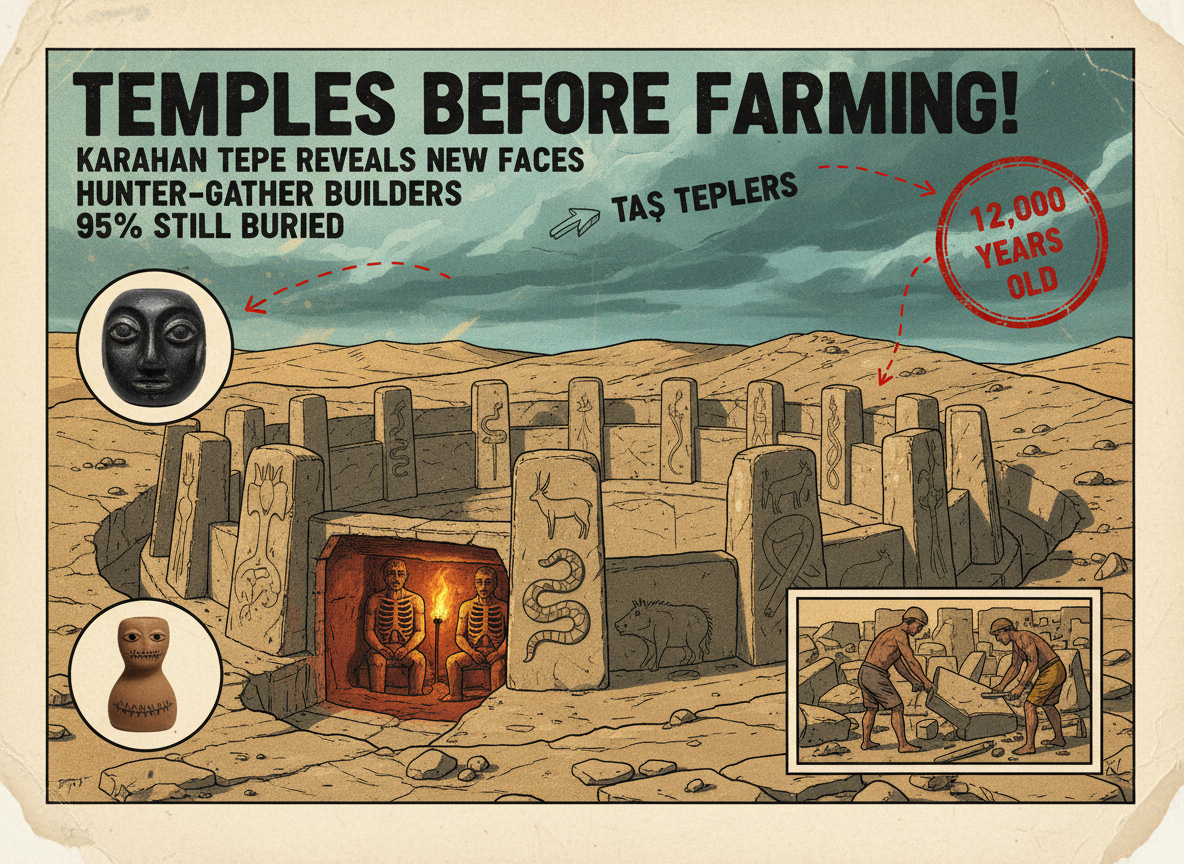
Fresh discoveries at a 12,000-year-old site in Turkey called Karahan Tepe, the possible earliest village in human history, have uncovered more carved human faces, animal sculptures, and new clues about what these people ate. What nobody has figured out yet is why hunter-gatherers with no known agriculture built one of the most organized ritual complexes on Earth.
There is a place in southeastern Turkey, on a windswept ridge in the Tek Tek Mountains, where people were building temples 12,000 years ago.
Not huts. Not storage pits. Temples. Massive circular enclosures carved out of bedrock, lined with T-shaped stone pillars that in some cases stood taller than a person and weighed several tons. Walls covered with detailed carvings of animals. Sculptures of human faces so precise they look almost modern. All of it built before pottery existed. Before farming was common. Before writing. Before metal tools.
The site is called Karahan Tepe, and you have probably heard less about it than its more famous neighbor, Göbekli Tepe, about 46 kilometers away. That is about to change.
New discoveries announced in late April 2026 have revealed more carvings, a second human statue matching the same haunting pose as the first one found there, new animal reliefs, and fresh laboratory analysis of what the people who built this place were eating. The results keep pushing the same uncomfortable question further forward: how does a group of hunter-gatherers, people with no permanent homes and no settled agriculture, build something this organized and this complex?
The Site Nobody Expected
Göbekli Tepe got famous fast. When German archaeologist Klaus Schmidt began excavating it in 1995 and announced he had found monumental stone structures dating back more than 11,000 years, it immediately changed what historians thought they knew about human civilization. For a long time, the accepted story was that humans settled into villages first, then developed agriculture, and only after that had the organization and resources to build large communal structures. Göbekli Tepe showed that the order was backwards. People built temples before they farmed.
Karahan Tepe, discovered by researcher Bahattin Celik in 1997, is part of a bigger regional picture called the Taş Tepeler project, which means Stone Hills in Turkish. It is a network of more than a dozen related prehistoric sites scattered across southeastern Turkey. Full excavations at Karahan Tepe only began in 2019 under Professor Necmi Karul of Istanbul University.
What they found almost immediately was remarkable. The site is covered with more than 250 T-shaped stone pillars. Some of those pillars are carved directly out of the bedrock and were never meant to be moved. There are circular and oval stone enclosures, interconnected by passageways, with working areas and platform spaces surrounding them. The whole complex spans about 10 hectares, and only about 5 percent of it has been excavated so far.
Karahan Tepe may actually be older than Göbekli Tepe. Archaeological dating suggests structures there began going up several centuries before the ones at its more famous neighbor. That would make it the earliest known example of monumental human construction anywhere in the world.
The New Discoveries
The freshest findings, reported in late April 2026 through the Taş Tepeler Project and covered by Arkeonews and The Debrief, add more pieces to a puzzle that refuses to become clearer.
A second human statue has been uncovered, carved in the same distinctive pose as the first major figure found at Karahan Tepe. The first statue was already unsettling by any measure. It was a life-sized or near-life-sized human figure seated in a ritual chamber with its ribs exposed and its features rendered with a specificity that researchers described as unlike anything seen from this period. Researchers have called it the Corpse Statue because of how it depicts the human body at a moment of physical decline or death. The discovery of a second matching statue suggests this was not a one-off. It was part of a deliberate artistic and possibly religious tradition.
More carved stone faces have been found, including a remarkable black serpentinite bead with expressive human faces carved on both sides, small enough to be held in one hand, detailed enough to recognize as a deliberate portrait. A stone figurine with what archaeologists describe as stitched lips has also emerged, meaning the mouth appears to have been deliberately sealed in the carving itself.
The diet analysis is the most recently published finding. Lab work done as part of the Taş Tepeler Project has determined that the people who built Karahan Tepe relied primarily on wild gazelle and legumes. The reliance on legumes was a surprise because researchers had expected to find more evidence of grain consumption. Instead, these people appear to have had a detailed, sophisticated understanding of plant harvesting that had nothing to do with the grains that later became the foundation of agriculture.
The gazelle hunting tells a story of its own. Gazelle is fast, alert, and difficult to take in numbers without coordinated group effort. Feeding a large workforce building monumental stone structures on a diet of primarily wild game and legumes would have required organized hunting parties working over significant distances.
What Has Never Been Explained
Only 5 percent of Karahan Tepe has been dug up. That means 95 percent of what those people built is still underground.
What has been found in that 5 percent includes a stone staircase, which suggests the buildings had multiple levels or at least intentional elevation changes. It includes a small quarry field adjacent to the main site where workers extracted and shaped the limestone for the pillars, showing that this was not a site where materials were brought from far away, but a purpose-built construction operation on location.
The most confusing part of the site remains the same question it posed from the beginning: why? Hunter-gatherers are mobile by definition. They follow food sources. They do not typically build structures that require months or years of communal labor, especially structures clearly designed for ritual purposes rather than shelter or food storage. To carve T-shaped pillars out of bedrock, move them into position, assemble circular enclosures, and then cover the walls with intricate animal and human carvings, a group of mobile hunter-gatherers would need to stop moving, gather in large numbers, coordinate their work, and share a common enough belief system to motivate all of that effort without any obvious material payoff.
Necmi Karul put it simply: “As communities became more sedentary, people gradually distanced themselves from nature and placed the human figure and the human experience at the center of the universe.”
But that sentence assumes the communities became sedentary first. The evidence at Karahan Tepe suggests something different: that the act of building together, of gathering around shared ritual spaces, may have been what caused people to become sedentary. The temple came before the village. The belief system came before the farm.
That flips everything we thought we knew about how civilization started.
And 95 percent of the site is still underground, waiting to be opened.
Sources: The Debrief, 12,000-Year-Old Discovery at Karahan Tepe Reveals an Ancient Key to Human Survival, Arkeonews, New Discoveries at 12,000-Year-Old Karahantepe, Wikipedia, Karahan Tepe, Karahan Tepe Archive Project, karahantepe.net, Times of Israel, At Neolithic Capital in Turkey, Carved Faces Upend Narrative of a Primitive Age
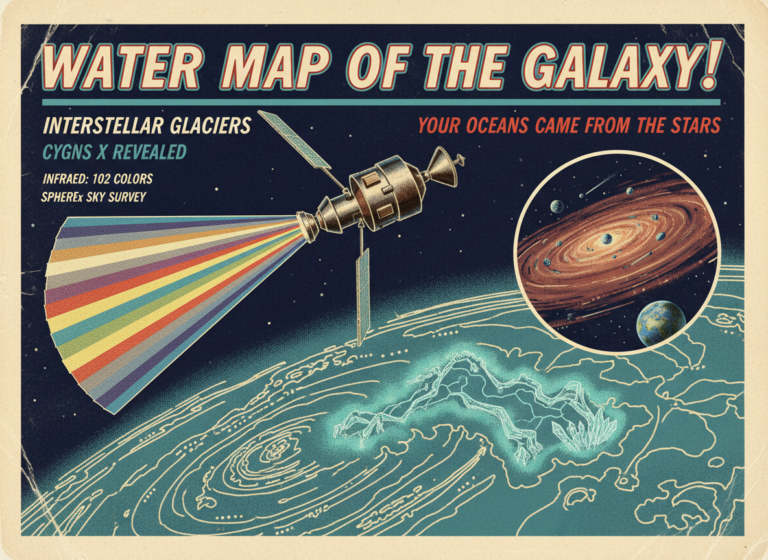
NASA Has Mapped the Water in the Galaxy. The Ocean Beneath Your Feet Came From Out There.
A study published in The Astrophysical Journal on April 15, 2026, based on data from NASA's SPHEREx mission, has produced the first…

A Machine Learning Algorithm Just Found 10,000 Alien Planets Nobody Had Seen Before. They Were Hidden in Data We Already Had.
The current official count of confirmed exoplanets — planets orbiting stars other than our sun — sits at roughly 6,300. It took…
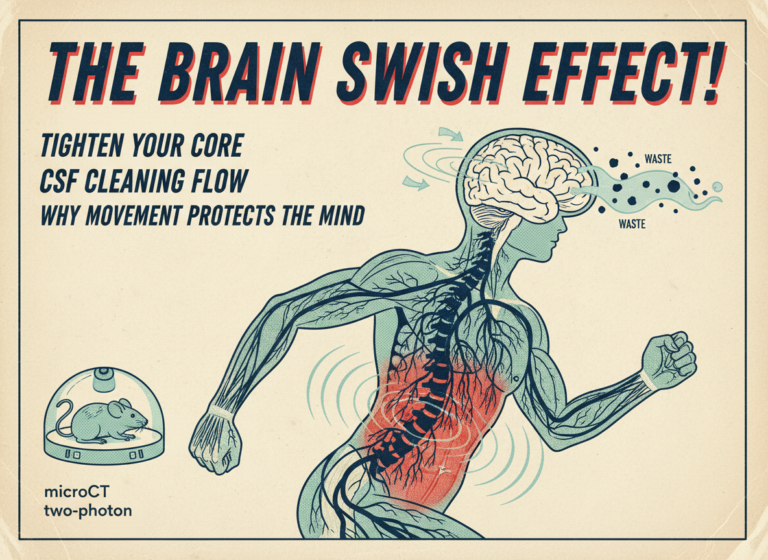
Every Time You Tighten Your Core, Your Brain Gently Swishes Around. That Might Be Keeping You Sane.
When you tighten your abdominal muscles — whether you are walking, standing up from a chair, or doing anything that engages your…
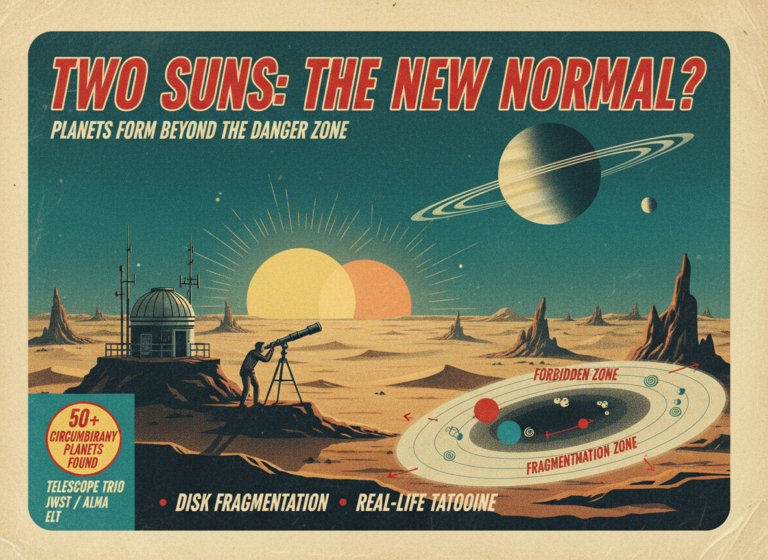
Star Wars Got It Right. Planets With Two Suns May Actually Be the Norm, Not the Exception.
For most of the history of astronomy, the assumption was that solar systems like ours — one star, one collection of orbiting…