Original Story
Every Time You Tighten Your Core, Your Brain Gently Swishes Around. That Might Be Keeping You Sane.
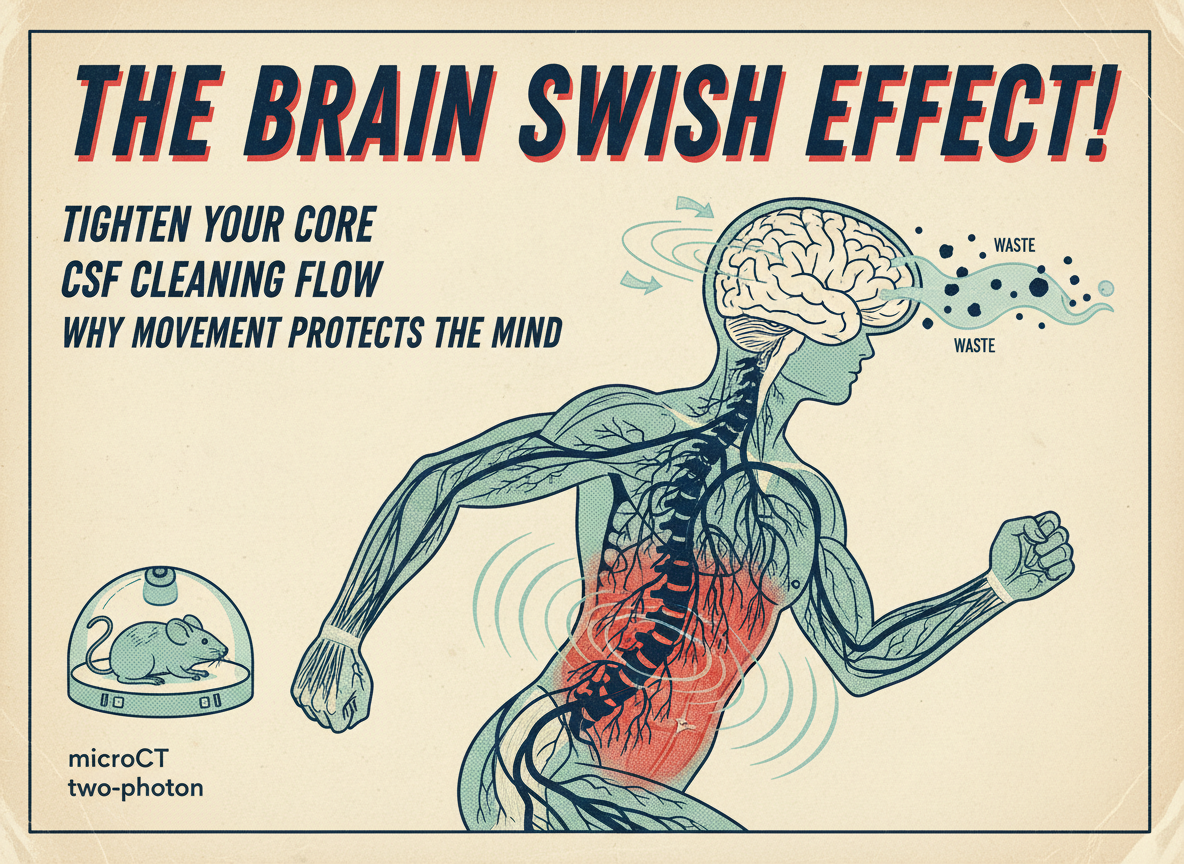
When you tighten your abdominal muscles — whether you are walking, standing up from a chair, or doing anything that engages your midsection — your brain moves. Not by much. The displacement is microscopic, imperceptible, and happens dozens of times a minute during normal physical activity. But according to a study published in Nature Neuroscience by researchers at Penn State University on April 27, 2026, that tiny motion may be one of the most important things your body does for long-term brain health. The mechanism: abdominal contractions compress blood vessels connected to the spinal cord, which transmits pressure upward to the brain, causing it to sway gently inside the skull. That sway pushes cerebrospinal fluid — the clear liquid surrounding your brain and spinal cord — across the brain’s surface, potentially washing away metabolic waste that, if left to accumulate, contributes to neurodegenerative diseases including Alzheimer’s.
To understand what this discovery means, you need to know a little about what cerebrospinal fluid is and what it does.
The brain is not sitting in your skull like a ball in a jar. It is suspended in cerebrospinal fluid — a clear, colorless liquid that cushions the brain, provides nutrients, and, critically, removes waste. Your brain is one of the most metabolically active organs in your body, burning a disproportionate amount of your daily energy. That activity produces waste products, including proteins like amyloid-beta, which clumps and forms the plaques associated with Alzheimer’s disease, and tau, which forms the tangles seen in multiple neurodegenerative conditions. Your cerebrospinal fluid removes those waste products by flowing across and through brain tissue.
The problem is that this flow requires movement. The fluid does not just sit there passively. Something has to drive it.
Researchers already knew that sleep was one key driver — during deep sleep, slow neural oscillations produce waves of cerebrospinal fluid that flow through the brain, potentially explaining why sleep deprivation is so strongly linked to dementia risk. Heartbeats and breathing also create minor pressure pulses that contribute. But those contributions alone did not fully explain how much fluid movement actually occurs during waking hours in physically active people. The Penn State study identified a third driver: the movement of the body itself.
What the Mice Showed
Lead author Professor Patrick Drew and his team at Penn State used microCT scanning and two-photon microscopy — techniques that allow extremely high-resolution imaging of living internal structures — to watch what happened inside the skulls of mice during physical movement. What they found was that a network of veins, called the vertebral venous plexus, runs through the interior of the vertebrae and connects the abdominal cavity directly to the spinal canal and brain. When abdominal muscles contract, they squeeze blood vessels in the abdomen, which pushes blood into those spinal veins and increases pressure in the dural sac — the membrane surrounding the spinal cord and brain.
That pressure increase causes the brain to shift slightly to the right and forward. The brain then returns to its resting position when the muscles relax. The motion is rostral-lateral — upward and sideways — and is tightly locked to the timing of the muscle contraction.
Computer simulations of this micro-displacement showed that even the small amount of sway it produces is sufficient to drive cerebrospinal fluid across the brain’s surface and through its tissue, potentially accelerating the clearance of waste products.
The team confirmed the mechanism by pressing gently on the abdomen of lightly anesthetized mice and watching the brain shift in exactly the same pattern, then return to baseline when the pressure was released.
What It Means for Exercise
The finding adds a mechanical explanation to something scientists have known for years without fully being able to explain: regular exercise powerfully reduces the risk of Alzheimer’s disease and other neurodegenerative conditions. Studies have repeatedly confirmed the link. The proposed explanations have ranged from increased blood flow to changes in neurotransmitter levels to neurogenesis — the growth of new neurons. The Penn State study adds a simpler possibility: when you move, your abdominal muscles contract, your brain gently swishes, your cerebrospinal fluid flows, and your brain cleans itself.
“This kind of motion is so small,” Drew said. “It’s what’s generated when you walk or just contract your abdominal muscles, which you do when you engage in any physical behavior. It could make such a difference for your brain health.”
He emphasized that more work is needed to understand how the mechanism translates to humans — the mouse brain is structured differently from the human brain, and the geometry of the pressure transmission may vary. But the study opens a new line of investigation: if body movement drives brain cleaning, then the type, duration, and intensity of movement may matter specifically for cerebrospinal fluid flow rather than just cardiovascular or muscular fitness.
The implication is practical. You do not need to run a marathon to engage this mechanism. You just need to move.
Sources: [Nature Neuroscience — Drew et al., Brain Motion Is Driven by Mechanical Coupling with the Abdomen (April 27, 2026). DOI: 10.1038/s41593-026-01589-7] — Penn State University — Hydraulic Brain: Body Motion Linked to Fluid Movement in the Brain (April 27, 2026) — ScienceDaily — Scientists Discover a Hidden Brain Cleaning Effect Triggered by Movement (May 1, 2026) — Bioengineer.org — Fluid Dynamics of the Brain: How Body Movement Influences Brain Fluid Flow (2026) — RegenHealthSolutions — Hydraulic Brain: Body Motion Linked to Fluid Movement in the Brain and Washing Away Cerebral Waste (May 2, 2026) — Hoodline — Penn State Study Says Tiny Tummy Tenses May Help Flush Dementia Waste (April 2026)

NASA Has Mapped the Water in the Galaxy. The Ocean Beneath Your Feet Came From Out There.
A study published in The Astrophysical Journal on April 15, 2026, based on data from NASA's SPHEREx mission, has produced the first…

A Machine Learning Algorithm Just Found 10,000 Alien Planets Nobody Had Seen Before. They Were Hidden in Data We Already Had.
The current official count of confirmed exoplanets — planets orbiting stars other than our sun — sits at roughly 6,300. It took…

They Built a Temple Complex Before They Had Farming, Writing, or Pottery. New Finds at Karahan Tepe Just Made the Mystery Bigger.
Fresh discoveries at a 12,000-year-old site in Turkey called Karahan Tepe, the possible earliest village in human history, have uncovered more carved…

Star Wars Got It Right. Planets With Two Suns May Actually Be the Norm, Not the Exception.
For most of the history of astronomy, the assumption was that solar systems like ours — one star, one collection of orbiting…