Original Story
NASA Just Cut Power to Voyager 1 to Keep It Alive. It Has Been Flying for 48 Years and Is Still Sending Data From Beyond the Solar System.
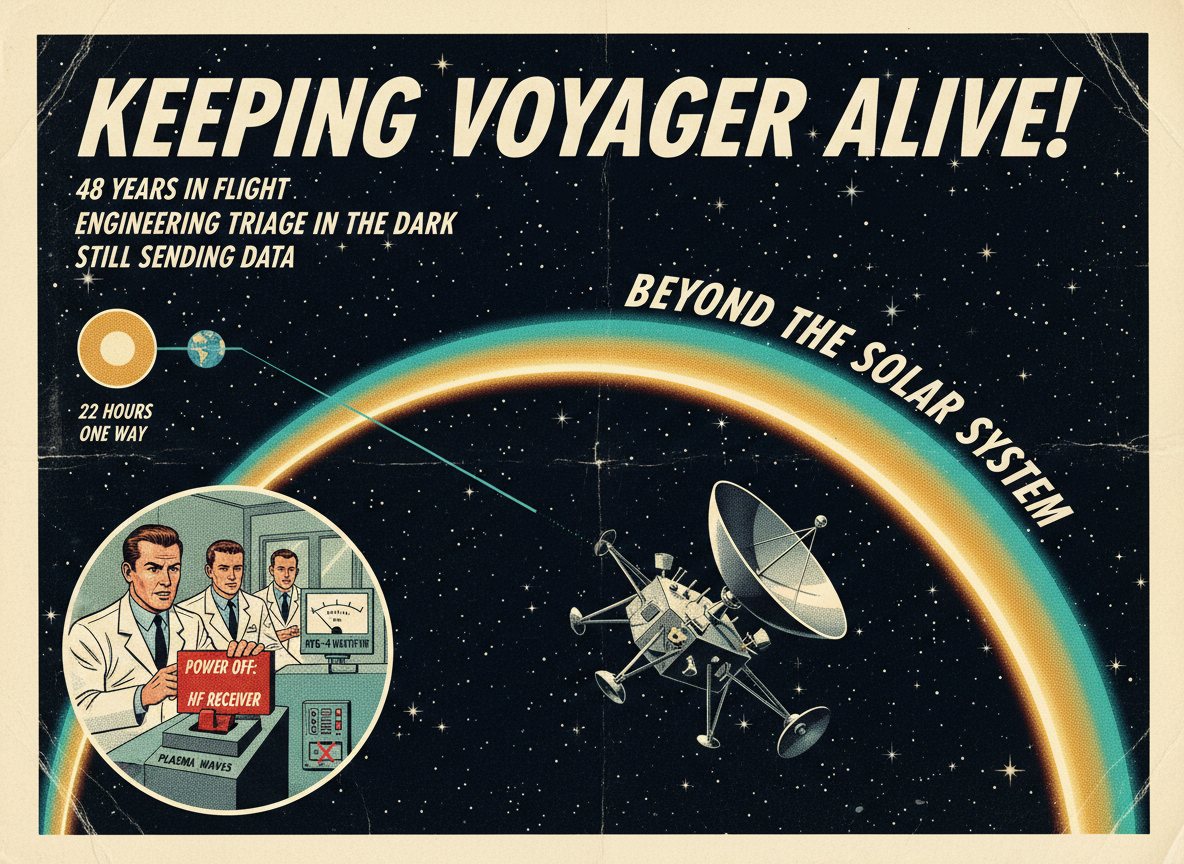
Voyager 1 is the most distant human-made object in the universe. It launched on September 5, 1977, and as of April 2026 is approximately 24 billion kilometers from Earth — so far that a radio signal traveling at the speed of light takes more than 22 hours to reach it and another 22 hours to return. This week, NASA engineers shut down one of its five remaining science instruments to conserve electrical power. The spacecraft is running on a steadily decaying plutonium-238 thermoelectric generator that loses roughly 4 watts of power per year. It has been doing this since 2020, systematically powering down instruments one at a time. But Voyager 1 is still flying. Still transmitting. Still returning data from interstellar space that no other instrument in human history has ever collected, from a location no other human-made object has ever reached.
The instrument shut down this week was the plasma wave subsystem’s high-frequency receiver, one of five science instruments still active on a spacecraft that launched with eleven. NASA’s Jet Propulsion Laboratory confirmed the decision on April 22, 2026. The plasma wave subsystem, which studies waves in space plasma, will continue to operate with its remaining components — only the high-frequency receiver was deactivated. The decision was made to redirect its power allocation to systems required for basic spacecraft health and data transmission.
The power budget on Voyager 1 is now extremely tight. The spacecraft’s plutonium-238 radioisotope thermoelectric generator (RTG) was designed to produce approximately 470 watts at launch. In 2026 it produces somewhere in the range of 290 watts — a reduction of roughly 38 percent over 48 years of radioactive decay. Operating a spacecraft on that power budget requires the kind of engineering triage that would have been considered impossible when the original mission was designed.
NASA engineers have been making these decisions for years, and the process is increasingly constrained. In 2020, the onboard heaters for one of the instruments were shut down to save power, which NASA engineers calculated would expose the instrument to temperatures below its design threshold. The instrument kept working anyway. In 2023, a computer memory chip failure caused Voyager 1 to transmit garbled data for months. The engineering team at JPL, working with 22-hour communication delays each way, diagnosed the problem remotely and devised a solution that relocated the affected software to a different part of the computer’s memory. The spacecraft resumed normal science operations. It was, at the time, the most remote software patch in the history of information technology.
What Voyager 1 Is Actually Doing Out There
Voyager 1 crossed the heliopause — the outer boundary of the solar wind bubble that surrounds our sun — in 2012, making it the first human-made object to enter true interstellar space. The heliopause is where the solar wind, the constant outflow of particles from the sun, becomes too weak to push back the interstellar medium: the thin soup of particles, dust, and cosmic rays that fills the space between stars.
In the interstellar medium, Voyager 1’s plasma wave instrument has detected phenomena that no previous spacecraft had ever observed: plasma oscillations caused by electron density waves that have allowed scientists to measure the density of interstellar space directly. That measurement — roughly 0.05 electrons per cubic centimeter — is a property of a region that no instrument had ever sampled before. It matches theoretical predictions well enough to be interesting and deviates from them just enough to keep researchers attentive.
The spacecraft is also detecting cosmic rays at levels consistent with interstellar space rather than the solar environment, providing a continuous baseline measurement of the radiation environment beyond the sun’s protective bubble — data that is relevant to planning future crewed missions beyond the inner solar system.
The nearest star to our sun, Proxima Centauri, is approximately 4.24 light-years away. At Voyager 1’s current speed of roughly 17 kilometers per second, the spacecraft will reach the distance of Proxima Centauri in approximately 73,000 years. It will not be pointing in Proxima Centauri’s direction when it does. It will not be transmitting. It will still be moving.
A spacecraft assembled by human beings in the 1970s with 1970s technology, running on decaying plutonium, controlled via radio signals that take 22 hours to arrive, is returning measurements from interstellar space in April 2026. NASA just turned off one of its instruments to keep it alive long enough to return a few more years of data that nobody else will ever be able to collect.
Sources: Unexplained Mysteries — NASA Shuts Down Voyager 1 Science Instrument to Conserve Power (April 22, 2026) — NASA JPL — Voyager Mission Status Updates (April 2026) — [Space.com — Voyager 1 Power Conservation Instrument Shutdown (April 2026)]
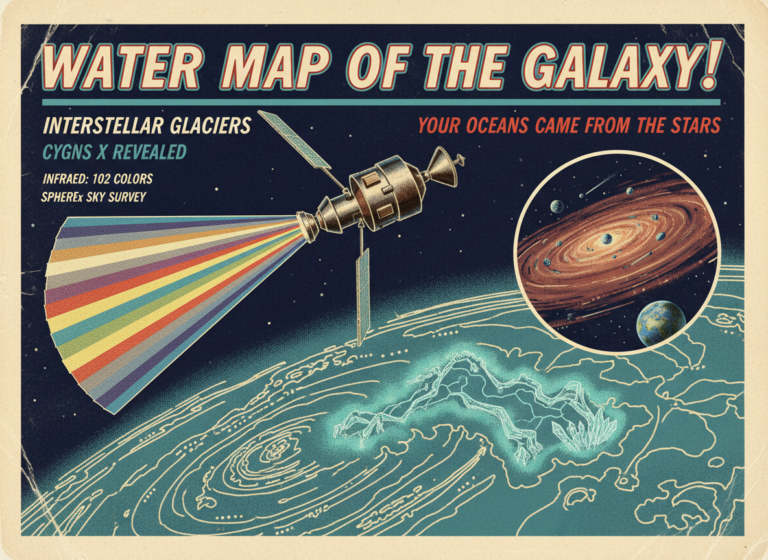
NASA Has Mapped the Water in the Galaxy. The Ocean Beneath Your Feet Came From Out There.
A study published in The Astrophysical Journal on April 15, 2026, based on data from NASA's SPHEREx mission, has produced the first…

A Machine Learning Algorithm Just Found 10,000 Alien Planets Nobody Had Seen Before. They Were Hidden in Data We Already Had.
The current official count of confirmed exoplanets — planets orbiting stars other than our sun — sits at roughly 6,300. It took…

Every Time You Tighten Your Core, Your Brain Gently Swishes Around. That Might Be Keeping You Sane.
When you tighten your abdominal muscles — whether you are walking, standing up from a chair, or doing anything that engages your…

They Built a Temple Complex Before They Had Farming, Writing, or Pottery. New Finds at Karahan Tepe Just Made the Mystery Bigger.
Fresh discoveries at a 12,000-year-old site in Turkey called Karahan Tepe, the possible earliest village in human history, have uncovered more carved…