Original Story
We Were Wrong About the Terror Bird. It Didn’t Grab and Shake. It Swung Its Head Like an Axe.
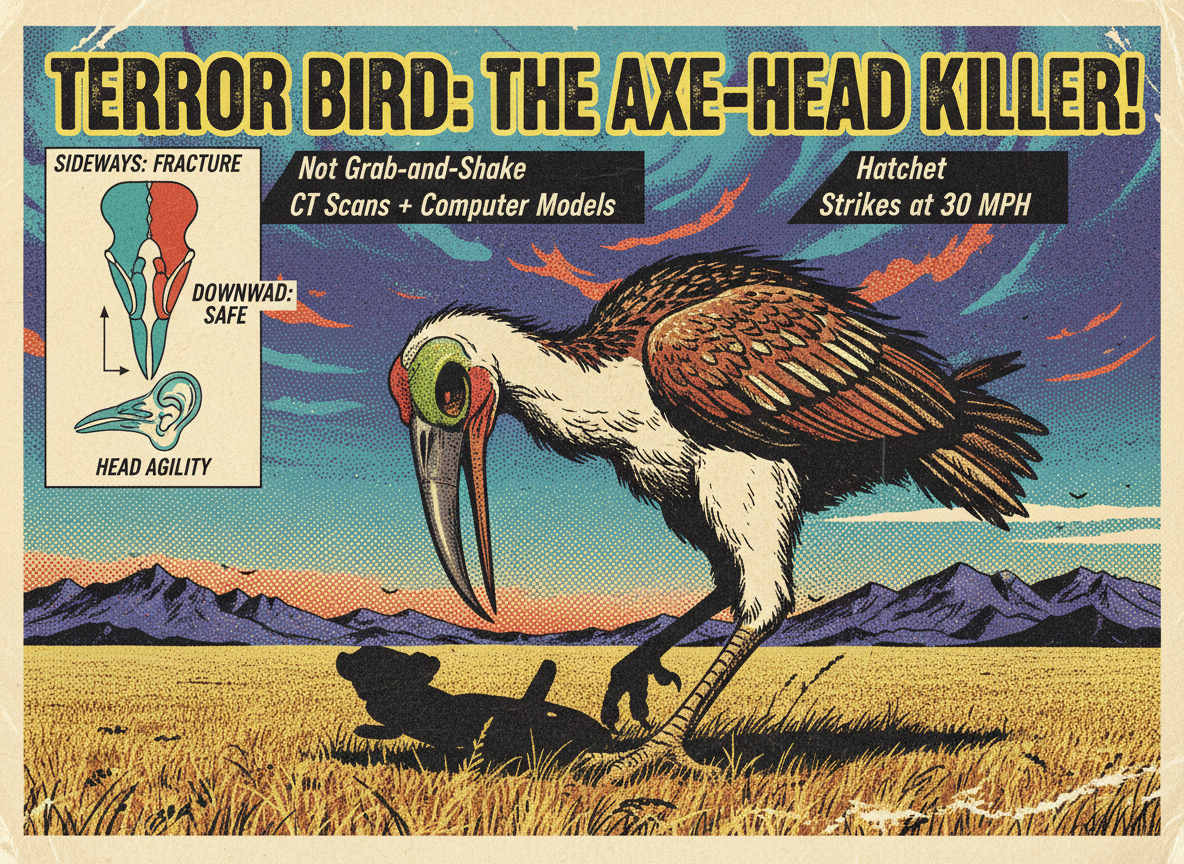
Phorusrhacids — commonly known as terror birds — were the dominant apex predators of South America for roughly 62 million years. Eighteen known species ranged from turkey-sized runners to giants nearly ten feet tall with skulls the size of a horse’s head. For most of the time they have been studied, scientists assumed they hunted the way most large predatory birds do: grabbing prey in their beak, shaking it violently, and tearing it apart. The problem is that the skull of a terror bird is not built for that at all. Biomechanical analysis of fossilized skulls using CT scanning and computer modeling has shown that lateral force — the kind generated by shaking — would have caused catastrophic stress failure in the bird’s beak. The skull was built for one thing: a fast, precise, straight-down strike. Like an axe.
Terror birds are not dinosaurs. They evolved after the mass extinction that killed the non-bird dinosaurs 66 million years ago, and they ruled South America during a long period when that continent was an island, cut off from North America by ocean. Without large mammalian predators competing in the open plains, birds got very big and very dangerous very fast.
The largest known terror bird skull belongs to a species called Kelenken guillermoi. That skull is 71 centimeters long — about 28 inches — with a beak roughly 46 centimeters in length, curved like a hook at the tip. The skull of the largest species would have been roughly comparable in size to the skull of a horse. The body attached to it stood around ten feet tall.
The standard assumption about how they killed was built on analogy. Raptors grab and shake. Hawks and eagles use their talons to grip and their beaks to tear. It seemed natural that a giant predatory bird would do something similar. Then researchers started actually analyzing what the skull of a terror bird could and could not physically withstand.
What the Skull Cannot Do
The key study used a method called Finite Element Analysis — a computer technique borrowed from engineering that measures how stress is distributed through a structure when force is applied in different directions. Researchers built a three-dimensional digital model of the skull of Andalgalornis steulleti, a medium-sized terror bird from Argentina, and applied simulated forces to it the way an engineer would stress-test a bridge.
The results were clear. When force was applied laterally — side to side, as in a shaking motion — stress concentrations in the beak reached levels that would cause fracture in a living animal. The skull was not built to resist sideways load. The beak was relatively weak in that direction.
When force was applied vertically — straight down, as in a chopping or hatchet-like strike — the skull handled it easily. The architecture of the beak, the way the bones were arranged internally, the rigidity of the cranial structure: all of it was optimized for absorbing downward impact rather than lateral stress. The bird could strike down hard and fast without damaging its own skull. It could not shake something side to side without risking breaking its own face.
What It Probably Actually Did
The picture that emerges from the biomechanical analysis is a hunting style more like a woodpecker than a hawk — or, as National Geographic put it when covering the original research, more like Muhammad Ali than a typical predator. The terror bird likely ran down prey using its powerful legs (biomechanical estimates suggest they could reach speeds of around 30 miles per hour), used its feet to pin smaller prey, and then delivered a rapid series of precise downward strikes with its beak to kill. For larger prey, the repeated ax-like blows to the skull or spine would have been sufficient to incapacitate.
Inner ear analysis of a nearly complete terror bird skeleton called Llallawavis scagliai confirmed the picture further: the inner ear anatomy showed exceptional head agility, meaning the bird could move its head with the fast, accurate precision required for repetitive targeted strikes. It could also hear low-frequency sounds that travel over long distances, suggesting it may have been able to communicate with others of its kind across open plains — and locate prey from far off.
A separate 2026 study published in Papers in Palaeontology confirmed a brand new terror bird species from Brazil, recovered from a cave deposit dated to just 25,000 years ago. Terror birds survived far more recently than most people realize, persisting until they overlapped in time with early modern humans in the Americas.
Sources: Unexplained Mysteries forum — We Were Wrong About the Terror Bird (April 27, 2026) — PLoS ONE — Degrange et al., Mechanical Analysis of Feeding Behavior in the Extinct Terror Bird Andalgalornis (2010, foundational biomechanical study) — National Geographic — Giant Terror Birds Used Their Heads Like Hatchets — Florida Museum of Natural History — The Terror Bird: Paleobiology of a Fierce Bird — Papers in Palaeontology — Machado et al., A New Terror Bird from the Late Pleistocene of Brazil (2026)

NASA Has Mapped the Water in the Galaxy. The Ocean Beneath Your Feet Came From Out There.
A study published in The Astrophysical Journal on April 15, 2026, based on data from NASA's SPHEREx mission, has produced the first…

A Machine Learning Algorithm Just Found 10,000 Alien Planets Nobody Had Seen Before. They Were Hidden in Data We Already Had.
The current official count of confirmed exoplanets — planets orbiting stars other than our sun — sits at roughly 6,300. It took…
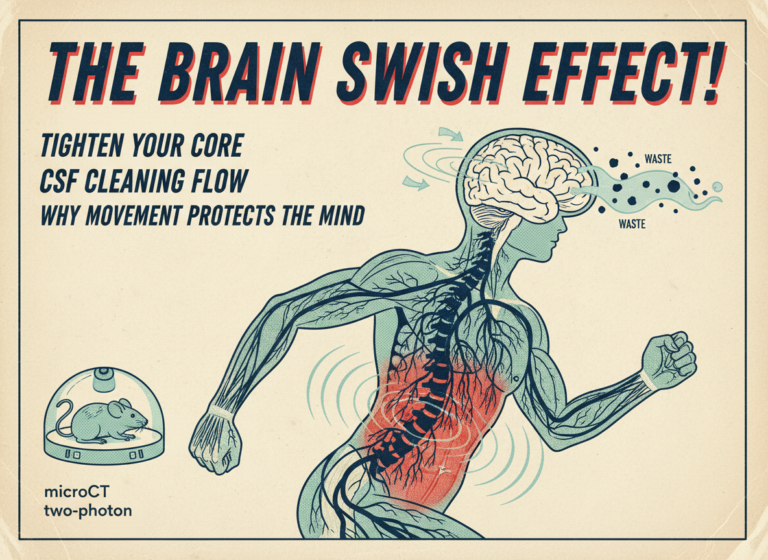
Every Time You Tighten Your Core, Your Brain Gently Swishes Around. That Might Be Keeping You Sane.
When you tighten your abdominal muscles — whether you are walking, standing up from a chair, or doing anything that engages your…
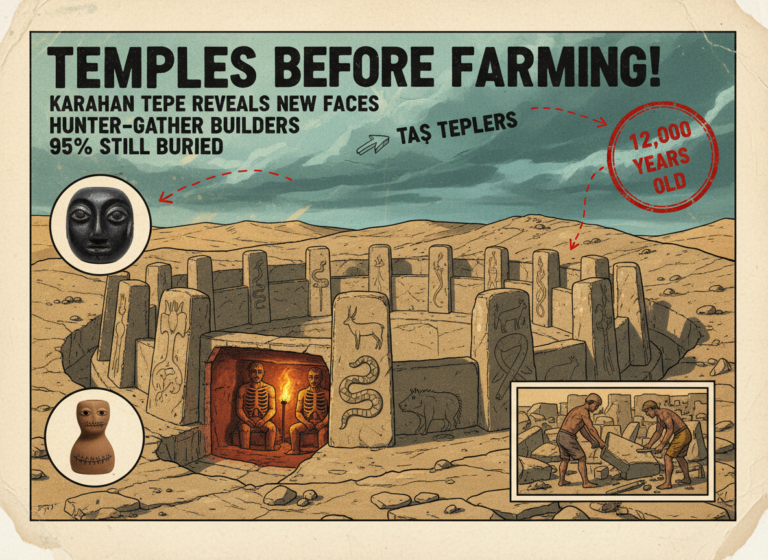
They Built a Temple Complex Before They Had Farming, Writing, or Pottery. New Finds at Karahan Tepe Just Made the Mystery Bigger.
Fresh discoveries at a 12,000-year-old site in Turkey called Karahan Tepe, the possible earliest village in human history, have uncovered more carved…