Original Story
NOAA Found a Golden Orb Two Miles Down on the Ocean Floor in 2023. They Just Figured Out What It Was.
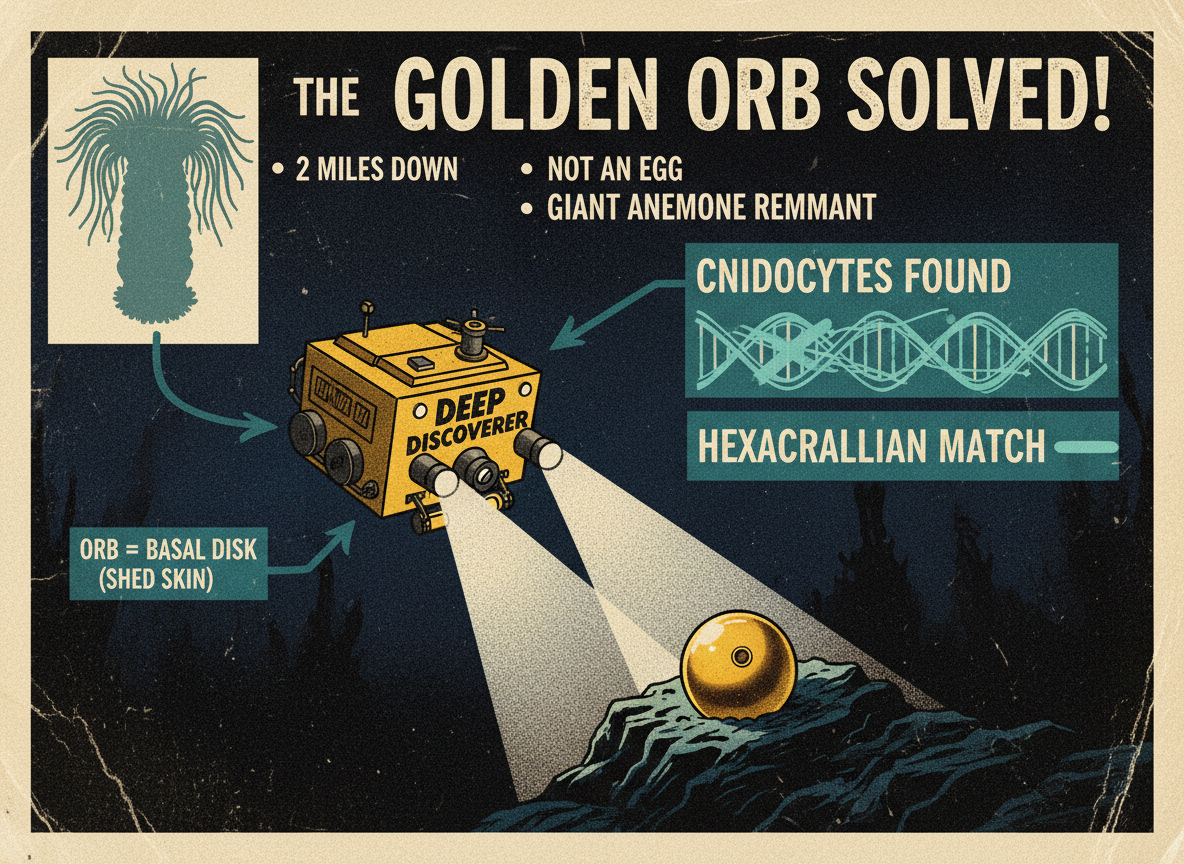
On August 30, 2023, a remotely operated vehicle called Deep Discoverer was exploring the seafloor of the Gulf of Alaska at a depth of more than 10,800 feet — nearly two miles straight down, in complete darkness — when its cameras picked up something unusual. Sitting on a rocky outcropping was a rounded, golden object with a small hole in it, shimmering in the ROV’s lights like it was made of polished metal. Nobody on the science team watching the live feed had ever seen anything like it. “I just hope when we poke it, something doesn’t decide to come out,” one researcher said on the live stream. “It’s like the beginning of a horror movie,” another agreed. They collected it, sent it to the Smithsonian, and spent two and a half years trying to figure out what it was. As of April 27, 2026, they have their answer. It is not an egg. It is not a sponge. It is not alien. It is something almost as strange: a piece of skin from a giant sea anemone that was apparently shed or left behind when the animal moved on.
The investigation took far longer than anyone expected. When the NOAA team first sent the golden orb to the Smithsonian National Museum of Natural History for analysis, Dr. Allen Collins — a zoologist and director of NOAA Fisheries’ National Systematics Laboratory — assumed it would be a quick identification. Deep-sea expeditions regularly turn up unfamiliar organisms, but most mysteries resolve themselves within days as scientists pool their knowledge.
Not this one.
Initial physical examination ruled out the most obvious candidates quickly. It was not a sponge. It was not a coral. It was not an egg case of any recognized species. The tissue was fibrous and dense in an unusual way, and it contained structures called cnidocytes — the specialized stinging cells that are a defining feature of the cnidarian family, which includes jellyfish, corals, and anemones. That narrowed things down considerably. But then DNA testing ran into a problem.
The orb was not just one organism. It was riddled with microscopic organisms living inside it — bacteria, fungi, and other microbes that had colonized the tissue during the years it sat on the seafloor. When scientists ran DNA analysis, they got a messy signal with genetic material from all of those passengers mixed together, making it extremely difficult to isolate the DNA of the original organism itself.
How They Finally Cracked It
The breakthrough came when the team moved from standard DNA testing to a more targeted approach, focusing specifically on genetic markers unique to hexacorallians — the subgroup of cnidarians that includes sea anemones. That analysis returned a clear match: Relicanthus daphneae, a species of giant deep-sea anemone known from a small number of previous observations in deep Pacific waters.
Then came the moment of recognition that Collins described with some embarrassment. “If you look under the base of the anemones, right on the side, you can often see this golden-colored cuticle sticking out from the bottom,” he said. “We were like, ‘It was right in front of us, kind of like the whole time. Never even noticed.'”
The golden orb was the basal disk — the anchoring structure at the very bottom of a giant anemone — left behind on the rock when the animal either died or detached and moved somewhere else. It is not a part of the anemone that anyone normally gets to see, because it is usually hidden beneath the animal’s body, pressed against the rock. In this case, the animal was gone and the base remained, dried and golden in the cold deep water.
What the Anemone Looks Like When It Is All There
For context on exactly what left this thing behind: Relicanthus daphneae is not a delicate, waving sea flower. The full animal has a cylindrical body that can grow up to three feet across. Its tentacles can stretch six feet in length. Its stinging spirocysts — the specific type of cnidocyte found in the golden orb — are the largest among all known cnidarian species. It is a substantial deep-sea predator, largely invisible to science because it lives in a depth range that very few research expeditions ever reach.
Collins admitted to being slightly let down by the answer. “I was sort of like, ‘Oh man, now no one’s going to care,’ because it’s not as interesting as a mystery,” he said. “Now, it’s an anemone.”
He is not entirely right. The discovery raised new questions that have not been answered: whether the golden base is related to reproduction, whether the anemone can deliberately shed and regrow it, and what exactly happens to allow an animal that large to simply detach and relocate. The deep sea keeps its secrets carefully.
Sources: NOAA — Scientists Reveal Identity of Mysterious Golden Orb Collected During NOAA Expedition (April 2026) — ScienceAlert — Mysterious Golden Orb at the Bottom of the Ocean Finally Identified (April 2026) — ScienceDaily — Scientists Finally Solve Mystery of Strange Golden Orb Found 2 Miles Deep (April 27, 2026) — Alaska Public Media — Scientists Identify Mysterious Golden Orb Discovered Off Alaska’s Coast (April 28, 2026) — WCNC — Ocean Mystery Solved: Scientists Identify Golden Orb Found in Deep-Sea Exploration (April 2026) — Unexplained Mysteries — Mystery of Strange Deep-Sea Golden Egg Has Finally Been Solved (April 27, 2026)
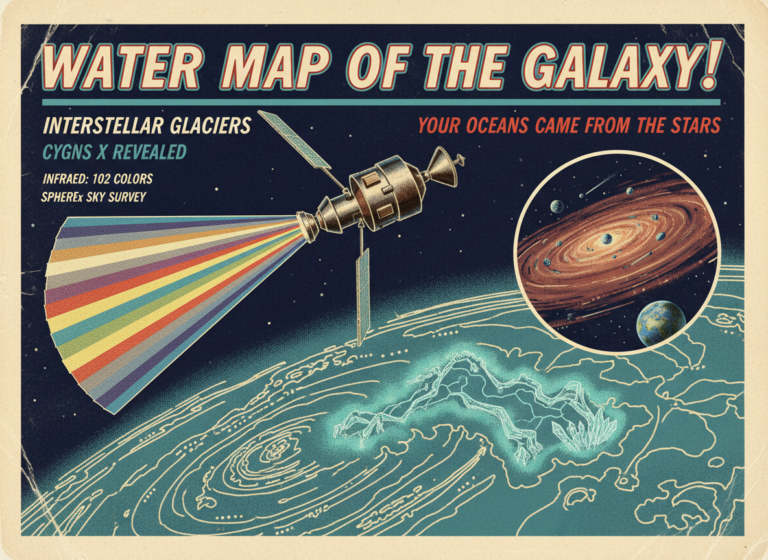
NASA Has Mapped the Water in the Galaxy. The Ocean Beneath Your Feet Came From Out There.
A study published in The Astrophysical Journal on April 15, 2026, based on data from NASA's SPHEREx mission, has produced the first…

A Machine Learning Algorithm Just Found 10,000 Alien Planets Nobody Had Seen Before. They Were Hidden in Data We Already Had.
The current official count of confirmed exoplanets — planets orbiting stars other than our sun — sits at roughly 6,300. It took…

Every Time You Tighten Your Core, Your Brain Gently Swishes Around. That Might Be Keeping You Sane.
When you tighten your abdominal muscles — whether you are walking, standing up from a chair, or doing anything that engages your…
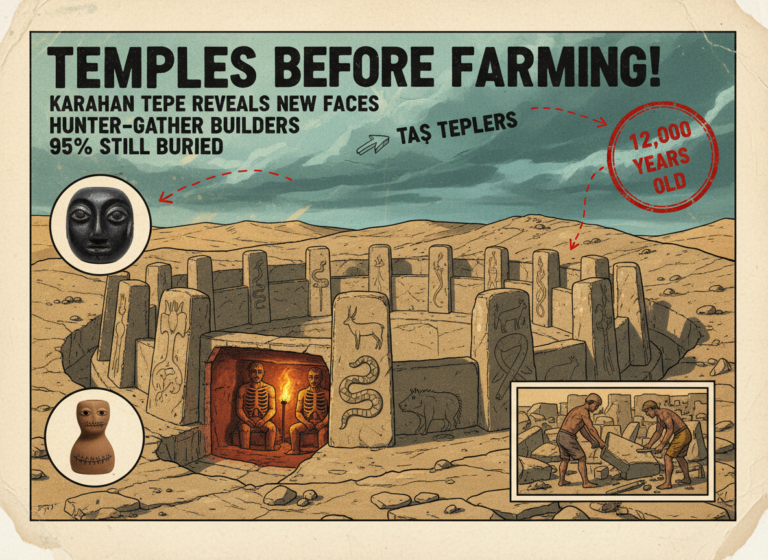
They Built a Temple Complex Before They Had Farming, Writing, or Pottery. New Finds at Karahan Tepe Just Made the Mystery Bigger.
Fresh discoveries at a 12,000-year-old site in Turkey called Karahan Tepe, the possible earliest village in human history, have uncovered more carved…