Original Story
Snakes Had Legs for 70 Million Years. A New Fossil Reveals What They Looked Like at the Moment They Were Losing Them.
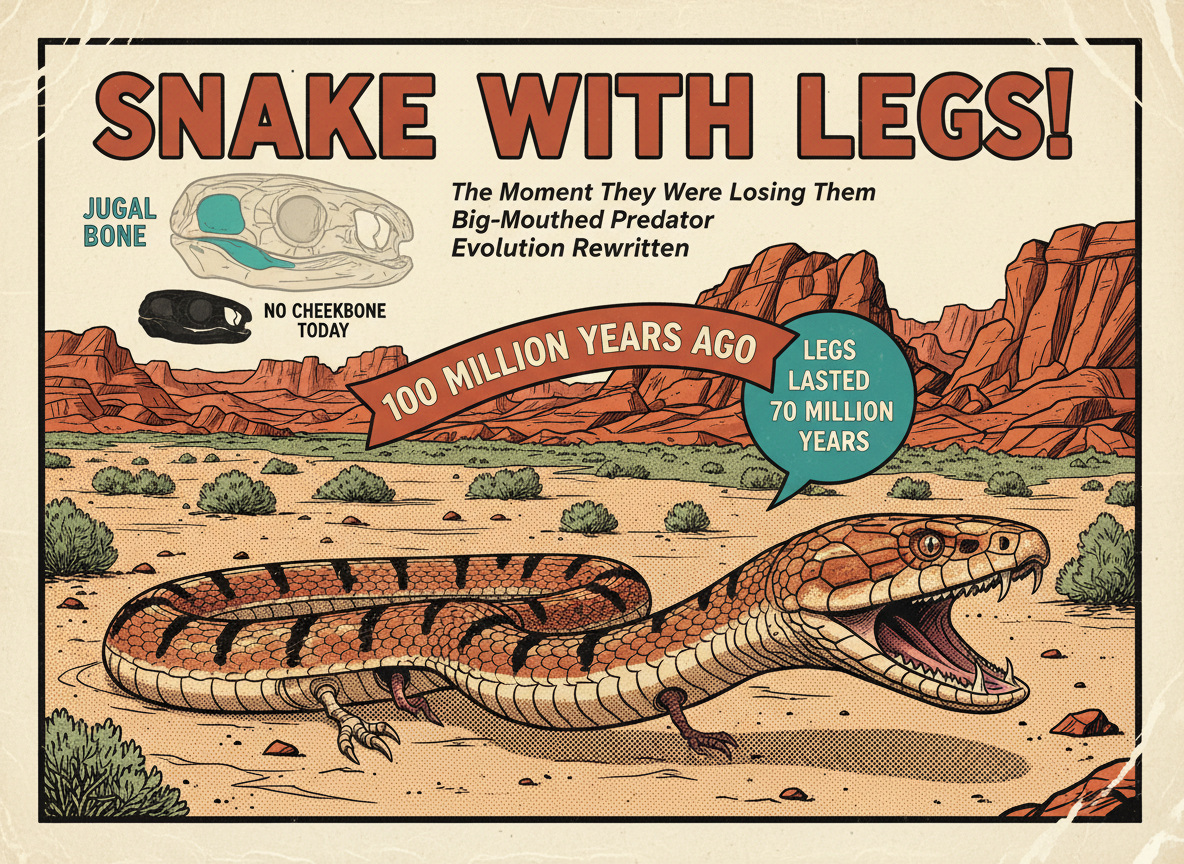
A remarkably preserved fossil of Najash rionegrina from the badlands of northern Patagonia, Argentina, has produced a new picture of what snakes looked like at the critical evolutionary junction between their limbed lizard ancestry and the limbless body plan they carry today. Najash lived approximately 100 million years ago during the Cretaceous period, and the new specimen is the most anatomically complete skull and skeleton of the species yet recovered. It shows that early snakes still had functional hind legs, still retained a cheekbone — a feature that has completely disappeared from every living snake species — and were not the small burrowing animals that decades of evolutionary theory predicted. They were large, wide-mouthed predators. The study was published this week by a collaboration of Argentine and University of Alberta paleontologists and is circulating across science and ancient mysteries platforms as of April 24, 2026.
The theory that snakes evolved from small, underground-burrowing lizards was the dominant model of snake origins for much of the twentieth century. The logic was intuitive: limblessness would be an advantage in tight subterranean passages, and the earliest snake fossils available to researchers showed small-bodied animals consistent with that lifestyle. The Najash material destroys that picture.
Najash rionegrina was first described in 2006 from fragmentary remains found in the Candeleros Formation of Río Negro Province in Argentina. It was immediately significant for being one of the oldest known snakes to retain fully functional hind limbs — real legs, positioned outside the rib cage, capable of bearing weight and likely used in locomotion. Subsequent excavations at the Barda Colorada locality produced additional Najash material of increasing completeness, and the current study represents the culmination of that excavation sequence.
The new specimen provides, for the first time, a largely complete skull of Najash rather than fragments. What it reveals about the skull is as significant as the limb evidence.
The Jugal Bone That Vanished
Modern snakes are defined by cranial kinesis — the extreme mobility of their skull bones, which allows them to swallow prey far larger than their head diameter. A cobra can swallow a rabbit. A reticulated python can, under extraordinary circumstances, swallow a human being. This flexibility is made possible by the near-complete elimination of structural connections between adjacent skull bones, including the loss of bones themselves.
The jugal bone, or cheekbone, is absent in all living snake species. It is present in lizards, in virtually all other terrestrial vertebrates, and, the new Najash skull shows, in snakes from 100 million years ago. The presence of the jugal in Najash, in combination with other ancestral cranial features preserved in the new specimen, allows researchers to track the precise sequence in which snake skull architecture dismantled itself over millions of years to produce the feeding apparatus in use today.
“This research revolutionizes our understanding of the jugal bone in snake and non-snake lizards,” said University of Alberta co-author Michael Caldwell. Lead author Fernando Garberoglio, of Fundación Azara at Universidad Maimónides in Buenos Aires, added: “Our findings support the idea that the ancestors of modern snakes were big-bodied and big-mouthed — instead of small burrowing forms as previously thought.”
What the Legs Mean
The legs themselves have always been the feature that makes Najash remarkable. What the new specimen adds is the duration question. Based on the Najash material and the broader fossil record of snakes, the researchers conclude that the lineage retained functional hind limbs for approximately 70 million years before losing them. That is not a brief transitional phase. That is a successful, diverse body plan that occupied multiple ecological niches — terrestrial, aquatic, burrowing — for a period of time longer than the entire lineage of Homo has existed.
Co-author Mike Lee of Flinders University summarized the implications: “These primitive snakes with little legs weren’t just a transient evolutionary stage on the way to something better. Rather, they had a highly successful body plan that persisted across many millions of years, and diversified into a range of terrestrial, burrowing and aquatic niches.”
The question of why snakes eventually lost their legs entirely, when the legs were clearly functioning and successful for such an extended period, does not have a simple answer. Fernando Garberoglio noted that being limbless has clearly not been a selective disadvantage — modern snakes occupy nearly every habitat on Earth, from oceans and deserts to rainforest canopies and deep soil, without any limbs at all. The loss happened. The advantage of the limbless form, at least in purely Darwinian terms, was apparently sufficient to drive an ancient and successful body plan to extinction, eventually leaving only the occasional vestigial pelvic spur in pythons and boas as evidence that their ancestors once walked.
Sources: ScienceDaily — University of Alberta: This 100 Million-Year-Old Snake Had Hind Legs and a Lost Bone That Changes Evolution (April 24, 2026) — Science Advances — Garberoglio et al., New Skulls and Skeletons of the Cretaceous Legged Snake Najash and the Evolution of the Modern Snake Body Plan — Unexplained Mysteries forum — This 100 Million-Year-Old Snake Had Hind Legs and a Lost Bone That Changes Evolution (April 24, 2026)

NASA Has Mapped the Water in the Galaxy. The Ocean Beneath Your Feet Came From Out There.
A study published in The Astrophysical Journal on April 15, 2026, based on data from NASA's SPHEREx mission, has produced the first…

A Machine Learning Algorithm Just Found 10,000 Alien Planets Nobody Had Seen Before. They Were Hidden in Data We Already Had.
The current official count of confirmed exoplanets — planets orbiting stars other than our sun — sits at roughly 6,300. It took…

Every Time You Tighten Your Core, Your Brain Gently Swishes Around. That Might Be Keeping You Sane.
When you tighten your abdominal muscles — whether you are walking, standing up from a chair, or doing anything that engages your…
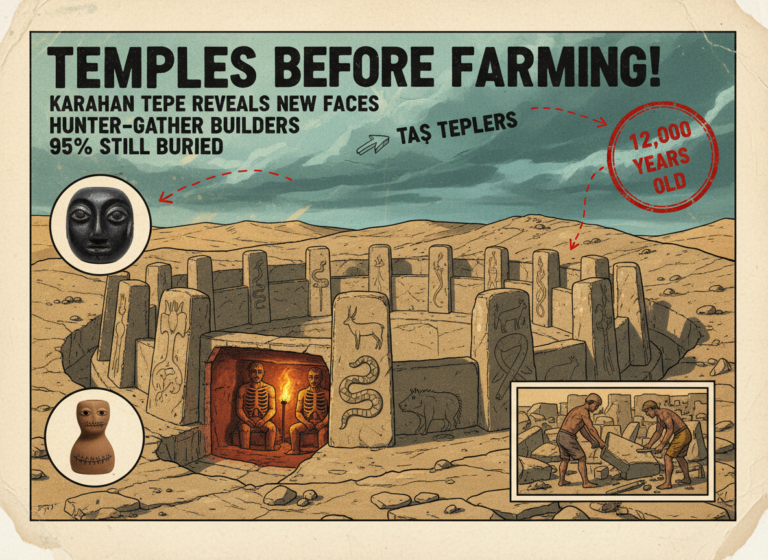
They Built a Temple Complex Before They Had Farming, Writing, or Pottery. New Finds at Karahan Tepe Just Made the Mystery Bigger.
Fresh discoveries at a 12,000-year-old site in Turkey called Karahan Tepe, the possible earliest village in human history, have uncovered more carved…