Original Story
Mystery Seed Packages Are Showing Up in Delaware Mailboxes Again. They Started in 2020 and Nobody Has Fully Stopped Them.
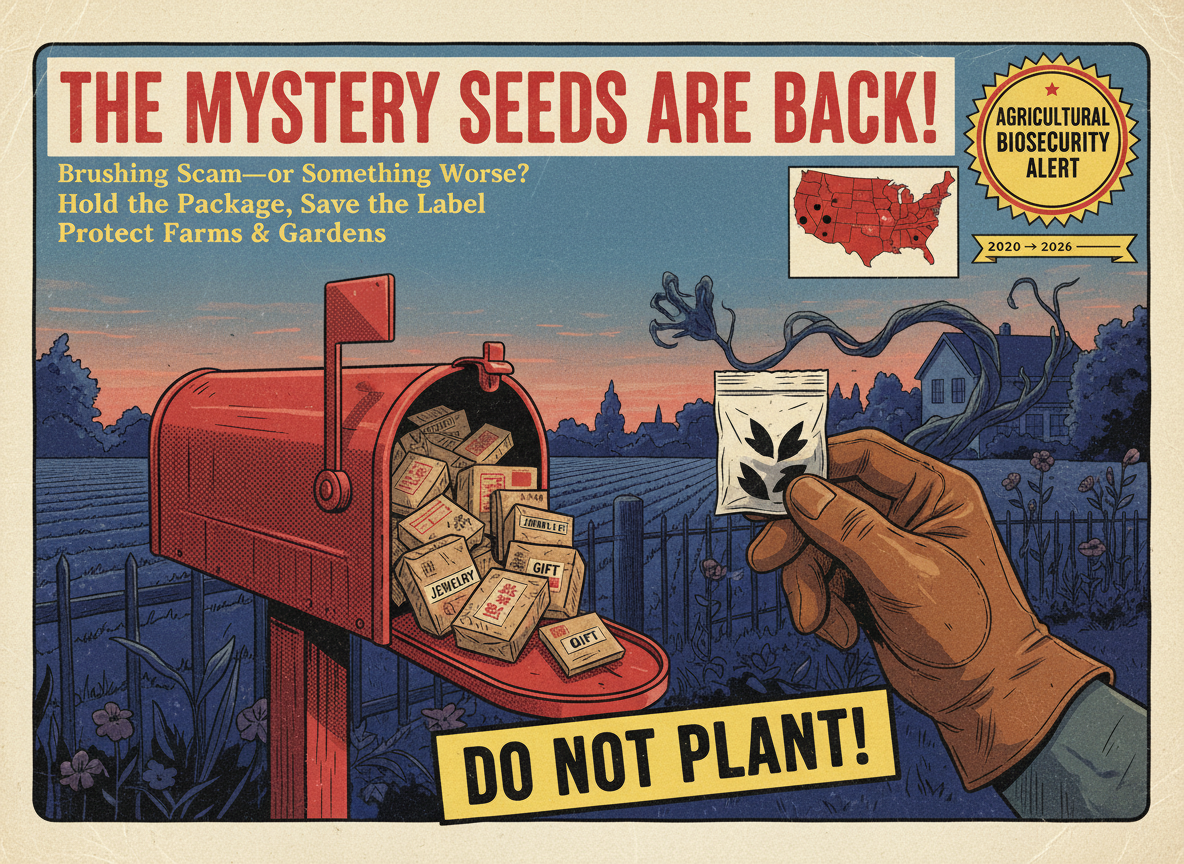
In the spring of 2020, thousands of Americans across at least 28 states started receiving packages in their mailboxes that they had not ordered. The packages came with Chinese writing on them. Inside: small packets of seeds. Nobody knew what kind. Nobody knew who sent them. The US Department of Agriculture and state agriculture departments across the country issued urgent warnings: do not plant these seeds. They could be invasive species. They could carry plant diseases. They could harm livestock. Five years later, in April 2026, the Delaware Department of Agriculture is issuing that warning again. The packages are back.
If you received an unexpected package in the mail containing seeds — especially if the package has Chinese writing on it, or if it was labeled as something else like jewelry or greeting cards — the Delaware Department of Agriculture wants you to know not to open it, not to plant anything in it, and not to throw it in the trash. They want you to hold onto the seeds, the packaging, and the mailing label, and bring them or mail them to the department’s headquarters in Dover.
“We know it might be tempting to plant them,” the department posted on social media, “but we’re asking for your help to keep our state’s farms, gardens, and green spaces safe.”
This is not the first time this has happened. It is not even the second or third.
The 2020 Wave
In the summer of 2020, the mystery seed phenomenon first grabbed national attention. Residents across the US began reporting packages containing unknown seeds, apparently sent from China, mixed in with cheap items like stud earrings or small plastic toys. The packages were addressed to the recipients by name, which was unsettling on its own — someone had their addresses. The seeds varied: some appeared to be herbs, some vegetables, some ornamental plants. None were labeled accurately.
The USDA intervened quickly. Their analysis of the seeds found a range of plant species, including some with the potential to become invasive if they established in US soil. The agency classified the packages as agricultural smuggling — importing plant material without proper authorization, bypassing biosecurity checks designed to prevent exactly this kind of introduction.
The investigation that followed pointed toward a practice called a “brushing scam.” In a brushing scam, sellers on platforms like Amazon or other e-commerce sites send unsolicited low-cost items to real people using scraped address data. Once the item is delivered, the seller posts a fake review in the recipient’s name to inflate their product ratings and make their account appear more legitimate. The product is cheap, delivery is cheap, and a positive-looking review history is worth more than the cost of the package. The recipient gets something they didn’t order and didn’t want.
Whether all of the 2020 seed packages were brushing scams or whether some had more deliberate agricultural interference motives was never definitively resolved. The USDA confirmed the brushing scam explanation for many cases while noting that the biosecurity threat remained real regardless of the sender’s intent.
The Pattern Since 2020
The packages never fully stopped. Texas agricultural officials confirmed in early 2026 that they had collected 1,101 unsolicited seed packages from over 100 locations across the state since February 2025 alone. The Texas Department of Agriculture described the pattern as a “serious and ongoing threat to the nation’s agricultural biosecurity,” noting that the seeds’ small size disguises the potential risk. An invasive weed that establishes itself in Texas farmland because someone absent-mindedly tossed a seed packet in the garden does not care how it got there.
The Delaware resurgence in April 2026 is the latest in this running pattern. The CBS Philadelphia affiliate confirmed multiple recent reports from Delaware residents receiving packets alongside jewelry and inexpensive items. The Delaware Department of Agriculture’s Michael Lewis told Coast TV: “If you get any seeds in the mail that you didn’t ask for, that you didn’t order, just be aware. Just be wary of them.”
Farmers have their own take on the risk. Daniel Magee of Magee Farms in Lewes, Delaware, noted that the state’s noxious weed law lists specific problem plants — Johnson Grass among them — that can overwhelm agricultural land once established. A single accidental planting of an unknown invasive seed can have consequences that take years to clean up.
The seeds are still arriving. The warnings are still necessary. Five years in, no one has made them stop.
Sources: Coast TV — Mystery Seeds Spark Warning from Delaware Department of Agriculture (April 2026) — CBS Philadelphia — Delaware Residents Being Asked to Keep Eye Out for Mystery Seeds in Mail (April 2026) — Feedstuffs — Mystery Seed Packages from China Causing Concerns (January 2026) — Texas Department of Agriculture — Commissioner Miller Warns Texas as China Mystery Seed Deliveries Continue (2026) — NBC News — 28 States Issue Warnings About Unsolicited Seed Packets from China (foundational 2020 reporting) — Unexplained Mysteries — The Mystery Seeds Phenomenon Is Back: This Time in Delaware (April 25, 2026)

NASA Has Mapped the Water in the Galaxy. The Ocean Beneath Your Feet Came From Out There.
A study published in The Astrophysical Journal on April 15, 2026, based on data from NASA's SPHEREx mission, has produced the first…

A Machine Learning Algorithm Just Found 10,000 Alien Planets Nobody Had Seen Before. They Were Hidden in Data We Already Had.
The current official count of confirmed exoplanets — planets orbiting stars other than our sun — sits at roughly 6,300. It took…

Every Time You Tighten Your Core, Your Brain Gently Swishes Around. That Might Be Keeping You Sane.
When you tighten your abdominal muscles — whether you are walking, standing up from a chair, or doing anything that engages your…

They Built a Temple Complex Before They Had Farming, Writing, or Pottery. New Finds at Karahan Tepe Just Made the Mystery Bigger.
Fresh discoveries at a 12,000-year-old site in Turkey called Karahan Tepe, the possible earliest village in human history, have uncovered more carved…