Original Story
They Called It Empty. It Was Home to a Lost Civilization for 5,000 Years.
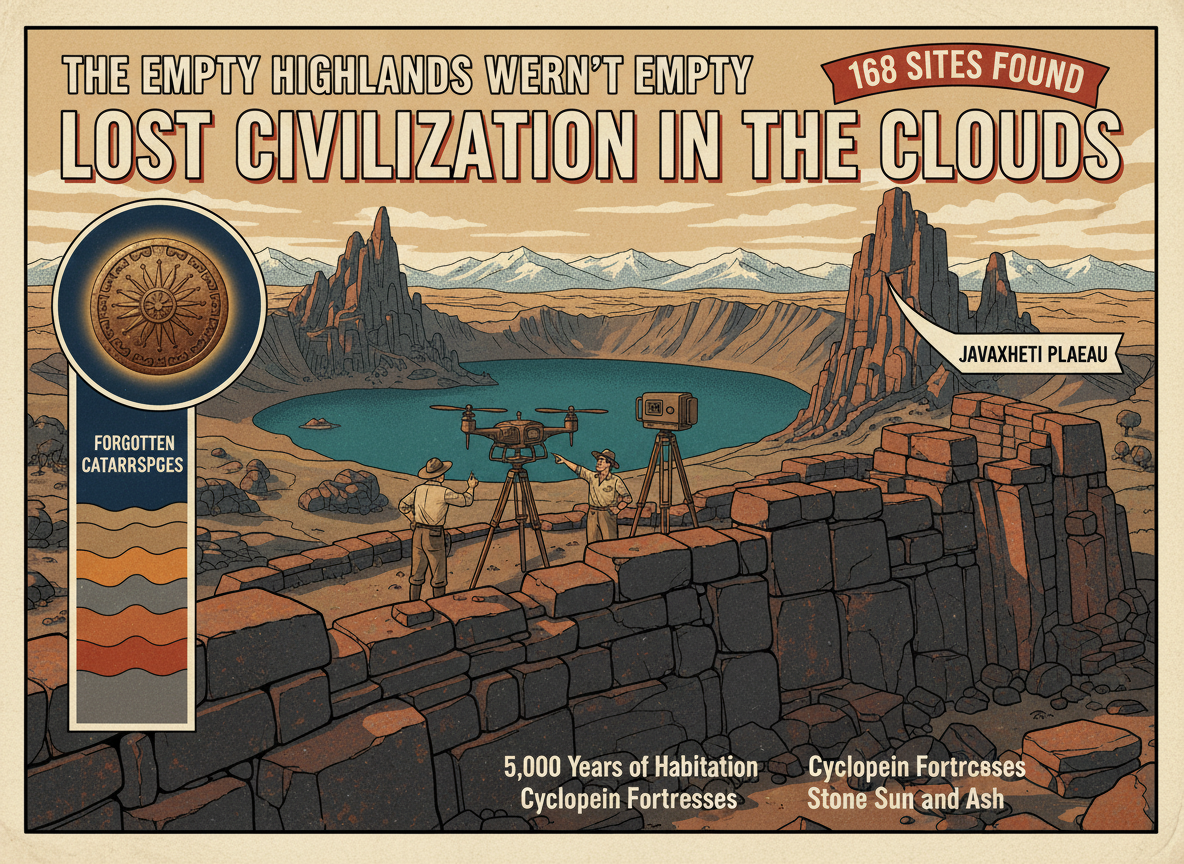
A new study published in Antiquity has documented 168 ancient sites across the Javakheti Plateau in the highlands of southern Georgia, including cyclopean fortresses built without mortar, a mysterious bronze solar disc, ash layers from forgotten catastrophes, and evidence of continuous human habitation from 3500 BC to the medieval period. For decades, archaeologists simply did not look.
The Javakheti Plateau sits at elevations between 1,500 and 3,300 meters in the South Caucasus, straddling the highland borderlands of southern Georgia near modern Armenia and Turkey. It is a volcanic landscape: basalt outcrops, ancient lava fields, crater lakes so still they mirror the sky, and winters long enough to define a civilization’s character. It is also, by almost every standard measure of 20th-century archaeological thinking, the kind of terrain you skip.
Too harsh. Too remote. Too unlikely to yield results proportionate to the effort of getting there.
For decades, that assumption held. The Samtskhe-Javakheti region remained what researchers diplomatically describe as underexplored, and what a more honest accounting would call ignored. Sites were noted. No systematic survey was conducted. No major excavation was attempted. The plateau sat at the margins of the archaeological map of the ancient Caucasus, assumed to be something like a blank, a gap between the better-documented cultures of the lowlands.
The assumption was wrong. A civilization had been living there for five thousand years, and nobody had bothered to look carefully enough to notice.
That has now changed.
A new study published in Antiquity by Cambridge University Press, produced by the Samtskhe-Javakheti Archaeological Project, a joint Georgian-Italian initiative operating since 2017, has documented 168 archaeological sites across the Javakheti highlands. The sites include cyclopean fortresses, multi-phase settlements, extensive necropolises, and artifacts pointing to complex ritual and symbolic traditions that persisted across millennia. The findings were described by the researchers as fundamentally shifting understanding of Bronze Age and Iron Age society in the region.
That may be an understatement.
What They Found
The methodology the project deployed represents the full toolkit of contemporary landscape archaeology. Satellite imagery, GPS mapping, geographic information systems-based spatial analysis, drone surveys, and ground-level recording were combined with targeted excavations at key sites. The result is the most comprehensive archaeological survey the Javakheti Plateau has ever received.
What came back reshaped the picture entirely.
The most visually striking component of the discovery is the cyclopean architecture. Across the plateau, the project documented massive stone structures built from unworked basalt blocks without the use of mortar. The word “cyclopean” refers to a construction tradition found across the ancient world, from Mycenaean Greece to Bronze Age Anatolia, in which walls are assembled from such large, irregular stones that later observers, encountering them without context, assumed giants or mythological figures must have built them. The blocks are too heavy to have been moved easily. The walls have stood, without binding material, for thousands of years.
The fortresses identified at the Abuli and Shaori complexes are among the most prominent examples. They sit on elevated ground, commanding views across the plateau, and their scale is described as imposing even in the dry language of the published study. But the research does not treat them simply as military architecture. The analysis suggests that rather than functioning as permanent defensive citadels, several of these megalithic enclosures operated as temporary refuges, used by mobile pastoralist groups during seasonal migrations across the high plateau. They were not just walls. They were nodes in a social and logistical network that mobile communities relied on across generations.
Sites including Abulis Gora and Saro-1 show evidence of repeated use from the Bronze Age onward, meaning communities returned to the same locations across thousands of years, a pattern of place attachment that implies cultural continuity far deeper than a few generations of habitation. Necropolises found near Bertakana and at Lake Tabatskuri, one of the plateau’s volcanic crater lakes, confirm persistent funerary traditions across the centuries. This is not a place people passed through. It is a place they kept coming back to because it meant something.
The Bronze Solar Disc
Among the artifacts recovered from excavations at the Baraleti site is a bronze disc decorated with solar symbolism.
Sun disc imagery appears across the ancient world in contexts ranging from Egypt to Britain, and in the Caucasus it connects to broader regional traditions of solar worship and cosmological representation that run through the Bronze Age cultures of the Black Sea and Caucasus highlands. The specific disc recovered at Baraleti Natsargora, as the site is formally identified, is noted in the study as a significant find, representing the kind of symbolic artifact that points to organized ritual life rather than simple subsistence activity.
The people who built those basalt fortresses also cast bronze objects that spoke in the visual language of the sun. They were not a simple pastoralist culture scraping through harsh winters. They were participants in the symbolic systems of the ancient world, leaving objects behind that encode beliefs sophisticated enough to survive in material form for three and a half thousand years.
The Ash Layers
At Baraleti Natsargora and several other sites across the plateau, excavators encountered thick layers of ash preserved within the archaeological deposits.
Ash layers in archaeological sites are not unusual. Hearths leave ash. Destroyed structures leave ash. But thick ash deposits at multiple sites across a defined geographic region tell a different kind of story, one that involves events large enough to affect communities across the landscape simultaneously.
The researchers describe these deposits carefully. They are markers of disruption, of events, whether volcanic, military, or climatic, that punctuated the continuous human presence on the plateau. The Javakheti region sits within a geologically active zone. Volcanic activity in the Caucasus during the Bronze and Iron Ages is documented. The ash layers at these sites may record those events in the physical stratigraphy of the settlements, laying down a geological diary of catastrophes that the people living through them survived, adapted to, and rebuilt from.
The presence of those layers also represents something significant in methodological terms. Ash is a precise datable material under the right conditions. As radiocarbon dating and environmental analysis continue, the ash deposits may allow researchers to pin the chronology of the plateau’s occupation to specific events with unusual precision.
Meghreki Fortress and the Decorated Interior
One of the two sites where the project conducted targeted excavations is Meghreki Fortress, a structure partially exposed by road construction before researchers arrived. What road construction revealed, and what subsequent excavation developed, is a site with continuous human activity documented from the Kura-Araxes culture around 3500 BC through the Iron Age and into the medieval period.
That span, from approximately 3500 BC to roughly 1000 AD, encompasses roughly 4,500 years of more or less unbroken occupation. The same site, the same elevated position, the same basalt walls and the plateau surrounding them, used by successive human communities across a timespan longer than the entire history of the Roman Empire measured from foundation to fall.
Within two domestic structures dated to the Achaemenid period, roughly the sixth to fourth centuries BC, excavators uncovered clay installations decorated with incised and painted geometric designs in red, white, and dark blue pigments. These are not utilitarian markings. The colors are deliberate, the patterns precise, and the combination of incised and painted surface treatment suggests skilled craft production. Comparable decorated plaques appear at nearby sites of Digasheni and Amiranis Gora, which the researchers interpret as evidence of a broader regional tradition in which decorated surfaces marked ritually significant domestic spaces.
These were not ordinary houses. Or if they were ordinary, the ordinary in the Javakheti highlands during the Achaemenid period included painted ceremonial interiors.
Why Nobody Looked
The question embedded in this discovery is one that the fringe archaeology community has been asking about the mainstream for a long time: why did it take until 2017 to begin systematic work on a region that shows 5,000 years of continuous occupation?
The answer the researchers give is climate and terrain. The Javakheti Plateau is genuinely hostile. Elevations above 3,000 meters, winter temperatures that can reach extreme lows, landscape conditions that make extended fieldwork difficult and access to sites sporadic. The assumption was that serious civilizations did not develop in conditions like these.
The assumption was wrong, and it was wrong in a predictable direction. Highland environments across the world have produced civilizations that were systematically underestimated precisely because the lowland-centric frameworks of archaeological thinking struggled to account for the adaptive capacity of human communities in extreme terrain. The Javakheti plateau communities did not fail to thrive because the conditions were harsh. They built fortresses from basalt blocks, decorated their homes with painted pigments, cast bronze solar discs, buried their dead in organized necropolises, and returned to the same sites across four millennia of continuous cultural memory.
Roberto Dan of the International Association for Mediterranean and Oriental Studies in Rome led the research. The Samtskhe-Javakheti Project is funded through the Italian Ministry of University and Research in collaboration with the Archaeological Association of Georgia and Tbilisi State University.
What the Fringe Has to Say About This
Cyclopean architecture, bronze solar discs, high-altitude ritual sites that dot a volcanic plateau, ash layers recording forgotten catastrophes. The mainstream archaeology framing of the Javakheti discovery is measured and methodological. The fringe framing practically writes itself.
The Kura-Araxes culture, which the Meghreki site’s earliest occupation connects to, is one of the most widespread and least understood Bronze Age cultures of the ancient Near East. It extended from the Caucasus into Anatolia, Iran, and possibly further, and it appears to have been a major vector of cultural transmission across the Bronze Age world. Its people built substantial settlements, produced distinctive ceramic traditions, maintained ritual fire practices, and apparently moved across an enormous geographic range in ways that modern scholarship is still working to map.
That culture was present at Meghreki Fortress 5,500 years ago. The same site that, centuries later, would have decorated Achaemenid-period interiors. The same plateau that, later still, would be used by people who built walls so massive that tradition required them to have been built by giants.
The connection between cyclopean construction traditions and anomalous ancient capabilities is a standard node in alternative history frameworks, from the pyramids to the walls of Mycenae to the megalithic structures of coastal Europe. The Javakheti finds add a new location to that map: a high-altitude volcanic plateau in the South Caucasus where an organized, ritually sophisticated, architecturally ambitious civilization existed for five thousand years without making it onto the archaeological map until eight years ago.
The mainstream explanation for why this happened is rational, and it is probably correct. The terrain was hard to work in, the assumption was that nothing was there, and archaeology moves slowly.
The fringe explanation, predictably, asks a different question. Not why was it hard to find. But what else, built by whom, in what other harsh terrain that we have dismissed as uninhabitable, are we still not looking at.
Sources: Ancient Origins, Archaeologists Reveal a Lost Civilization in the Georgia Highlands, Heritage Daily, Archaeologists Reveal a Lost Civilisation in Georgia Highlands, Arkeonews, Archaeologists Uncover 168 Ancient Sites in Georgia’s Highlands, Including Mysterious Bronze Sun Disc, Greek Reporter, Ancient Cyclopean Structures in Georgia Rewrite History of Mysterious Caucasus Civilization, Bizsiziz, A Lost Civilization in the Clouds, Dan R. et al., “Layers of Stone and Ash: New Perspectives from the Samtskhe-Javakheti Archaeological Project,” Antiquity, 2026, doi:10.15184/aqy.2026.10331

NASA Has Mapped the Water in the Galaxy. The Ocean Beneath Your Feet Came From Out There.
A study published in The Astrophysical Journal on April 15, 2026, based on data from NASA's SPHEREx mission, has produced the first…

A Machine Learning Algorithm Just Found 10,000 Alien Planets Nobody Had Seen Before. They Were Hidden in Data We Already Had.
The current official count of confirmed exoplanets — planets orbiting stars other than our sun — sits at roughly 6,300. It took…

Every Time You Tighten Your Core, Your Brain Gently Swishes Around. That Might Be Keeping You Sane.
When you tighten your abdominal muscles — whether you are walking, standing up from a chair, or doing anything that engages your…
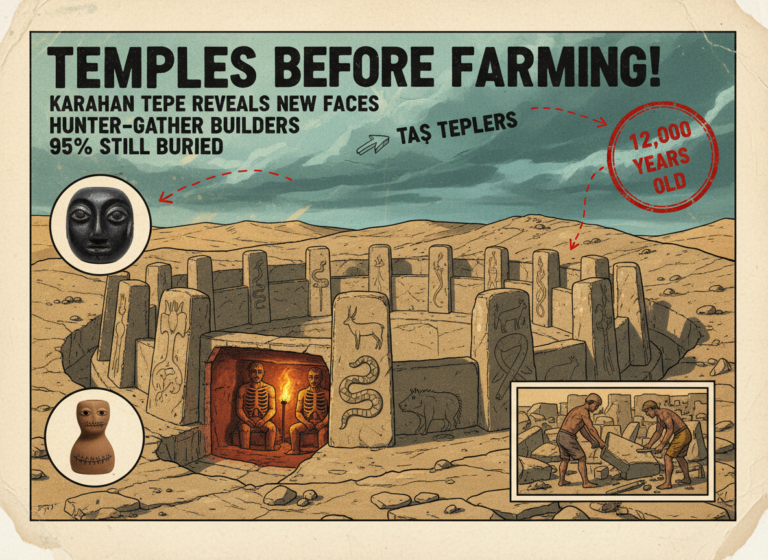
They Built a Temple Complex Before They Had Farming, Writing, or Pottery. New Finds at Karahan Tepe Just Made the Mystery Bigger.
Fresh discoveries at a 12,000-year-old site in Turkey called Karahan Tepe, the possible earliest village in human history, have uncovered more carved…