Original Story
The Greeks Wrote About a Perfect Civilization at the North Pole. New Evidence Suggests It Might Have Been Real.
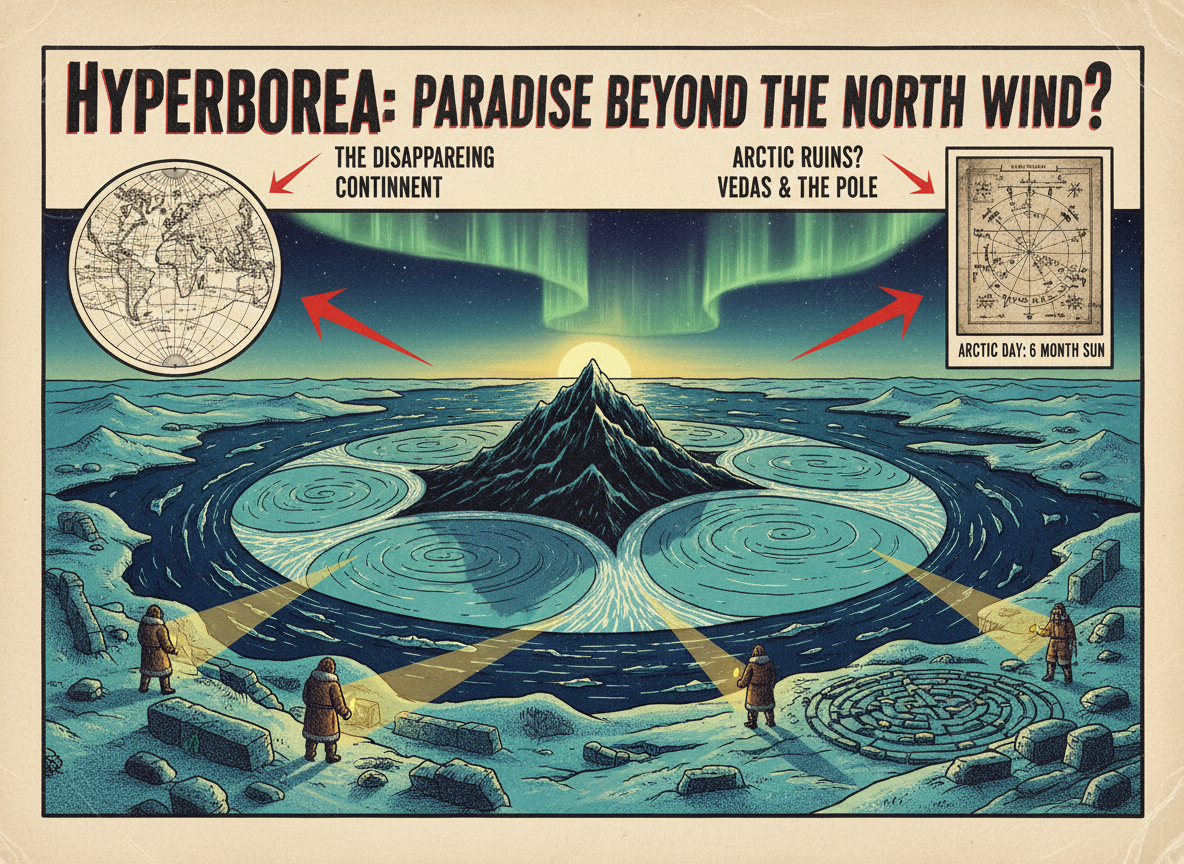
For 2,500 years, ancient writers described a paradise beyond the north wind called Hyperborea, home to giants who lived 1,000 years without war or disease. Mainstream historians wrote it off as mythology. But a 16th-century map, a series of massive stone structures in the Russian Arctic, ancient Hindu texts, and a growing stack of geological anomalies are making that easy dismissal harder to defend.
Here is something most history books do not mention.
In 1569, the famous mapmaker Gerardus Mercator drew a map of the North Pole. You have probably seen his work before. He invented the mapping style that almost every world map still uses today. On that 1569 map, the North Pole is not covered in ice and ocean. It shows a landmass. A large continent, divided into four sections by rivers flowing out from a central mountain. Mercator labeled it the Arctic continent and described it based on older source material he trusted.
Today, the North Pole is nothing but ocean and floating ice. No landmass. No continent. No rivers.
So either Mercator made a serious error on the most detailed map of his era, or he was working from information about something that used to be there.
That question is at the heart of one of the oldest and most controversial debates in all of alternative history: Was Hyperborea real?
What the Ancient Greeks Said
The word Hyperborea comes from Greek. It means, literally, “beyond the north wind.” The Greeks called the north wind Boreas, and they believed that if you traveled far enough past where that wind came from, you would reach a completely different world.
The poet Pindar wrote about it around 500 BC. He described Hyperborea as a place where music never stopped, the people never got sick, and no one grew old or went to war. They lived, he said, for a thousand years.
Herodotus, who is called the Father of History because he was one of the first people to actually try to write accurate accounts of the world, mentioned the Hyperboreans in 450 BC. He said they sent mysterious offerings wrapped in wheat straw to the sacred island of Delos, passed from one neighboring people to the next until the packages reached their destination. These were not, in his telling, a fairy tale people. They were a real civilization that other real civilizations traded with.
The Roman author Pliny the Elder described them as living in a perfect climate where the sun shone for six months straight and never set. He said they were real and that travelers had reached their land.
Now stop and think about that detail for a second. Six months of continuous sunlight is not a fantasy. It is what actually happens above the Arctic Circle. The ancient Greeks, writing from the Mediterranean, had accurate knowledge of what the Arctic day cycle looks like. How did they know that? They had no satellites. They had no explorers who had made it that far north and returned with detailed notes.
Some researchers say they inherited this knowledge from people who had actually lived there.
The Kola Peninsula: Where the Stone Blocks Are
The Kola Peninsula is a chunk of land in the far northwest of Russia, jutting into the Arctic Ocean above the Arctic Circle. It is cold, remote, and mostly empty. It is also the place where a series of strange stone structures have been discovered that no one has fully explained.
In the early 1900s, a Russian explorer and scientist named Alexander Barchenko led an expedition to the Kola Peninsula. He had heard stories from local people about ancient stone labyrinths, carved figures, and structures that seemed far too large and deliberate to have been made by the small nomadic populations known to have lived there. When he arrived, he found them.
He discovered what appeared to be ruins. Massive stone slabs. Rock carvings. A stone labyrinth with walls that required enormous effort to construct. He reported that some structures appeared to be aligned with cardinal directions, meaning they were built to face north, south, east, and west with unusual precision.
His findings were quickly classified by Soviet authorities, and Barchenko himself was executed in 1938 during Stalin’s purges. His research was buried in state archives for decades.
When independent researchers and later Russian archaeological teams went back to the Kola Peninsula, they found that the structures he described were still there. The Seyozero region, in particular, continues to be a focus of alternative archaeology. Stone pillars, ancient labyrinths built from flat rocks, and carved surfaces that appear far older than the known history of the area keep drawing attention. The Russian research group Cosmopoisk has conducted multiple expeditions there.
No official archaeological excavation with full scientific resources has ever been completed at the site.
The Book That Changed Everything
In 1903, an Indian scholar named Bal Gangadhar Tilak published a book called “The Arctic Home in the Vedas.”
Tilak was not a fringe researcher. He was a respected mathematician, astronomer, and one of the most important political leaders in India’s independence movement. He was also a deeply serious scholar of the ancient Hindu texts called the Vedas, which are among the oldest written religious documents in the world.
After spending years analyzing the astronomical data embedded in those texts, including references to specific star positions, sunrise and sunset patterns, and descriptions of seasons, Tilak reached a conclusion that mainstream scholars at the time found shocking.
The Vedic people, he argued, did not originate in India or in the Middle East. The astronomical descriptions in the oldest Vedic texts, he said, could only match the conditions at the North Pole or very close to it. He was describing long periods of continuous daylight, and extended periods of darkness, the exact conditions of the Arctic.
His argument was that the people who wrote the Vedas came from the far north, and that they carried this astronomical memory with them when a massive climate change forced them to migrate south, eventually reaching India.
This put one of the world’s oldest surviving religious traditions in a direct line with the location the Greeks called Hyperborea.
Tilak was not alone in drawing this connection. Other scholars in the early 20th century pointed to similar patterns in Persian, Norse, and Slavic mythology. All of these traditions contain stories of a paradise in the far north, a land of the gods, that was destroyed by cold or ice. All of them describe their ancestral homeland as a place where the sun rose once and set once in a year, which is the exact description of life above the Arctic Circle.
Mercator’s Map and the Disappearing Continent
Back to that map.
Gerardus Mercator was not making things up when he drew a continent at the North Pole. He was working from earlier source material. In a letter written in 1577, he referenced a book called “Inventio Fortunata,” which described the Arctic region based on journeys made in the 14th century. That book no longer exists. It vanished from history. But Mercator trusted it enough to include what it described on the most technically advanced map of his era.
What his map shows at the North Pole is a landmass that roughly matches the size and position of where geological evidence says dry land did in fact exist during earlier periods in Earth’s history. The Arctic was not always covered in ocean and ice. Before the last Ice Age, which ended roughly 12,000 years ago, parts of the far north that are now underwater or ice-covered were accessible land.
Sea levels were lower then. Land that is now submerged was dry. The Arctic Ocean was smaller. A landmass at or near the North Pole is not geologically impossible for the period when Earth’s climate was different.
In 2020, seismic studies of the Greenland ice sheet detected what researchers described as massive voids deep beneath the ice, vast underground spaces of uncertain origin. Satellite imagery of northern Russia and Greenland has shown what appear to be long, straight lines and geometric patterns beneath the surface ice and tundra, patterns that some researchers argue are too regular to be purely natural.
None of this has been confirmed as evidence of an ancient civilization. But it has also not been fully explained away.
What Modern Science Actually Says
To be clear about where mainstream science stands: there is no confirmed physical evidence of a technologically advanced civilization at the North Pole. Archaeologists have found no ruins, no artifacts, no writing systems, and no human remains from any such culture in the Arctic.
The scientific consensus is that the Hyperborea described in ancient texts is mythology. It belongs to the same category of “utopia at the edge of the world” stories that ancient cultures used to describe idealized places they could not reach. The Elysian Fields. Shangri-La. The Garden of Eden. These were not maps. They were ideas.
The Greek descriptions of six-month sunlight and six-month darkness, the mainstream argument goes, were gathered from sailors and traders who had traveled to Scandinavia and reported back what they saw. The Greeks extrapolated from those accounts and imagined a land further north where everything was more extreme, more perfect, more divine.
Tilak’s theory about Vedic origins in the Arctic is considered discredited by most modern scholars of Vedic literature. The astronomical data he used, they argue, can be explained by the mathematical methods the Vedic writers used to track celestial cycles, not by actual observation from the North Pole.
The Kola Peninsula stone structures have not been formally dated. Their age and origin are disputed. The alternative history community treats them as ancient and significant. Professional archaeologists who have examined them have offered more conventional explanations involving medieval-period nomadic activity.
Why the Story Will Not Die
Despite all of that, the idea of Hyperborea keeps coming back. And the reason is that several pieces of the puzzle do not fit neatly into the conventional story.
The first is Mercator’s map. He was the best cartographer of his age. He was not in the habit of inventing continents. He sourced his information from a text that is now missing. The fact that the text it came from no longer exists is itself an interesting detail.
The second is the Vedic connection. Tilak may have been wrong about the specific astronomical interpretations, but the fact that one of the most rigorous scholars of the Vedas spent years arguing that the oldest sections of those texts described Arctic conditions is not nothing. The question of where the Vedic people came from has not been fully settled.
The third is the sheer number of ancient cultures that tell some version of the same story. A paradise in the far north. A civilization of advanced, long-lived people. A catastrophic event that destroyed it and forced the survivors to migrate south. The Greeks called it Hyperborea. The Hindus called it Uttarakuru. The Norse described a warm land north of the ice. The Siberian Yakut people have traditions about ancestors from a warm northern land. The stories do not all trace back to each other. They appear to have developed independently, in cultures that had no known contact with each other, and they keep pointing in the same direction.
The fourth is what is happening right now. As the Arctic ice melts at a pace that has no modern precedent, land and seabed that has been buried under ice for thousands of years is being exposed. Whatever might be preserved under that ice, ancient structures, human remains, artifacts, is becoming accessible in a way it has not been for at least 12,000 years.
Nobody has found anything yet. But nobody has looked in most of it, either.
The legend of Hyperborea is 2,500 years old. The ice is melting. If there was ever going to be a time when the question got a definitive answer, it might be now.
Sources: Ancient Origins, Secrets of Hyperborea: An Ancient Arctic Civilization Discovered?, Wikipedia, Hyperborea, Britannica, Hyperborean, MRU, Secrets of Hyperborea, Have Scientists Already Discovered a Mysterious Arctic Civilization?, Tilak, Bal Gangadhar. “The Arctic Home in the Vedas.” 1903.
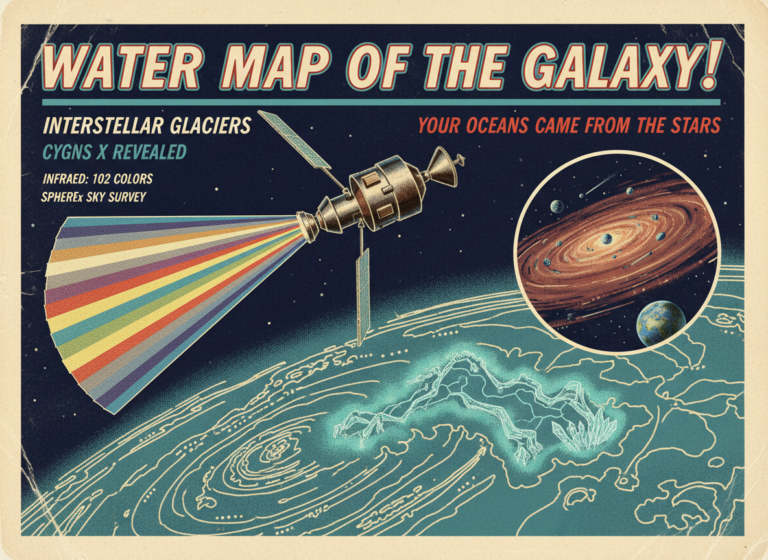
NASA Has Mapped the Water in the Galaxy. The Ocean Beneath Your Feet Came From Out There.
A study published in The Astrophysical Journal on April 15, 2026, based on data from NASA's SPHEREx mission, has produced the first…

A Machine Learning Algorithm Just Found 10,000 Alien Planets Nobody Had Seen Before. They Were Hidden in Data We Already Had.
The current official count of confirmed exoplanets — planets orbiting stars other than our sun — sits at roughly 6,300. It took…

Every Time You Tighten Your Core, Your Brain Gently Swishes Around. That Might Be Keeping You Sane.
When you tighten your abdominal muscles — whether you are walking, standing up from a chair, or doing anything that engages your…
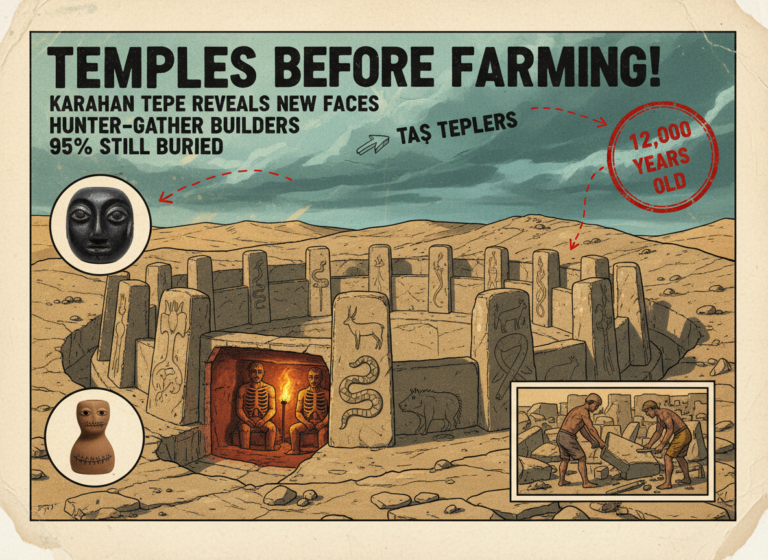
They Built a Temple Complex Before They Had Farming, Writing, or Pottery. New Finds at Karahan Tepe Just Made the Mystery Bigger.
Fresh discoveries at a 12,000-year-old site in Turkey called Karahan Tepe, the possible earliest village in human history, have uncovered more carved…