Original Story
A Scottish Farmer Saw a Puma-Sized Black Cat Cross the Road in the Cairngorms. He’s Seen It Twice Before.
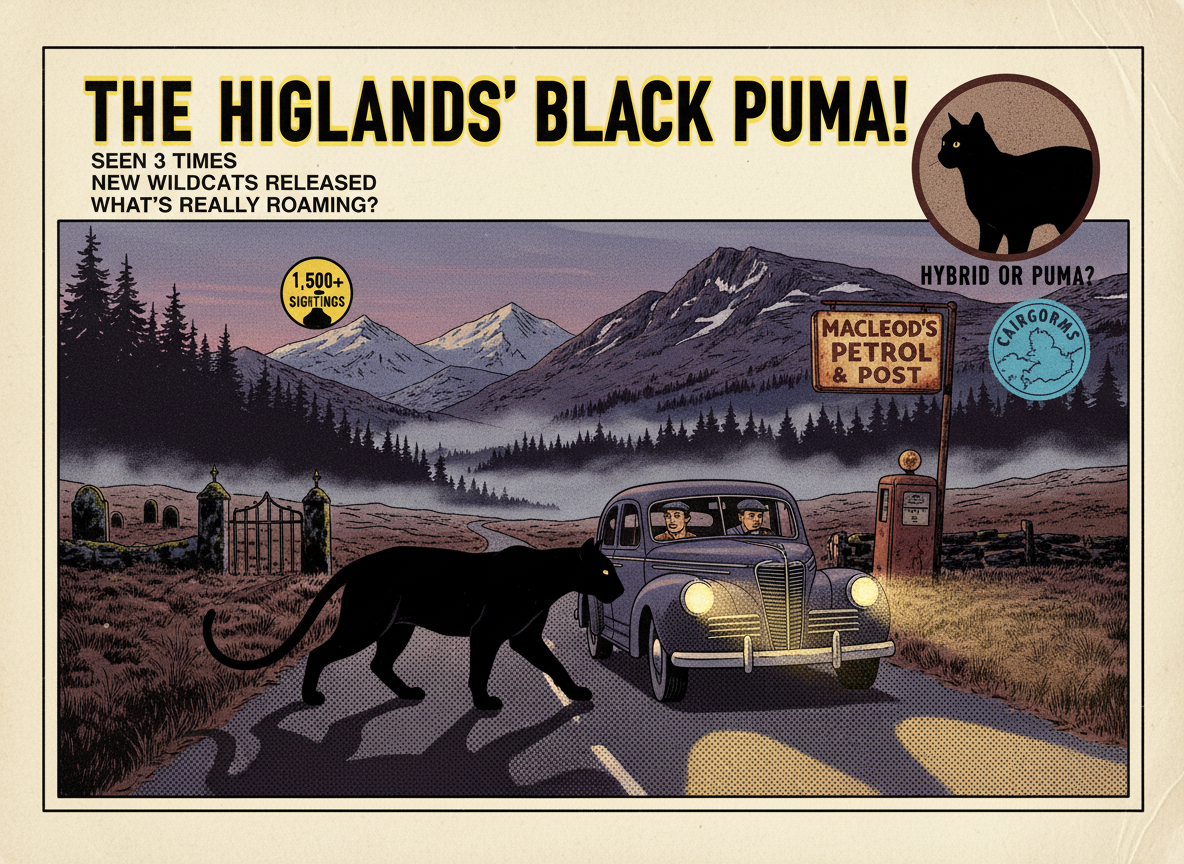
Last Friday evening, April 18, 2026, farmer John Kirk and his wife were driving into Grantown-on-Spey in the Scottish Highlands when a very large black cat crossed the road in front of their car near a cemetery and an old petrol station. Kirk described it as approximately puma-sized. When he posted about the encounter on Facebook, he said he was surprised by the number of people who came forward to say they had seen the same animal. This was not Kirk’s first encounter with such a creature: he has seen a large black cat in the same area twice previously, including once at Boat of Garten, a village roughly four miles south of Grantown. The sighting was reported to the Strathspey Herald and to Coast to Coast AM, and was logged by the Unexplained Mysteries news team on April 20, 2026, with sixteen comments already filed.
Grantown-on-Spey sits on the northeastern edge of the Cairngorms National Park, the largest national park in the United Kingdom by area, a landscape of ancient Caledonian forest, moorland, and mountain that has produced a remarkable concentration of large cat reports over decades. According to the Scottish Big Cat Mapping Project, more than 1,500 large or unusual cat sightings have been recorded in and around the Cairngorms, spanning reported species from wildcats and lynx to pumas and leopards.
The Cairngorms have a particular complication that makes these sightings harder to dismiss as pure misidentification: the area is home to genuine large native felines. Eighteen Scottish wildcats — a critically endangered subspecies of the European wildcat, declared functionally extinct in Britain in 2019 before a captive breeding and reintroduction program was launched — have been released into the park over the past three years by the Saving Wildcats project, operated by the Royal Zoological Society of Scotland. The wildcats are being introduced precisely because a viable breeding population was thought to have collapsed. If they are present, large felids of genuine wildcat scale are now moving through the Cairngorms in small numbers.
But Kirk’s description does not fit a wildcat. The Scottish wildcat (Felis silvestris grampia) is a heavily built animal by domestic cat standards, but it tops out at roughly ten to fourteen pounds and a length of around two feet. A puma — the comparison Kirk reached for unprompted — typically weighs between 80 and 200 pounds, measures between five and eight feet from nose to tail, and can leap distances exceeding thirty feet. Kirk said the animal was “about puma size.”
The Kellas Cat and What It Means
Paul Macdonald, who runs the Scottish Big Cat Research organization, offered a modifying explanation to the Scottish Sun. The Kellas cat, he noted, is a documented hybrid between domestic felines and Scottish wildcats, capable of reaching substantially larger sizes than purebred wildcats. They can be dark or solid black in coloration, and Macdonald acknowledged they can be misidentified as pumas by observers in poor light or at vehicle speed.
His assessment of the Highlands sighting environment: “Pumas and Kellas sightings are few and far between but they have been consistent, they tend to be very solitary and stay away from people. But they are wild so I wouldn’t advise trying to feed it.”
The Dangerous Wild Animals Act 1976 made private ownership of big cats illegal in the UK. Prior to that legislation, pumas, leopards, and other large exotic cats were kept as private pets in Britain with relative frequency. When the act came into force, it is documented that some owners released their animals into the wild rather than pay to legally house and register them. It is within the realm of plausibility that a small, self-sustaining population of large cats has persisted in Britain’s more remote landscapes for fifty years. Whether it is plausible in perpetuity, given typical puma lifespans of around ten to fifteen years in the wild, remains the core unanswered question that every new sighting reopens.
Kirk has seen this animal, or one like it, in the same highland corridor three times. He was not alone this time. The size was consistent across each encounter.
The petrol station it crossed in front of is a fixed landmark. The cemetery is a fixed landmark. The road is a fixed landmark. Whatever John Kirk and his wife saw in Grantown-on-Spey at 9:45 p.m. on April 18, 2026, it was large enough to be recognized as puma-sized by a farmer who had seen it before.
Sources: Yahoo News UK / The Herald — Big Black Cat the Size of a Puma Spotted in Highlands, Several Witnesses Claim (April 19-20, 2026) — Coast to Coast AM — Puma-Like Big Cat Sighting Reported in Scotland (April 21, 2026) — Unexplained Mysteries — Large Black Puma-Like Cat Spotted Roaming the Scottish Highlands (April 20, 2026)

NASA Has Mapped the Water in the Galaxy. The Ocean Beneath Your Feet Came From Out There.
A study published in The Astrophysical Journal on April 15, 2026, based on data from NASA's SPHEREx mission, has produced the first…

A Machine Learning Algorithm Just Found 10,000 Alien Planets Nobody Had Seen Before. They Were Hidden in Data We Already Had.
The current official count of confirmed exoplanets — planets orbiting stars other than our sun — sits at roughly 6,300. It took…

Every Time You Tighten Your Core, Your Brain Gently Swishes Around. That Might Be Keeping You Sane.
When you tighten your abdominal muscles — whether you are walking, standing up from a chair, or doing anything that engages your…

They Built a Temple Complex Before They Had Farming, Writing, or Pottery. New Finds at Karahan Tepe Just Made the Mystery Bigger.
Fresh discoveries at a 12,000-year-old site in Turkey called Karahan Tepe, the possible earliest village in human history, have uncovered more carved…