Original Story
Congo’s Dinosaur Creature Is Being Seen More Than Ever. The Reason Says Something Uncomfortable About the Real World.
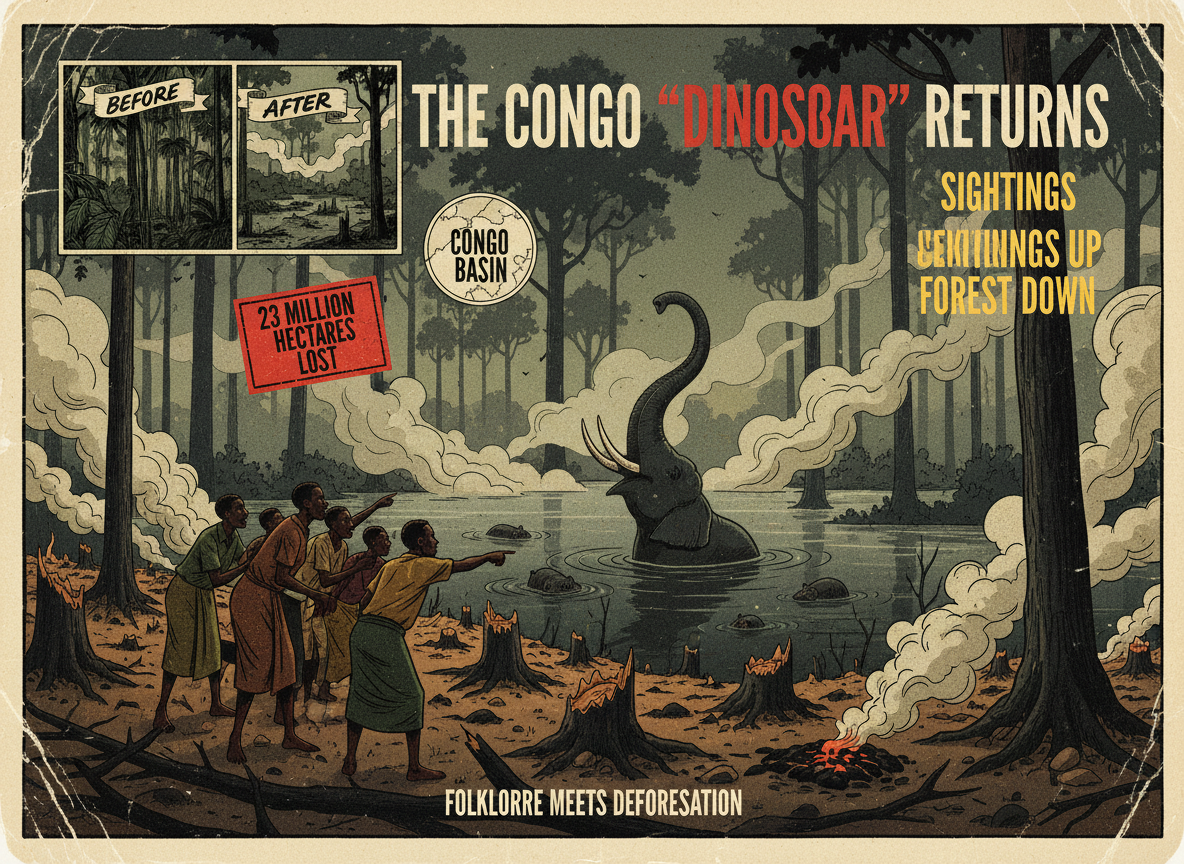
For centuries, the Bantu-speaking peoples of Central Africa have passed down accounts of a large, semi-aquatic creature that lives in the swamps and rivers of the Congo Basin — a creature described as having a long neck, a bulky gray-brown body, four sturdy legs, and a long tail. It is called mokele-mbembe, meaning roughly “one who stops the flow of rivers” in the Lingala language. Western explorers and cryptozoologists encountered these accounts in the early 20th century and became convinced they were describing a living sauropod dinosaur — a relative of Brachiosaurus, somehow surviving in the deep forests of Central Africa. Dozens of expeditions have been mounted in search of it. None has found physical evidence of its existence. And now, in 2025 and into 2026, sightings of the creature are on the rise — more reports, from more people, across more of the Congo Basin than at any time in recent memory. The reason, according to conservationists and researchers who work in the region, has nothing to do with dinosaurs.
To understand what is happening in the Congo right now, you need to understand what the Congo has lost.
The Congo Basin is the second-largest tropical rainforest on Earth, after the Amazon. It covers roughly 1.5 million square miles across the Republic of the Congo, the Democratic Republic of the Congo, Cameroon, Gabon, and neighboring countries. Its rivers, swamps, and forests represent one of the most biodiverse environments on the planet, home to forest elephants, western lowland gorillas, okapis, chimpanzees, bonobos, and thousands of other species, many of them found nowhere else.
Since 2000, the Congo Basin has lost approximately 23 million hectares of forest. That is an area comparable to the total land mass of the United Kingdom, cleared over roughly twenty-five years. The clearing is driven by subsistence farming, commercial agriculture, charcoal production, and the expansion of human settlements. As the forest shrinks, the animals that live in it are pushed outward, into contact with communities that have never encountered them before.
Laura Vlachova, a Czech conservationist working in and around the Congo region, described the pattern to National Geographic: “In bigger settlements where habitats are being pushed into and people aren’t used to seeing large animals, they’re suddenly encountering them all the time. It’s these people who tell me they’ve seen mokele-mbembe. I think what it really shows is how folklore is starting to reflect the reality of a shrinking ecosystem.”
What People Are Actually Seeing
The most likely explanations for the accelerating reports are animals that most people in these expanding settlements have genuinely never seen before. Forest elephants — which are smaller than savanna elephants but still enormous — move differently and look different from the animals most people imagine when they think of an elephant. Their long trunks swinging through dense forest tree lines can produce a profile that, to an unfamiliar observer expecting nothing large in that area, is startling and difficult to immediately categorize. Hippopotamuses moving through swamp territory at dusk or in turbid water can look like something massive and low-slung and ancient. Gorillas, when heard rather than seen, produce vocalizations that can be deeply unsettling to someone who has never encountered one.
The region also has genuine historical precedent for mystery animals. The okapi — a large forest mammal that looks like a cross between a giraffe and a zebra, with distinctive striped hindquarters — was described in local legends and dismissed by Western science for years before it was formally described in 1901. The pygmy hippopotamus was assumed to be legend before it was documented. The Congo forest is genuinely large enough and impenetrable enough that new large species have been confirmed in the modern era. That context keeps the mokele-mbembe question from being entirely dismissible.
What the evidence does not support is a surviving sauropod dinosaur. Non-avian dinosaurs went extinct approximately 66 million years ago, and there is no plausible mechanism by which one could have survived undetected in a region that, while remote, has been inhabited by human communities for tens of thousands of years and extensively surveyed by dozens of expeditions specifically searching for large megafauna. The Congo is not Jurassic Park.
Selah Abong’o, a Congolese conservationist who once had her own terrifying encounter in the Odzala-Kokoua National Park that she initially attributed to mokele-mbembe, now offers a different and more sobering read. “When I think about it now, it saddens me,” she told National Geographic. “People are still confusing elephants and apes for mokele-mbembe, and that’s largely because of deforestation. And the Congo is still disappearing.”
The dinosaur of the Congo is being seen everywhere. The forest it is supposedly hiding in is not.
Sources: National Geographic — What’s Behind the Strange Rash of Dinosaur Sightings in the Congo? (August 2025) — IFLScience — Sightings of the Legendary Mokele-Mbembe Dinosaur of the Congo Are Increasing: What Is Going On? (March 2025) — SYFY Wire — The Congo River Basin’s Dinosaur-Like Mokele-mbembe, Explained — WION News — Is a Dinosaur Wading in the Swamps of Congo? Here’s the Truth — Unexplained Mysteries — Sightings of the Enigmatic Mokele-Mbembe Are Reportedly on the Rise (March 29, 2025) — Paranormal Observer — Mokele-Mbembe Sightings Accelerating, Congo Deforestation Linked to Reports (April 2026) — Wikipedia — Mokele-mbembe
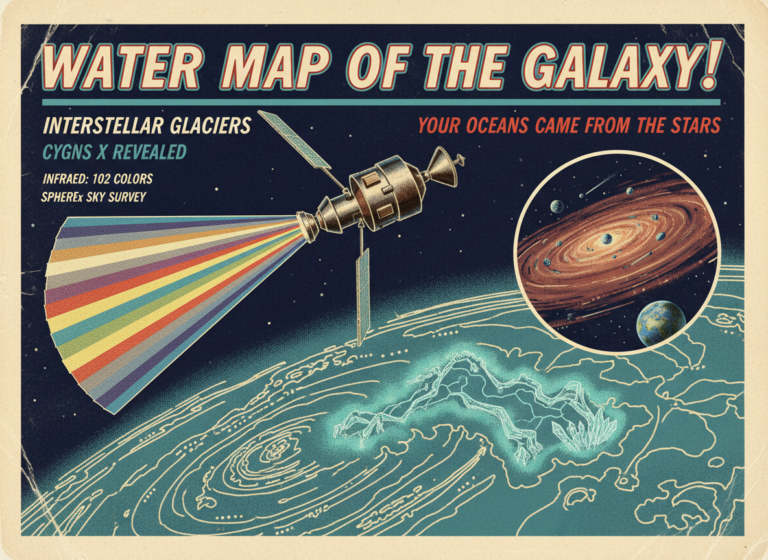
NASA Has Mapped the Water in the Galaxy. The Ocean Beneath Your Feet Came From Out There.
A study published in The Astrophysical Journal on April 15, 2026, based on data from NASA's SPHEREx mission, has produced the first…
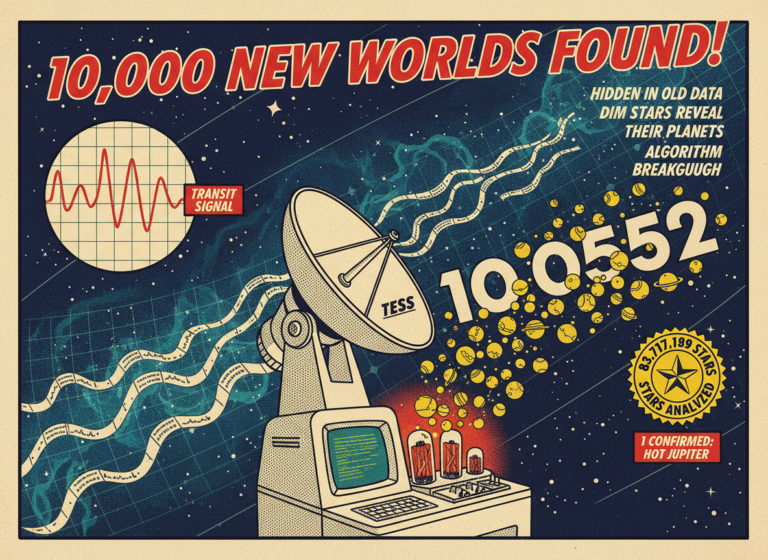
A Machine Learning Algorithm Just Found 10,000 Alien Planets Nobody Had Seen Before. They Were Hidden in Data We Already Had.
The current official count of confirmed exoplanets — planets orbiting stars other than our sun — sits at roughly 6,300. It took…

Every Time You Tighten Your Core, Your Brain Gently Swishes Around. That Might Be Keeping You Sane.
When you tighten your abdominal muscles — whether you are walking, standing up from a chair, or doing anything that engages your…
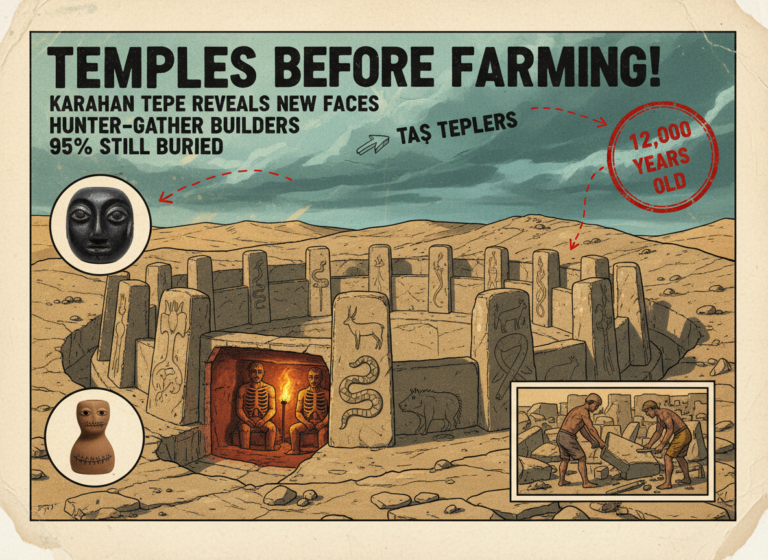
They Built a Temple Complex Before They Had Farming, Writing, or Pottery. New Finds at Karahan Tepe Just Made the Mystery Bigger.
Fresh discoveries at a 12,000-year-old site in Turkey called Karahan Tepe, the possible earliest village in human history, have uncovered more carved…