Original Story
The Maya Collapse Has a City-Sized Problem. This Place Had Plenty of Water and Still Vanished.
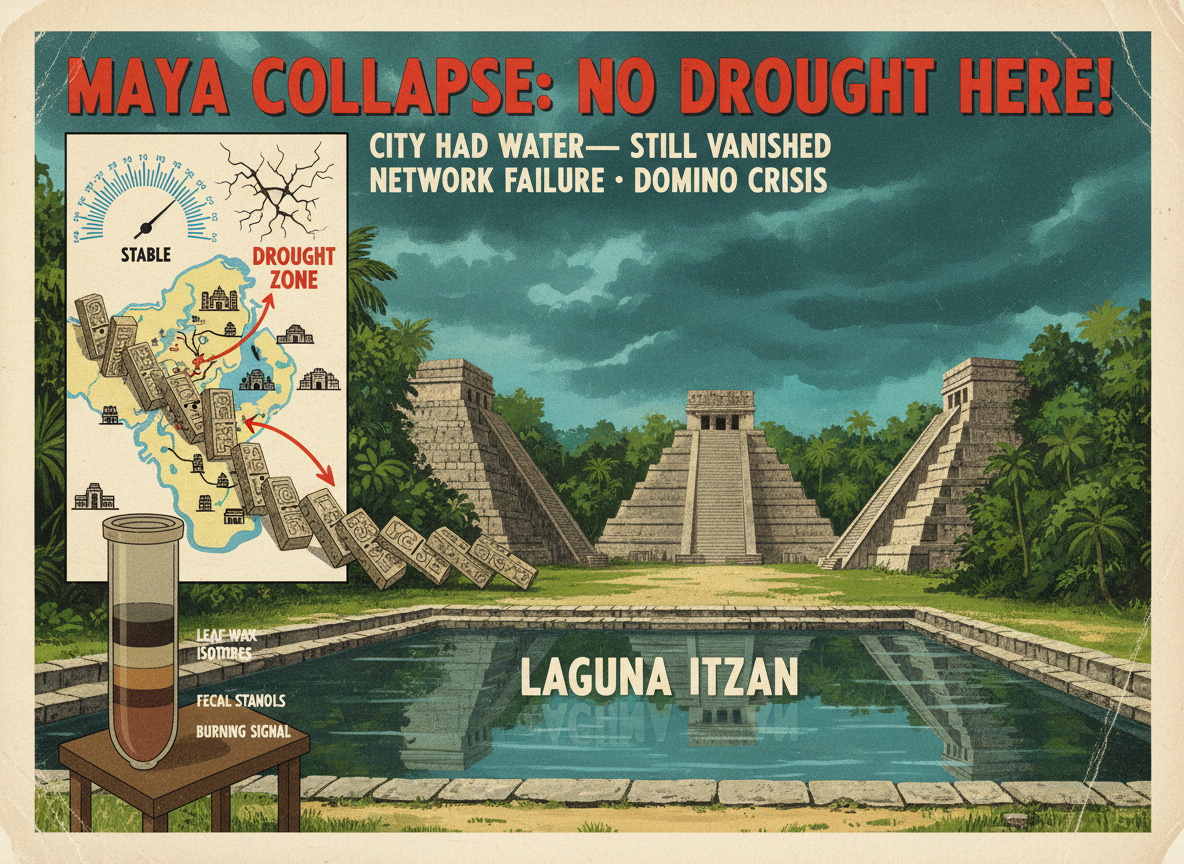
For decades, the dominant explanation for the collapse of the Classic Maya civilization between roughly 750 and 900 CE has been drought. The story was clean and intuitive: a series of severe dry periods struck the Maya lowlands in Central America, crops failed, populations declined, cities were abandoned, and one of the most sophisticated civilizations the ancient Americas had produced simply fell apart. The problem is that a team at Université de Montréal, led by geography professor Benjamin Gwinneth, has spent years analyzing sediment cores from a lake near the ancient Maya city of Itzan in Guatemala, and they cannot find the drought. The lake preserves 3,300 years of chemical evidence about past climate. It shows that Itzan had stable rainfall and a functioning agricultural system right up until its population collapsed and the site was abandoned. A city with water, farms, and no apparent environmental crisis, which vanished anyway, at exactly the same time as drought-stricken cities hundreds of miles away. The drought theory cannot explain that. The new explanation is both simpler and more disturbing: the Maya didn’t just collapse from the ground up. They fell like dominoes.
First, the archaeology. The Classic Maya period ran roughly from 250 to 900 CE and was one of the most remarkable cultural achievements in the ancient world. At its peak, the Maya lowlands — a region spanning present-day Guatemala, Mexico, Belize, Honduras, and El Salvador — contained dozens of major cities connected by trade routes, political alliances, agricultural networks, and shared religious systems. Cities like Tikal, Caracol, Copán, and Palenque featured monumental architecture, sophisticated writing, complex astronomy, and dense urban populations. By 900 CE, nearly all of them had been abandoned. Population declined by an estimated 50 to 90 percent in the southern lowlands within roughly 150 years.
The drought explanation emerged from paleoclimate data, primarily from lake sediments and cave stalagmites, showing clear evidence of severe dry periods coinciding with the collapse timeline. A major 2012 paper in Science demonstrated a strong correlation between drought episodes and population decline across the Maya lowlands. The story seemed largely settled.
Then researchers started looking at individual sites more carefully. And Itzan didn’t cooperate.
What the Sediment Said
Gwinneth’s team extracted sediment cores from Laguna Itzan, a lake near the archaeological site, and analyzed three types of chemical evidence across 3,300 years. Polycyclic aromatic hydrocarbons — compounds released by burning — show the intensity of the slash-and-burn agriculture the Maya used to clear forest. Leaf waxes record vegetation types and, through isotope analysis, past rainfall levels. Fecal stanols are compounds from human and animal waste that settle into lake sediment over time and can serve as a rough proxy for how many people were living nearby.
The combined picture from Itzan told a clear story. The site was first settled roughly 3,200 years ago. Population grew through the Classic period. Agricultural intensity increased, then shifted — the slash-and-burn signature faded and was replaced by indicators of more intensive farming techniques, consistent with a city-scale agricultural system feeding a large, organized population. And the rainfall record, derived from hydrogen isotope analysis of the leaf waxes, showed something distinctive: Itzan sits near a mountain range where moist air from the Caribbean rises and drops as rain. While cities to the north were drying out, Itzan remained consistently wet.
“While other Maya regions suffered devastating droughts, Itzan appeared to have a stable climate,” Gwinneth said. And then its population dropped sharply, agriculture disappeared from the record, and the site was abandoned — at almost exactly the same time as its drought-stricken neighbors.
The Domino Explanation
The explanation Gwinneth and his team propose is not that drought was irrelevant to the Maya collapse. It is that drought was the match, not the fire. The fire was the network.
Maya cities were not self-contained. They were deeply enmeshed in regional trading relationships, political alliances, and economic interdependence. They depended on each other for goods, labor, military support, and legitimacy. When drought struck cities in the central lowlands, Gwinneth argues it set off a cascade of secondary crises: wars over scarce resources, collapse of royal dynasties, mass migration out of drought zones, breakdown of trade routes. Those secondary crises rippled outward, reaching places like Itzan that had no local drought at all.
“The answer lies in the interconnectedness of Maya societies,” Gwinneth said. “When the central lowlands were hit by drought, this may have triggered a cascading series of crises: wars between cities over resources, the collapse of royal dynasties, mass migrations, disruption of trade routes, and so on.”
Itzan did not run out of water. It ran out of the network it depended on to function as a city.
“The transformation of the Maya civilization was not a mechanical result of a uniform climate catastrophe,” Gwinneth concluded. “It was a complex phenomenon in which climate, social organization, economic networks, and political dynamics were intertwined.”
The people who built the pyramid cities of the Maya lowlands did not simply fail when the rain stopped. They failed when everything failed together.
Sources: ScienceDaily — Maya Collapse Mystery Deepens as Scientists Find No Drought at Key Site (April 27, 2026) — Phys.org — The Collapse of Maya Civilization: Drought Doesn’t Explain Everything (November 2025) — Biogeosciences — Gwinneth et al., 3,300-Year Multiproxy Reconstruction of Human Activity and Climate at Laguna Itzan, Guatemala (2025) — Discover Magazine — The Disastrous Maya Collapse Knocked Down an Entire Network of Cities in Mesoamerica — Université de Montréal — The Collapse of Maya Civilization: Drought Doesn’t Explain Everything (November 2025) — Unexplained Mysteries forum — Maya Collapse Mystery Deepens as Scientists Find No Drought at Key Site (April 2026)
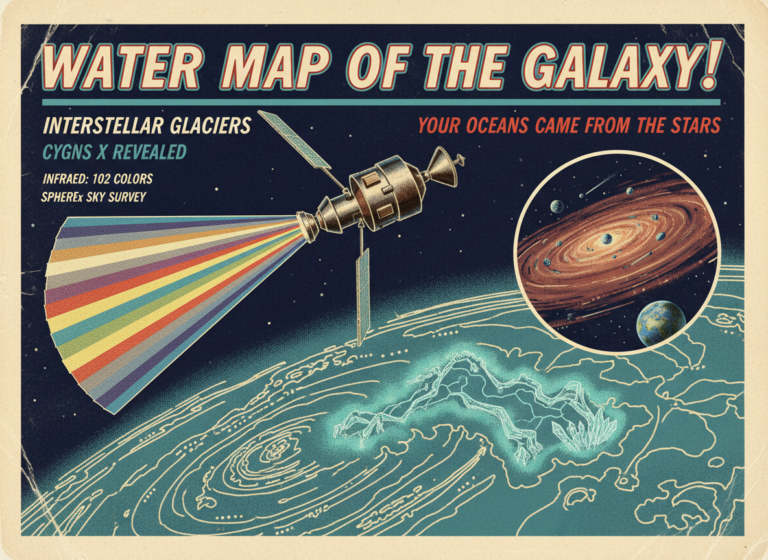
NASA Has Mapped the Water in the Galaxy. The Ocean Beneath Your Feet Came From Out There.
A study published in The Astrophysical Journal on April 15, 2026, based on data from NASA's SPHEREx mission, has produced the first…

A Machine Learning Algorithm Just Found 10,000 Alien Planets Nobody Had Seen Before. They Were Hidden in Data We Already Had.
The current official count of confirmed exoplanets — planets orbiting stars other than our sun — sits at roughly 6,300. It took…

Every Time You Tighten Your Core, Your Brain Gently Swishes Around. That Might Be Keeping You Sane.
When you tighten your abdominal muscles — whether you are walking, standing up from a chair, or doing anything that engages your…
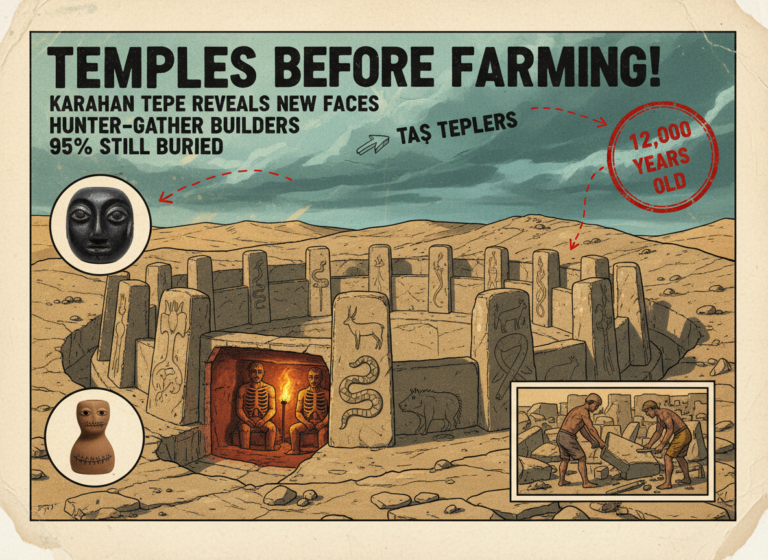
They Built a Temple Complex Before They Had Farming, Writing, or Pottery. New Finds at Karahan Tepe Just Made the Mystery Bigger.
Fresh discoveries at a 12,000-year-old site in Turkey called Karahan Tepe, the possible earliest village in human history, have uncovered more carved…