Original Story
Science Just Figured Out Why Some Buildings Feel Haunted. The Answer Is Sound You Can’t Hear.
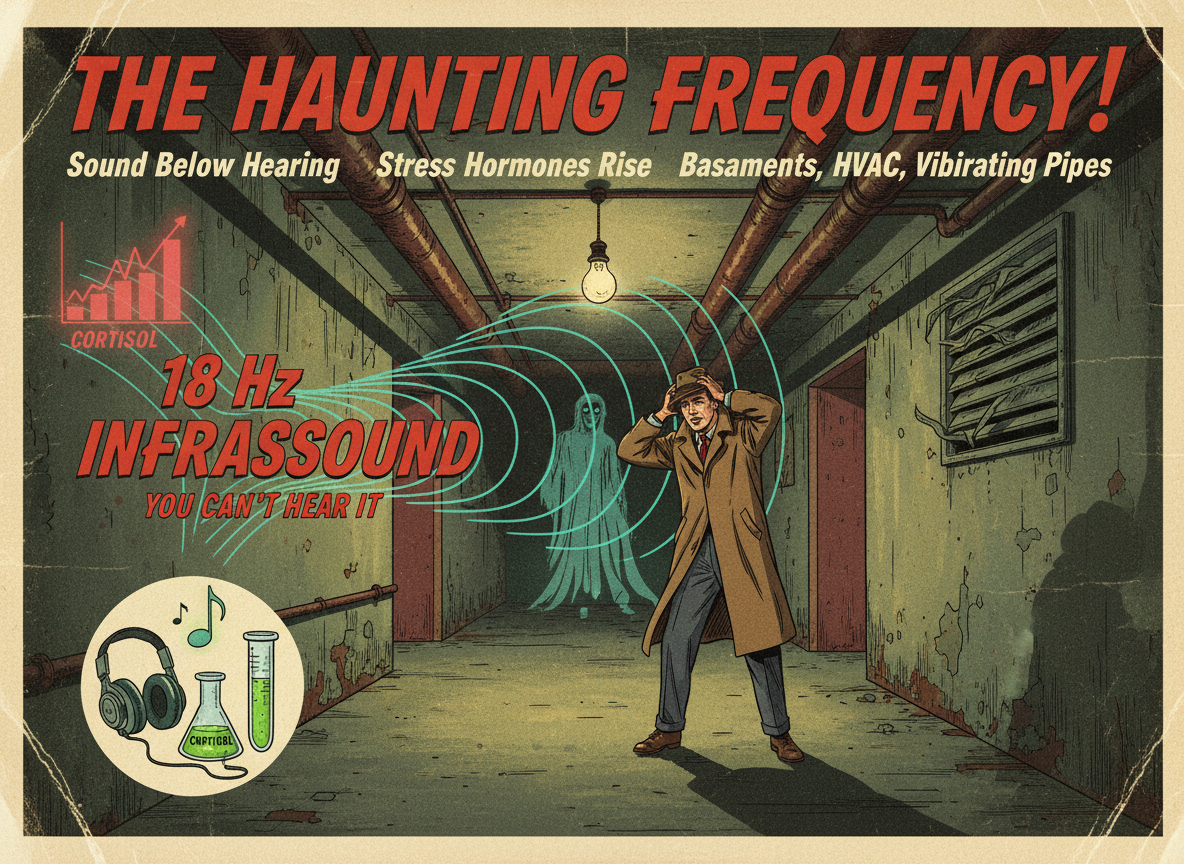
If you have ever walked into a basement or an old building and felt an immediate, unexplained sense of dread — not fear of the dark, not anything you could point to, just a creeping unease that seemed to come from nowhere — there may be a very physical explanation. New research published April 27, 2026 in the journal Frontiers in Behavioral Neuroscience found that brief exposure to infrasound, a type of extremely low-frequency sound that the human ear cannot consciously detect, causes measurable increases in stress hormones, irritability, and negative mood. The effect happens even when people have no idea the sound is present. Researchers from MacEwan University and the University of Alberta, who conducted the study, say infrasound is common in exactly the kinds of environments people describe as haunted: old basements, buildings with aging ventilation systems, structures near heavy traffic or industrial machinery. The pipes vibrate. You feel it without knowing it. And if someone has already told you the place is haunted, your brain has a ready explanation for why you suddenly feel so wrong.
To understand why this matters, you need to know what infrasound actually is. Sound travels as waves through the air, and the frequency of those waves — measured in hertz, or cycles per second — determines the pitch we hear. Human hearing covers a range of roughly 20 hertz to 20,000 hertz. Go below 20 hertz and the sound becomes infrasound: too low to register as a conscious auditory experience, but not too low to affect the body.
Infrasound is generated by a wide range of sources: industrial machinery, wind farms, ventilation systems, air conditioning units, heavy traffic, weather events like thunderstorms, and seismic activity. Old buildings with aging infrastructure are particularly likely to produce it. Pipes vibrate at low frequencies. HVAC systems do too. If you are in a building with a creaky, older mechanical system, you are almost certainly being bathed in low-frequency vibrations you cannot consciously detect.
The new study, led by Prof. Rodney Schmaltz of MacEwan University, tested the effects of infrasound on human emotional state using a well-controlled experimental design. Participants listened to music in a lab setting. In some sessions, infrasound at 18 Hz was played alongside the music. In others, it was not. Crucially, participants were not told whether infrasound was present, and most could not accurately detect it when it was.
What Happened to the Participants
Even without consciously hearing the infrasound, the participants showed measurable changes. Their salivary cortisol levels rose. Cortisol is the hormone your body releases in response to stress — it is the core chemical signal of the fight-or-flight response. Their self-reported irritability also increased. They rated the music they were listening to as sadder. They reported feeling less interested in what was happening.
None of these people could hear the sound. But their bodies were responding to it.
“Consider visiting a supposedly haunted building,” Schmaltz explained in the announcement of the findings. “Your mood shifts, you feel agitated, but you can’t see or hear anything unusual. In an old building, there is a good chance that infrasound is present, particularly in basements where aging pipes and ventilation systems produce low-frequency vibrations. If you were told the building was haunted, you might attribute that agitation to something supernatural.”
The History Behind the Theory
This is not the first time infrasound has been linked to paranormal reports. The classic case comes from researcher Vic Tandy, who worked at a laboratory with a reputation for being haunted in the 1980s. Tandy reported feeling deeply uneasy while working late one night and thought he saw a shadowy figure in his peripheral vision. The following day, he noticed that the blade of a fencing foil he had clamped in a vice was vibrating on its own, despite nothing touching it. When he measured the lab, he found it was resonating at 18.98 Hz — very close to the frequency used in the new study. The ventilation system was generating infrasound that was bouncing around the room. When the system was modified, the experiences stopped.
The new Frontiers study is described by its authors as a first step, not a final answer. The sample size was relatively small. The researchers tested only one specific frequency. Other frequencies might produce different or stronger effects, and individual sensitivity to infrasound likely varies across people.
What the study confirms is that the mechanism is real. Your body reacts to sound it cannot hear. If that reaction happens in a building someone has labeled as haunted, in a context where you are already primed to look for an explanation, your brain will find one.
Sources: Frontiers in Behavioral Neuroscience — Schmaltz et al., Increased Stress and Irritability from Infrasound Exposure: Implications for Paranormal Experiences (April 27, 2026) — EurekAlert — The Cause Might Be Vibrating Pipes Rather Than Restless Spirits: Increased Stress and Irritability from Infrasound Exposure May Explain Paranormal Experiences (April 27, 2026) — 404 Media — Scientists Investigated a Frequency Linked to Paranormal Encounters. The Results Were Unsettling. (April 28, 2026) — The Debrief — Scientists Explore Paranormal Experiences and the Effects of Inaudible Infrasound (April 28, 2026) — International Sound Directory — Haunted Feelings May Actually Be Caused by Silent Infrasound (April 27, 2026) — Unexplained Mysteries — Could Ultrasound Be Responsible for Some Paranormal Experiences? (April 27, 2026)

NASA Has Mapped the Water in the Galaxy. The Ocean Beneath Your Feet Came From Out There.
A study published in The Astrophysical Journal on April 15, 2026, based on data from NASA's SPHEREx mission, has produced the first…

A Machine Learning Algorithm Just Found 10,000 Alien Planets Nobody Had Seen Before. They Were Hidden in Data We Already Had.
The current official count of confirmed exoplanets — planets orbiting stars other than our sun — sits at roughly 6,300. It took…
Every Time You Tighten Your Core, Your Brain Gently Swishes Around. That Might Be Keeping You Sane.
When you tighten your abdominal muscles — whether you are walking, standing up from a chair, or doing anything that engages your…

They Built a Temple Complex Before They Had Farming, Writing, or Pottery. New Finds at Karahan Tepe Just Made the Mystery Bigger.
Fresh discoveries at a 12,000-year-old site in Turkey called Karahan Tepe, the possible earliest village in human history, have uncovered more carved…