Original Story
The Scale Scientists Use to Rank Alien Civilizations Has a Fatal Flaw. What It Actually Measures Is How Fast a Species Destroys Itself.
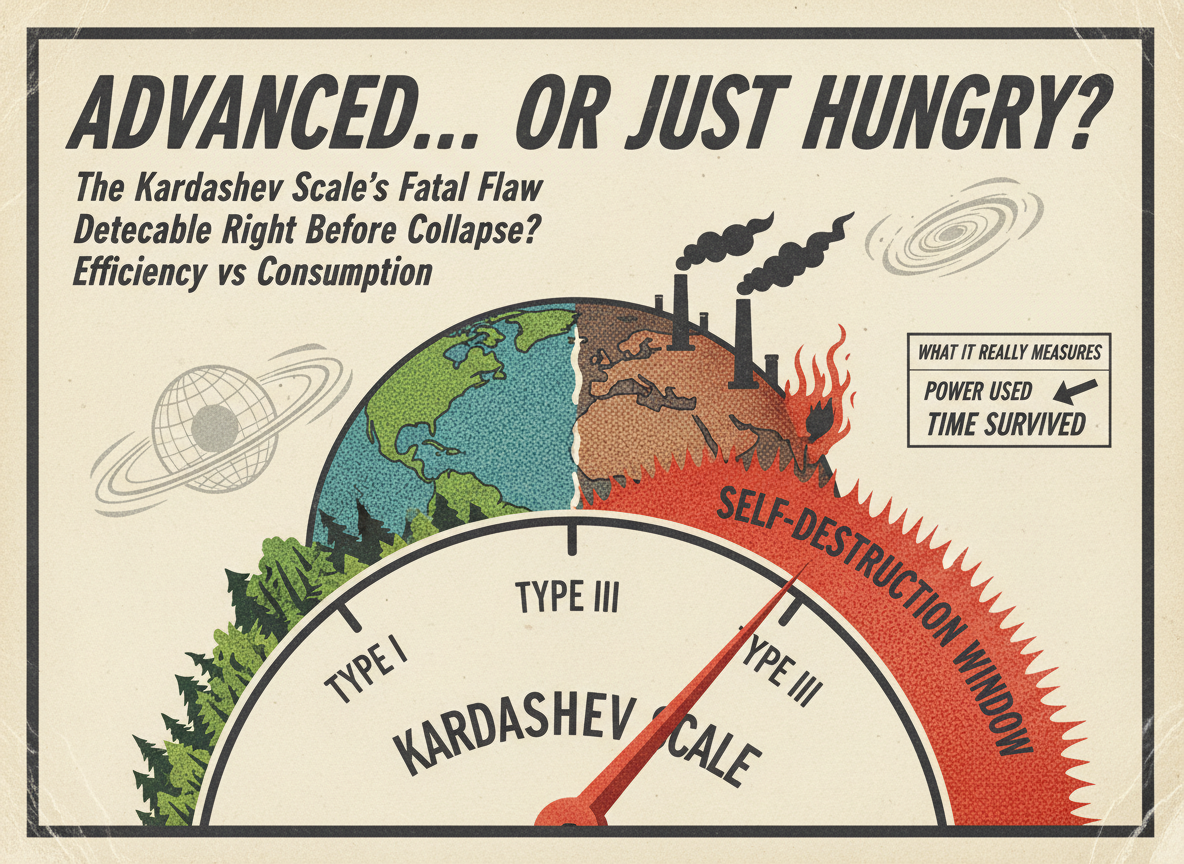
In 1964, a Soviet astrophysicist named Nikolai Kardashev proposed a simple three-tier scale to rank how advanced an extraterrestrial civilization might be, based entirely on how much energy it can harness. A Type I civilization uses all the energy available on its home planet. A Type II uses all the energy from its star. A Type III uses all the energy from its entire galaxy. The scale has been used by everyone from Carl Sagan to Stephen Hawking to sci-fi writers ever since. The problem, explored in detail in a piece published April 25, 2026, and circulated widely on Unexplained Mysteries, is that the scale measures power consumption — not intelligence, not longevity, not wisdom, not survival. A civilization that burns through energy fast enough to hit Kardashev Type I might be doing so precisely because it is destroying its own planet in the process. The scale has no mechanism for distinguishing a thriving civilization from one that is eating itself alive.
The Kardashev Scale was designed as a tool for SETI — the Search for Extraterrestrial Intelligence. The idea was simple and practical: if advanced alien civilizations exist, they would likely produce detectable energy signatures. A civilization that had mastered its home star would emit enormous amounts of infrared radiation. Astronomers could scan for these signatures without having to wait for a radio signal. The scale gave researchers a framework for what to look for and how to rank what they found.
As a detection tool, it is still useful. As a description of what “advanced” means, it has a problem that researchers and science writers have been poking at more frequently in recent years: the scale rewards consumption, not survival.
What Kardashev Actually Measures
Here is a concrete example. Human civilization, as of 2026, is somewhere around Kardashev 0.73 on the scale. We do not yet use all of Earth’s available energy — we still rely heavily on fossil fuels, have not fully deployed solar and other renewable systems at global scale, and have not begun to tap the full energy budget of the planet.
If current trends continued and humanity began consuming energy dramatically faster — say, through rapid industrialization of every remaining undeveloped region, full exploitation of all fossil fuel reserves, and large-scale nuclear fission — we would move up the Kardashev scale quickly. We would also likely trigger runaway climate change, accelerate biodiversity loss, and destabilize the systems that make the planet livable.
The scale would call that progress. The civilization doing it might not survive long enough to matter.
This is the flaw. Kardashev Type I sounds like graduation. It might just be the point at which a civilization has figured out how to burn enough of its home planet’s resources to register on a sensor. The scale says nothing about what the civilization looks like on the inside, how long it has survived, how equitably its energy is distributed, or whether the methods it used to climb the scale left it with a livable world on the other side.
The Alternative Frameworks
Several researchers have proposed alternatives or modifications. One approach adds a fourth axis to the original three — measuring information processing capacity rather than just energy. A civilization that learns to do more with less, by getting dramatically more efficient at computation and communication, might be more genuinely “advanced” in any practical sense than one that simply burns more fuel.
Another proposal scales civilizations by longevity rather than output. A civilization that has survived for ten million years at a moderate energy level is arguably more impressive — and more worth emulating — than one that hit Type I in five hundred years and then collapsed.
The Fermi Paradox — the observation that if intelligent life is common in the universe, we should have detected signs of it by now — gets a new dimension from this critique. One explanation for the silence is that civilizations reaching the energy levels required to be detectable tend to do so through the same unsustainable methods that lead to their collapse. They become visible to our instruments right around the time they stop existing. On that reading, the Kardashev Scale is not a map of civilization development. It is a map of the window between when a species becomes detectable and when it disappears.
Whether humanity represents evidence for or against that theory depends on which direction we go from here.
Sources: Unexplained Mysteries — The Alien Civilization Kardashev Scale Has One Fundamental Flaw (April 25, 2026) — Wikipedia — Kardashev Scale — Big Think / Ethan Siegel — Why the Kardashev Scale Is Fundamentally Flawed (referenced April 2026)

NASA Has Mapped the Water in the Galaxy. The Ocean Beneath Your Feet Came From Out There.
A study published in The Astrophysical Journal on April 15, 2026, based on data from NASA's SPHEREx mission, has produced the first…

A Machine Learning Algorithm Just Found 10,000 Alien Planets Nobody Had Seen Before. They Were Hidden in Data We Already Had.
The current official count of confirmed exoplanets — planets orbiting stars other than our sun — sits at roughly 6,300. It took…

Every Time You Tighten Your Core, Your Brain Gently Swishes Around. That Might Be Keeping You Sane.
When you tighten your abdominal muscles — whether you are walking, standing up from a chair, or doing anything that engages your…

They Built a Temple Complex Before They Had Farming, Writing, or Pottery. New Finds at Karahan Tepe Just Made the Mystery Bigger.
Fresh discoveries at a 12,000-year-old site in Turkey called Karahan Tepe, the possible earliest village in human history, have uncovered more carved…