Original Story
Archaeologists Are Using Cosmic Ray Detectors to Scan the Ground Under Jerusalem for the Ark of the Covenant. Previous Scans Already Found Unknown Voids.
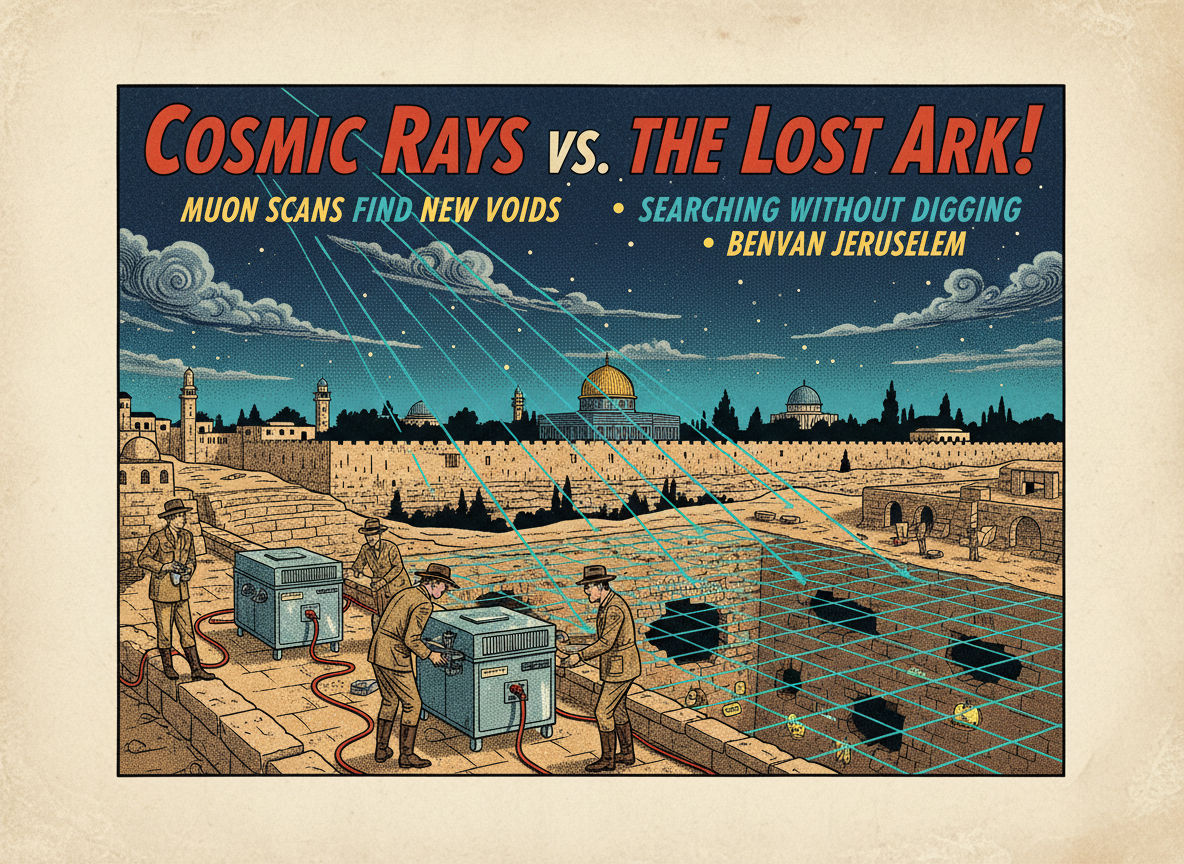
Archaeologist Dr. Chris McKinny has proposed that the Ark of the Covenant may be hidden within underground spaces in the City of David, the ancient settlement immediately south of Jerusalem’s Temple Mount. To investigate without disturbing sacred ground — and without triggering the political, religious, and jurisdictional obstacles that have blocked conventional excavation under the Temple Mount for decades — researchers are using muon detectors: instruments that track subatomic particles produced when cosmic rays from space strike Earth’s atmosphere. These particles penetrate deep underground and can image density variations in buried material, allowing scientists to map hidden chambers and detect large metal objects without digging. Previous muon scans of the area have already confirmed “previously unknown voids and structures” buried beneath the City of David. McKinny released a documentary, Legends of the Lost Ark, on April 7, 2026, proposing three ancient traditions that collectively point to the Ark being deliberately hidden before the Babylonian destruction of Jerusalem in 586 BC.
The Ark of the Covenant, as described in Exodus and subsequent biblical texts, was a rectangular chest of acacia wood overlaid with gold, measuring roughly four feet long, two and a half feet wide, and two and a half feet tall. It contained the tablets of the Ten Commandments and was kept inside the Holy of Holies, the innermost chamber of Solomon’s Temple in Jerusalem. Its last confirmed biblical mention places it in that temple before the Babylonian siege of 586 BC, after which it disappears entirely from the historical record.
What happened to it is one of antiquity’s most enduring open questions. The range of proposed answers spans from the mundane (it was destroyed with the temple) to the geographically ambitious (it’s in Ethiopia, at the Church of Our Lady Mary of Zion in Axum, where priests have claimed to guard it for centuries) to the subterranean (it was hidden beneath Jerusalem itself before the Babylonians arrived).
McKinny’s documentary focuses on three major traditions from ancient Jewish literature and oral history that collectively favor the hidden-beneath-Jerusalem explanation.
The Three Traditions
The first, drawn from Jewish oral tradition and referenced in various Talmudic sources, holds that King Solomon anticipated the eventual destruction of his temple and built a hidden underground chamber accessible only through a complex system of tunnels, into which the Ark was moved when the Babylonian threat became unavoidable. Under this account, the Ark has been beneath the Temple Mount continuously for over 2,500 years.
The second tradition, the “Rock Legend,” draws on accounts suggesting the prophet Jeremiah hid the Ark at a site described as being between two mountains. The third, the Mount Nebo Legend, proposes that Jeremiah took the Ark and other sacred objects to a cave on Mount Nebo in what is now Jordan.
McKinny stops short of claiming he knows where the Ark is. His documentary examines the traditions and their archaeological plausibility, and highlights the emerging technology that may allow investigators to test the underground Jerusalem hypothesis without the political and religious confrontation that conventional excavation would require.
Why Muons Could Change Everything
Muons are byproducts of cosmic ray collisions in Earth’s upper atmosphere. They arrive at the surface constantly and penetrate deep into the earth — through rock, soil, and building foundations — before decaying. The rate at which they are absorbed depends on the density of what they pass through. A void, a chamber, or a large metallic object produces a distinctive signature in the muon flux. Muon detectors placed in and around an area of interest can map what lies beneath in three dimensions, non-invasively.
The same technology was used to discover a previously unknown hidden chamber in the Great Pyramid of Giza in 2017 and has since been applied to multiple archaeological and geological surveys globally.
Researchers have already begun placing muon detectors in the City of David, the settlement immediately south of the Temple Mount that formed the core of ancient Jerusalem. Earlier scans have produced data confirming the presence of previously unknown underground voids and structures — spaces that pre-date current knowledge of the site’s archaeological record.
McKinny expressed optimism that ground-penetrating radar, seismic scanning, electrical resistivity tomography, and muon detection used in combination could eventually map the tunnel network beneath the Temple Mount itself without requiring any physical excavation. The Ark, if it is there, is plated with gold inside and out. Gold is highly distinctive in muon imaging.
The barriers are not primarily technological. Religious authorities control access to the Temple Mount, and Muslim Waqf officials have historically and actively opposed archaeological investigation beneath it, in one documented instance in 1999 removing hundreds of truckloads of excavated soil before Israeli authorities intervened. Those obstacles have not disappeared. But the technology is no longer the limiting factor.
Sources: Unexplained Mysteries — New Underground Scans Could Help to Locate the Ark of the Covenant (April 22, 2026) — Daily Mail / Mogaznews — Ark of the Covenant’s Final Resting Place Pinpointed by Archaeologists as Fresh Search Begins (April 21, 2026) — All Israel News / Charisma — Buried Beneath Time: Could New Technology Reveal the Ark of the Covenant? (April 6, 2026) — WND — New Search Launches for the Bible’s Ark of the Covenant (April 22, 2026)
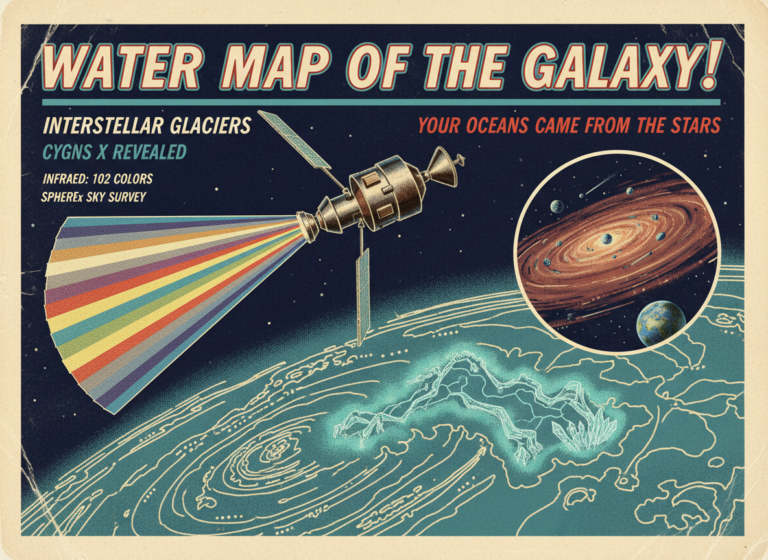
NASA Has Mapped the Water in the Galaxy. The Ocean Beneath Your Feet Came From Out There.
A study published in The Astrophysical Journal on April 15, 2026, based on data from NASA's SPHEREx mission, has produced the first…

A Machine Learning Algorithm Just Found 10,000 Alien Planets Nobody Had Seen Before. They Were Hidden in Data We Already Had.
The current official count of confirmed exoplanets — planets orbiting stars other than our sun — sits at roughly 6,300. It took…

Every Time You Tighten Your Core, Your Brain Gently Swishes Around. That Might Be Keeping You Sane.
When you tighten your abdominal muscles — whether you are walking, standing up from a chair, or doing anything that engages your…
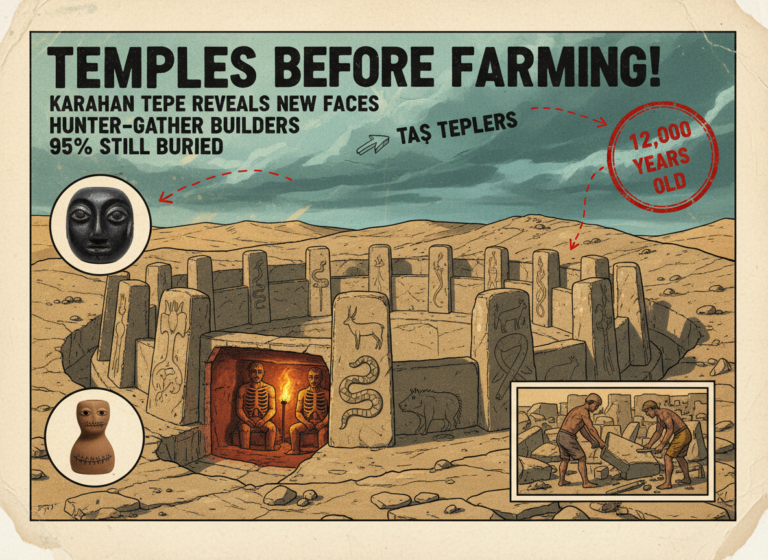
They Built a Temple Complex Before They Had Farming, Writing, or Pottery. New Finds at Karahan Tepe Just Made the Mystery Bigger.
Fresh discoveries at a 12,000-year-old site in Turkey called Karahan Tepe, the possible earliest village in human history, have uncovered more carved…