Original Story
A Six-Month-Old Neanderthal Had the Body of a One-Year-Old Human. Its Brain Was Already Ahead Too.
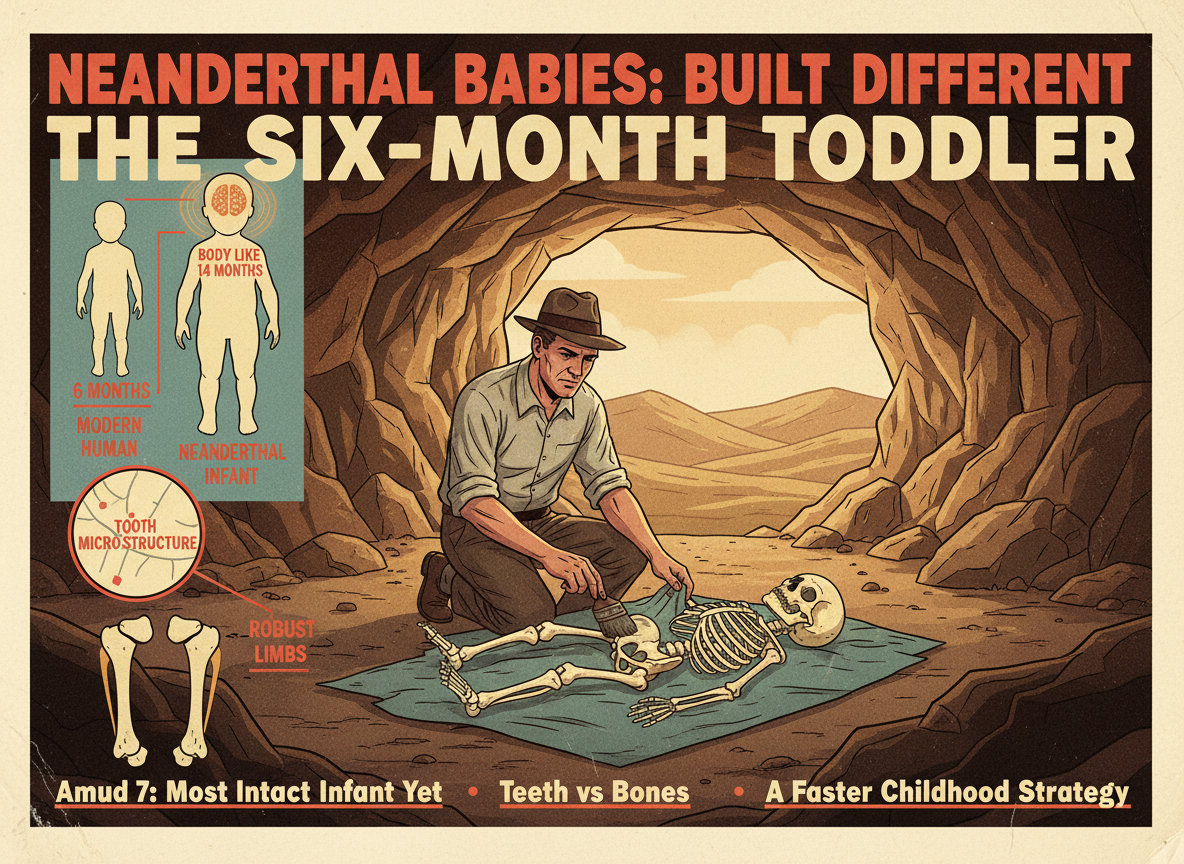
A near-complete infant skeleton from Amud Cave in northern Israel, designated Amud 7 and dating to approximately 51,000 to 56,000 years ago, is the most intact Neanderthal infant ever recovered in this age range. Analysis of its teeth, a reliable marker of developmental age, places the infant at around six months old when it died. Analysis of its limb bones, skull, and overall body size places it at the physical development equivalent of a fourteen-month-old modern human infant. Brain growth was accelerating at the same rate as the body. The discrepancy is not a data error. The study, published in Current Biology in April 2026 and led by Ella Been of Ono Academic College in Israel, documents what appears to be a fundamentally different developmental strategy: Neanderthals grew faster than we do, demanded more energy to do it, and the pattern holds across multiple infant specimens.
Amud Cave sits roughly four kilometers from the western shore of the Sea of Galilee. The site was first excavated in the 1960s and again in the 1990s. Amud 7 was recovered in 1992 — 111 bone fragments, most of them from an infant whose sex remains undetermined. The bones are unambiguously Neanderthal: robust, thick-walled, built to a heavier structural specification than modern human infant bones of comparable developmental age.
The research team analyzed growth markers across multiple tissue types. Dental enamel increments — the daily and weekly growth lines laid down in tooth development — indicated the infant died at approximately six months. The long bones of the arms and legs told a different story: their length and cortical density corresponded to a modern human infant of approximately fourteen months. The skull was also tracking ahead of the dental calendar, suggesting the brain itself was expanding faster than modern human infants at the same chronological age.
“Most notably, the infant exhibits signs of unusually rapid somatic growth,” the researchers wrote in Current Biology, using the technical term for body growth as distinct from organ-specific development, “suggesting that Neanderthals had a distinct developmental strategy in early life.”
Lead author Ella Been put it more directly to New Scientist: “In the first few years of life, from birth through early childhood, Neanderthals grew faster than modern humans.”
Why Faster Growth Made Sense for Neanderthals
The evolutionary logic is available even if the specific mechanisms are still being worked out. Neanderthals lived in Eurasia through the Ice Ages, in environments characterized by brutal cold, fluctuating climate, and demanding physical conditions. A larger, stronger body at an earlier age confers survival advantages in that context: better heat retention — smaller bodies lose heat faster than larger ones — earlier physical independence, faster attainment of the strength required to participate in the cooperative hunting strategies documented at sites like Tinshemet Cave.
The energy cost of this strategy was substantial. Brain and body growth running in parallel and both running ahead of schedule would have required significantly higher caloric throughput from lactating mothers, more intensive provisioning, and a social structure capable of supporting that demand. The Neanderthal dietary record — which shows heavy reliance on large game protein — is consistent with that caloric profile.
What the study clarifies is that this was not an isolated quirk of one individual infant. The researchers compared Amud 7 to other known Neanderthal infant remains and found the same pattern: body growth running ahead of dental development, brain growth tracking with body growth rather than on the more gradual modern human schedule.
Chris Stringer, the Natural History Museum paleoanthropologist who described the Tinshemet Cave discovery earlier this week as “probably going to be the most important finds in the region from the last 50 years,” notes that the Amud 7 evidence fills a critical developmental gap and identifies three distinct growth phases in young Neanderthals. The first phase, covering infancy and early toddlerhood, is characterized by the surge in body and brain growth that Amud 7 now documents.
By approximately age seven, the growth rate differences between Neanderthal and Homo sapiens children appear to diminish, with both species then following a more similar developmental trajectory. The race to physical maturity happened early and fast. After that, apparently, the biology converged.
None of this, as researchers note without quite explaining it, was sufficient to prevent the species from going extinct approximately 40,000 years ago.
Sources: Current Biology — Been et al., Rapid Growth in a Neandertal Infant from Amud Cave in Israel (April 2026) — Phys.org — Baby Neanderthals May Have Had a Rapid Growth Spurt Compared to Modern Babies (April 2026) — ZME Science — Neanderthal Babies Were Apparently Built Different and Reached Toddler Size in Only Six Months (April 18, 2026) — Greek Reporter — Neanderthal Infants Were Much Larger and Grew Faster Than Modern Humans (April 17, 2026) — Futurism — You Are Not Prepared to Learn the Size of Neanderthal Infants (April 2026) — Unexplained Mysteries — Neanderthal Babies Were Larger and Grew Faster Than Human Babies (April 18, 2026)

NASA Has Mapped the Water in the Galaxy. The Ocean Beneath Your Feet Came From Out There.
A study published in The Astrophysical Journal on April 15, 2026, based on data from NASA's SPHEREx mission, has produced the first…

A Machine Learning Algorithm Just Found 10,000 Alien Planets Nobody Had Seen Before. They Were Hidden in Data We Already Had.
The current official count of confirmed exoplanets — planets orbiting stars other than our sun — sits at roughly 6,300. It took…

Every Time You Tighten Your Core, Your Brain Gently Swishes Around. That Might Be Keeping You Sane.
When you tighten your abdominal muscles — whether you are walking, standing up from a chair, or doing anything that engages your…

They Built a Temple Complex Before They Had Farming, Writing, or Pottery. New Finds at Karahan Tepe Just Made the Mystery Bigger.
Fresh discoveries at a 12,000-year-old site in Turkey called Karahan Tepe, the possible earliest village in human history, have uncovered more carved…