Original Story
A 1-Ton Meteor Just Tore Through a Woman’s Bedroom in Houston. This Is the Second Time in One Week.
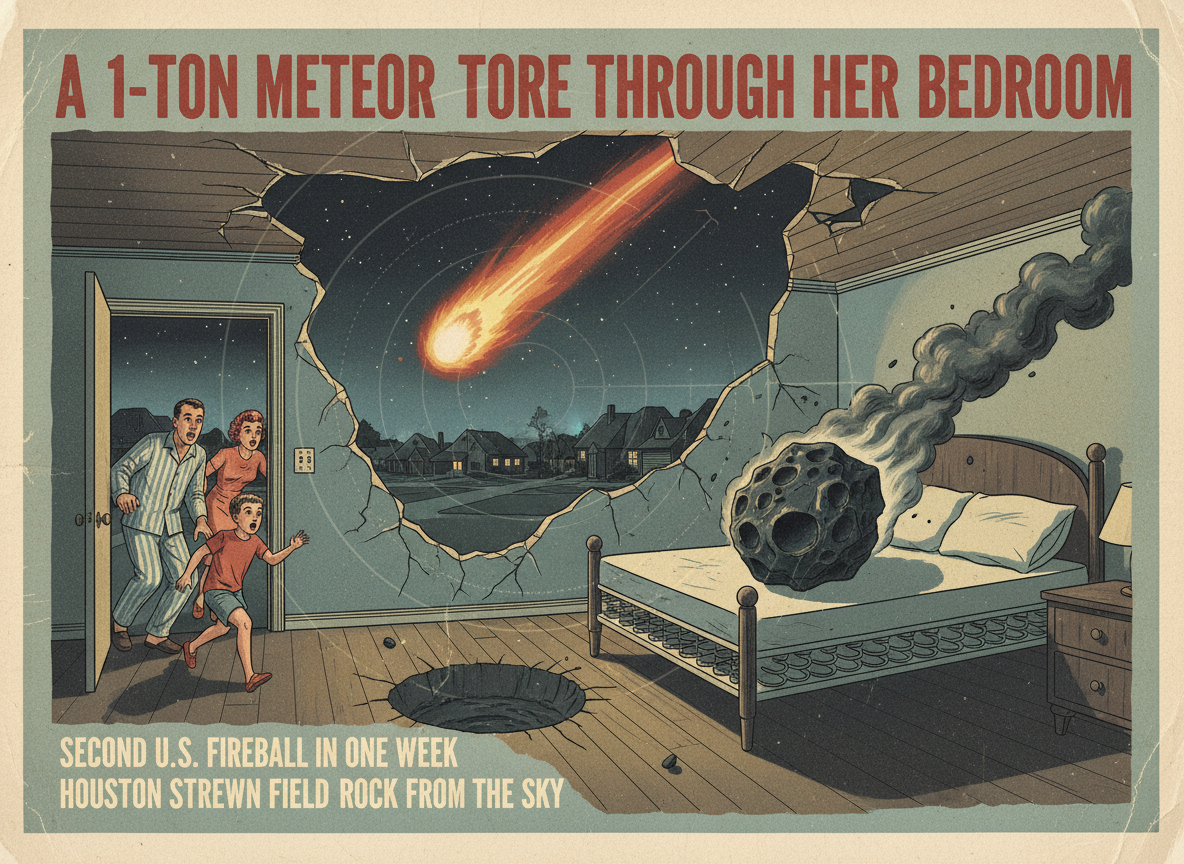
On Saturday March 21, a one-ton meteor traveling at 35,000 miles per hour broke apart over Houston, Texas. A fragment punched through the roof of Sherrie James’s house in Cypress Station, put a hole in her daughter’s bedroom ceiling, dented the floor, and bounced back up to hit the ceiling again. NASA has mapped a strewn field across multiple northwest Houston neighborhoods. This is the second major meteor event over the continental United States in eight days.
Sherrie James was in her bathroom on Saturday afternoon when she heard a boom followed by a thud from her daughter’s room. She went to check. There was a hole in the ceiling. There was a dent in the floor. And on the floor next to her daughter’s bed was a large, black, unusually heavy rock that had not been there before.
“I said, ‘Everybody, back out, get out of the room,'” James told ABC13. “I said, ‘I don’t know what this is, but this might be a meteor.’ I said, ‘I don’t know?’ First thing I did was call the fire department.”
The fire department came, looked at the rock, said it was not a normal rock, and told her it might have fallen from a plane. They came back twenty minutes later after reports of a meteor came in from across the Houston area. The rock in her bedroom, the fire chief said, was almost certainly a fragment of it.
What NASA Found
NASA’s Astromaterials Research and Exploration Science division confirmed the event and published a full account. The meteor first became visible 49 miles above Stagecoach, northwest of Houston, at approximately 4:40 p.m. local time on Saturday. It was traveling southeast at 35,000 miles per hour. Before it broke apart, it measured roughly three feet in diameter and weighed approximately one ton. It fragmented 29 miles above Bammel, just west of Cypress Station.
The fragmentation released the energy equivalent of 26 tons of TNT, roughly the same as a hundred lightning strikes occurring simultaneously. That is what produced the boom that rattled homes across the Houston metropolitan area and prompted hundreds of residents to flood social media with reports of an explosion.
NASA’s Doppler weather radar identified the strewn field, the scatter pattern of surviving meteorite fragments reaching the ground, as running across northwest Houston neighborhoods including Champion Forest, Cypresswood, Cypress Station, and stretching toward the edge of I-45. The agency published a map showing estimated fragment weights by zone, with the heaviest projected fragments concentrated in the Bammel Road corridor.
Fragment hunters have already moved into the area. Meteorite researcher Roberto Vargas, who recovered fragments from the Ohio meteor event eight days earlier, was among those responding. Fragments from falls of this kind can be worth up to $100 per gram on the collector market.
The Second Event in Eight Days
This is not an isolated week for American meteor activity. On March 17, a separate fireball weighing approximately seven tons and measuring six feet across broke apart over northeastern Ohio and parts of Pennsylvania, traveling at 39,200 miles per hour. It fragmented roughly 50 miles above Lake Erie, producing sonic booms across multiple states. That event prompted a meteorite hunt in Sharon Center, Ohio.
Two significant daytime meteor events producing sonic booms over populated areas within eight days of each other is unusual. Whether it represents coincidence, a debris stream intersecting Earth’s orbital path, or simply the reality that the planet is struck by space material far more regularly than most people realize, the sequence has drawn attention from astronomers and fringe researchers alike.
James, for her part, has a straightforward response to having a piece of the solar system land in her daughter’s bedroom: she is keeping the rock, and she bought a lottery ticket.
Sources: NBC News — Meteor streaks across Texas sky before breaking up in fireball — CBS News — Possible meteorite crashes into Houston area home — Houston Public Media — Meteors are more common than you might think — NASA ARES — Houston TX meteorite fall

NASA Has Mapped the Water in the Galaxy. The Ocean Beneath Your Feet Came From Out There.
A study published in The Astrophysical Journal on April 15, 2026, based on data from NASA's SPHEREx mission, has produced the first…

A Machine Learning Algorithm Just Found 10,000 Alien Planets Nobody Had Seen Before. They Were Hidden in Data We Already Had.
The current official count of confirmed exoplanets — planets orbiting stars other than our sun — sits at roughly 6,300. It took…

Every Time You Tighten Your Core, Your Brain Gently Swishes Around. That Might Be Keeping You Sane.
When you tighten your abdominal muscles — whether you are walking, standing up from a chair, or doing anything that engages your…

They Built a Temple Complex Before They Had Farming, Writing, or Pottery. New Finds at Karahan Tepe Just Made the Mystery Bigger.
Fresh discoveries at a 12,000-year-old site in Turkey called Karahan Tepe, the possible earliest village in human history, have uncovered more carved…