Original Story
Scientists Finally Think They Know Why Neanderthals Went Extinct. It Wasn’t Climate Change. It Was Us.
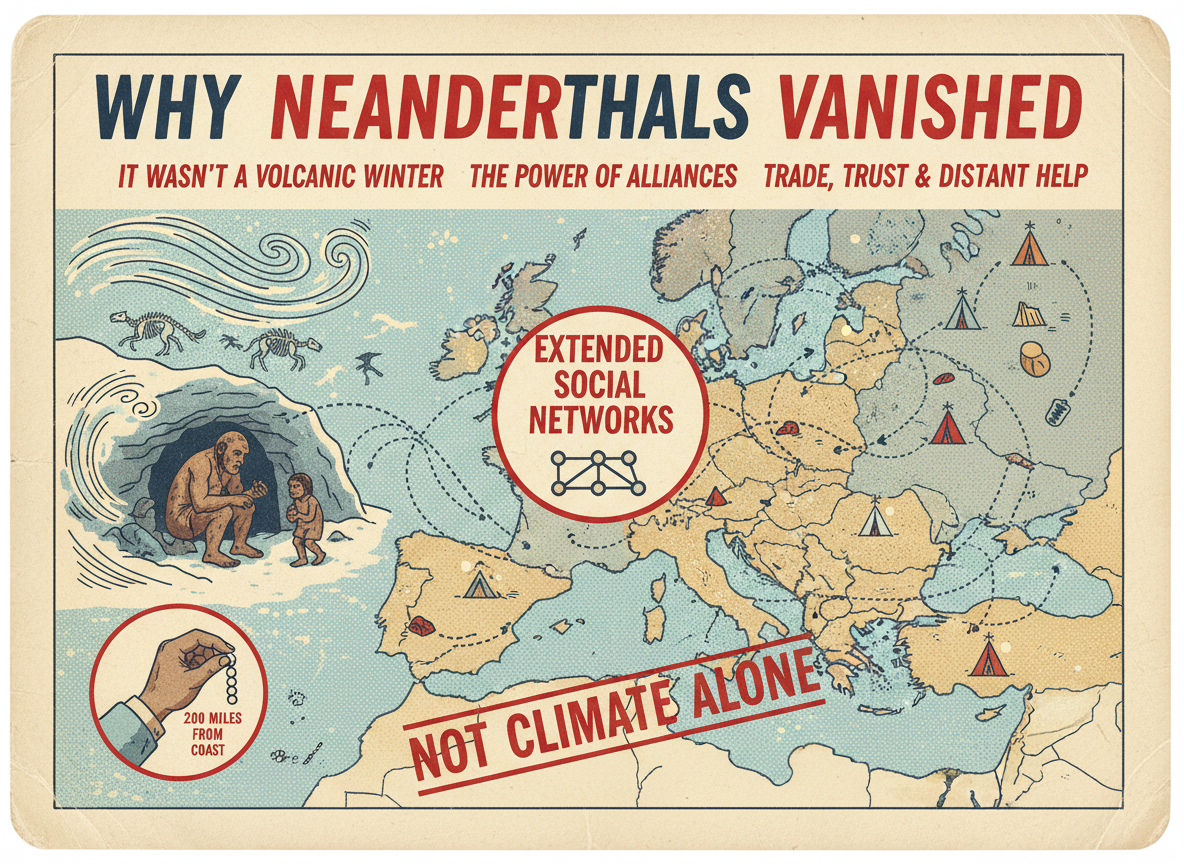
A new study published April 28, 2026, argues that Neanderthals did not go extinct because of a volcanic winter, climate shifts, or disease. They disappeared because modern humans had stronger, more flexible social networks. When the Ice Age got harder, we could call on distant groups for help. They could not.
Neanderthals were not primitive.
This is something scientists have been saying with increasing confidence for years, and the evidence keeps piling up. They used fire. They made tools. They buried their dead. They wore jewelry made from eagle talons. As of May 13, 2026, we now know at least one of them had a root canal 59,000 years ago. They had large brains, complex speech, and may have created art.
And yet, about 40,000 years ago, they were gone.
Modern humans arrived in Europe from Africa sometime around 45,000 years ago. Within about 5,000 years, the Neanderthals who had lived in Europe and western Asia for at least 400,000 years had disappeared. The timing is not subtle. The overlap between modern human arrival and Neanderthal extinction has been obvious to researchers for decades. The debate has always been about the mechanism. What exactly did modern humans do, or what advantage did they have, that resulted in the Neanderthals dying out?
A new study published in the journal Human Evolution on April 28, 2026, proposes the most compelling answer yet, and it has nothing to do with direct violence.
The Social Network Difference
The study argues that the key difference between Neanderthals and modern humans was not intelligence, tool complexity, or physical strength. It was the structure of their social networks.
Modern humans, the study suggests, were connected to each other across much larger geographic distances. They maintained relationships with groups that were not immediate neighbors. They exchanged goods, information, and people over long distances. They had what researchers call extended social networks, meaning they could call on groups dozens or hundreds of miles away when things went wrong.
Neanderthals, the evidence suggests, lived in smaller, more isolated groups. Their social world was local. The groups they interacted with were the groups nearby. When conditions got harder, they had fewer options.
In evolutionary terms, this difference matters enormously when the environment becomes unstable.
The period when Neanderthals went extinct, roughly 45,000 to 40,000 years ago, was also a period of significant climate instability in Europe and western Asia. Temperatures fluctuated. Vegetation zones shifted. The animals that Neanderthals depended on for food moved, reduced in numbers, or changed their patterns. This is exactly the kind of environment where extended social networks provide a decisive advantage.
If one group in a network has a bad hunting season or loses access to a key resource, the extended network can buffer that loss. Other groups can share food, information about better hunting grounds, or knowledge of alternative resources. Isolated groups facing the same crisis have to solve it alone.
The study authors propose that modern humans could form these extended networks because of specific cognitive and communicative abilities that allowed them to maintain relationships with people they did not see regularly. Trust and cooperation across larger distances, the ability to form alliances with strangers and maintain them over time, may have been the critical advantage.
The Evidence Behind the Theory
The archaeological record for this theory comes from comparing what Neanderthals and modern humans left behind.
Modern human sites from this period consistently show what archaeologists call exchange networks: objects made from materials that came from sources far away. Flints from quarries 200 or more miles distant. Shells from coasts hundreds of miles inland. Ornamental objects traded across large distances. These are the physical traces of relationships being maintained across space.
Neanderthal sites, while showing sophisticated tool manufacture, generally show local material sources. The stone they used was typically from nearby outcrops. The range of their material culture was geographically limited compared to what modern humans were doing at the same time.
This is not proof that Neanderthals could not form broader relationships. It is evidence that they generally did not, or that their networks were significantly more constrained than those of modern humans moving into the same regions.
The researchers also point to what happened when Ice Age conditions worsened. Modern human populations contracted and then expanded again as conditions improved, suggesting they had the network resilience to weather hard times and recover. Neanderthal populations, based on genetic evidence of progressive reduction in diversity over their final millennia, show a pattern more consistent with steady decline without recovery.
What Does Not Kill You
It is worth noting what the social network theory says did not cause the Neanderthal extinction, because much of the prior debate has centered on these alternatives.
Climate change alone does not explain it. Neanderthals had survived multiple glacial cycles over 400,000 years. Ice ages came and went. They adapted. The particular instability that overlapped with modern human arrival was not categorically different from what they had survived before.
Disease is also unlikely to be the primary explanation. While the introduction of new pathogens from modern humans into a naive Neanderthal population would have caused mortality, the evidence for it as a primary extinction driver is not strong, and modern humans and Neanderthals clearly coexisted long enough to interbreed successfully. If modern humans carried diseases that were immediately lethal to Neanderthals, the crossover populations would not have been viable.
Direct warfare is possible but remains unconfirmed by the archaeological record. There is no compelling physical evidence of sustained, systematic violence between the two groups at the scale required to explain extinction.
The social network theory does not require any of these as primary drivers. It simply requires that modern humans, when times got hard, had more people to call on. And Neanderthals did not.
It is, in a way, the most mundane explanation for one of history’s most dramatic disappearances. Not fire, not plague, not conquest. Just connection. Modern humans were better at staying in touch.
Whether that makes the story more or less haunting is a question each reader will answer differently.
Sources: ScienceDaily, Scientists Think They Finally Know Why Neanderthals Vanished, April 28, 2026, Wikipedia, Neanderthal Extinction, Wikipedia, Neanderthal, NPR, Neanderthals May Have Drilled Out a Cavity 59,000 Years Ago (for context on Neanderthal intelligence), May 13, 2026
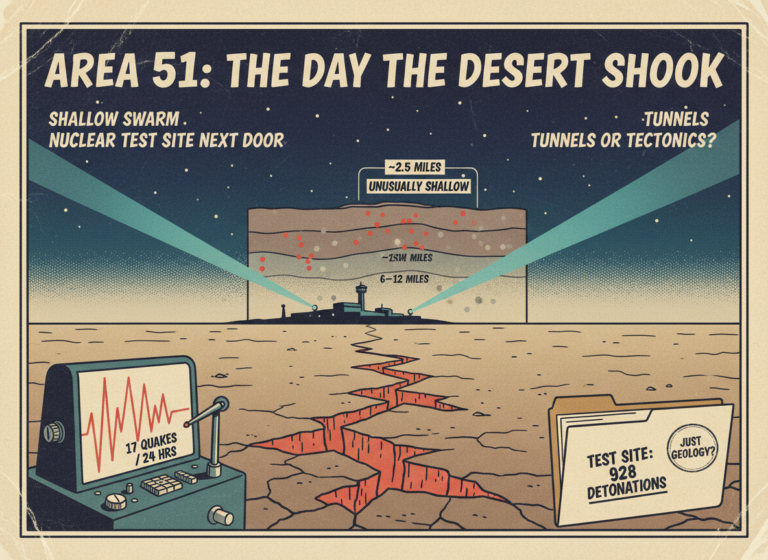
Area 51 Had 17 Earthquakes in One Day. Scientists Have an Explanation. Nobody Fully Believes It.
On April 30, 2026, at least 17 earthquakes struck within 24 hours near the most secretive military base in the United States.…
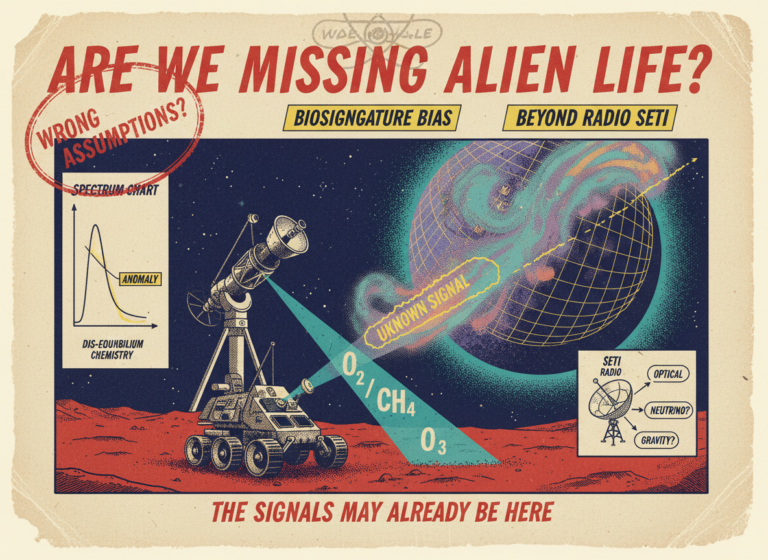
NASA Admits It May Be Looking for Alien Life the Wrong Way. The Signals Could Already Be Here.
A study published in the International Journal of Astrobiology and flagged by Unexplained Mysteries on May 21, 2026, contains a warning from…
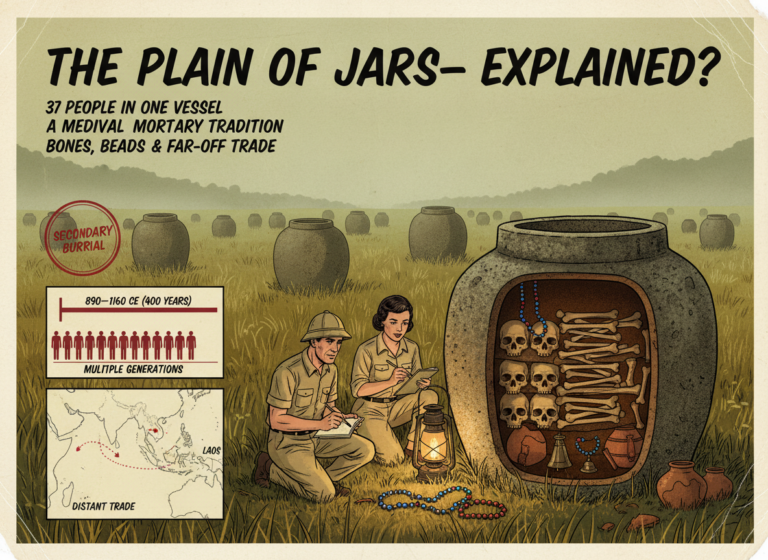
A Stone Jar in Laos Held the Bones of 37 People Across 400 Years. It May Finally Explain What the Plain of Jars Was For.
In the highlands of northeastern Laos, scattered across mountain plateaus and grassy plains, there are thousands of enormous stone jars. The largest…
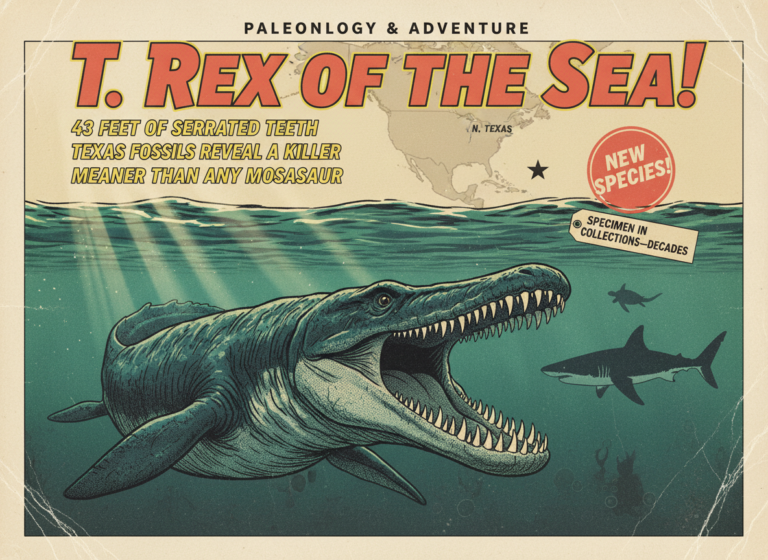
Scientists Just Named a New Sea Monster After T. Rex. It Was Twice as Long as a Great White and "Meaner Than Any Mosasaur."
A 43-foot marine reptile that patrolled the shallow seas covering what is now northern Texas 80 million years ago has been formally…