Original Story
Scientists Just Named a New Sea Monster After T. Rex. It Was Twice as Long as a Great White and “Meaner Than Any Mosasaur.”
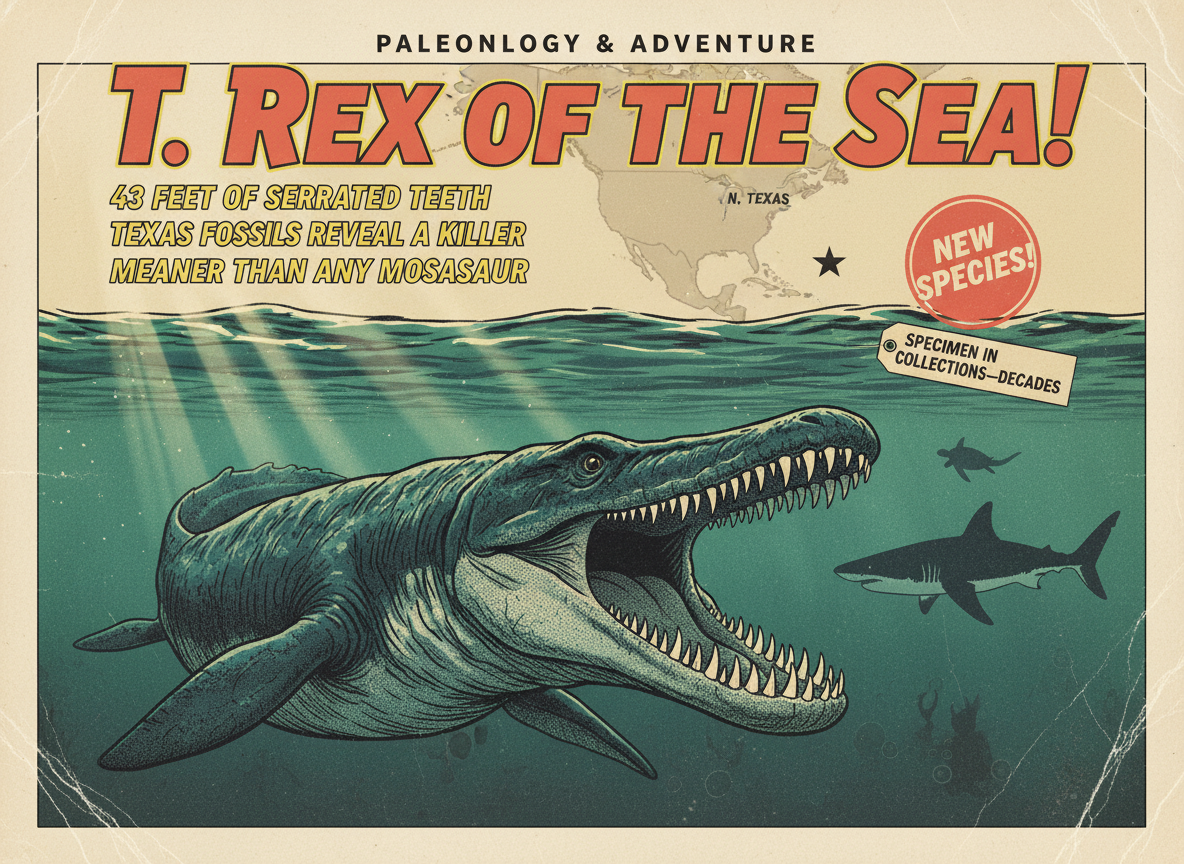
A 43-foot marine reptile that patrolled the shallow seas covering what is now northern Texas 80 million years ago has been formally identified as a brand new species — and named Tylosaurus rex. The name is deliberate. Tylosaurus rex, or T. rex for short, is an homage to the iconic Tyrannosaurus rex, but the two animals are not related. Tylosaurus was a mosasaur, a family of ocean-going scaled reptiles that were the dominant sea predators of the Late Cretaceous period. This new species, described in a study published May 21, 2026, in the Bulletin of the American Museum of Natural History, is one of the largest mosasaurs ever identified. It had finely serrated teeth unlike those of any known mosasaur, jaw and neck musculature suggesting exceptional biting power, and a body roughly twice the length of the largest great white sharks alive today. The researchers describe it simply as “meaner than any other mosasaur.” The fossils that revealed it were sitting in museum collections for decades. Nobody had looked at them closely enough until now.
The Western Interior Seaway was one of the most extraordinary bodies of water that has ever existed on Earth. During the Late Cretaceous period — roughly 100 to 66 million years ago — a shallow inland sea split North America down the middle, running from what is now the Arctic in the north to the Gulf of Mexico in the south. States that are now hundreds of miles from the ocean, including Kansas, Nebraska, and Texas, sat at the bottom of this seaway. It was warm, relatively shallow, and packed with life. Enormous plesiosaurs with long necks swam through it. Giant turtles three times the size of anything alive today cruised its shallows. Fish grew to the size of school buses. And at the top of all of it, ruling the water column as absolutely as T. rex ruled the land, were the mosasaurs.
Mosasaurs were not dinosaurs and not fish. They were scaled, air-breathing reptiles closely related to monitor lizards, which had transitioned to a fully aquatic lifestyle. Their bodies were streamlined and their limbs had evolved into flippers. The largest of them were genuine sea monsters by any reasonable measure.
Tylosaurus rex is a new addition to that already impressive group — and not a modest one.
Why It Was Hiding in Plain Sight
The fossils that became Tylosaurus rex were discovered in northern Texas in the late 19th and early 20th centuries, including a holotype specimen first found in 1979 along the shores of Lake Ray Hubbard near Dallas. For decades, these specimens were classified as Tylosaurus proriger, the most common and best-known tylosaurid mosasaur, whose remains are primarily from Kansas and date to roughly 84 million years ago.
Lead author Amelia Zietlow, a research associate at the American Museum of Natural History who is now at the History Museum at the Castle in Wisconsin, began examining the Texas specimens more carefully and noticed that they were both larger than typical T. proriger and consistently different from it in a cluster of anatomical details. The teeth were serrated in a way not previously seen in the genus. The jaw and neck attachments indicated musculature substantially more powerful than comparable T. proriger specimens. And the Texas specimens were geologically about four million years younger than the Kansas material, suggesting a separate, younger lineage.
“The holotype for the newly described Tylosaurus rex is a giant specimen displayed at the Perot Museum that was first discovered in 1979 along an artificial reservoir near Dallas,” the researchers wrote. Two other famous mosasaur specimens now join it in the new species: “Bunker,” a massive individual on display at the University of Kansas since 1911, and “Sophie,” which has been on display at the Yale Peabody Museum. Both were previously called T. proriger. They are now T. rex.
What Made It Meaner
The distinguishing features that set Tylosaurus rex apart from its cousins point to a predator that was built specifically for force rather than speed. Co-author Ron Tykoski of the Perot Museum described the physical case directly: “Besides being huge, roughly twice the length of the largest great white sharks, Tylosaurus rex appeared to be a much meaner animal than other mosasaurs.”
The finely serrated teeth are the most immediately striking detail. Serrated teeth in a predator function differently from smooth teeth. A smooth tooth concentrates force at the tip and is efficient for puncturing. A serrated tooth — like a steak knife — applies force in multiple small cutting edges along its length, allowing it to slice through tough material as it moves through it. In a predator of this size, serrated teeth suggest prey requiring sustained cutting force rather than puncture-and-grip prey capture. Possible targets included giant sea turtles, large fish, plesiosaurs, and other mosasaurs.
The robust jaw and neck musculature adds to the picture. A prey item strong enough to require exceptional grip and enough force to prevent escape — rather than a quick strike-and-bite — is a prey item that required this level of physical adaptation to reliably subdue.
What Remains Unknown
The naming of Tylosaurus rex resolves the taxonomic question — these specimens now have a proper scientific identity — but leaves others open. Where did T. rex fit in the mosasaur family tree relative to T. proriger? Did the two species overlap in range and time, or did T. rex replace T. proriger as the lineage shifted south and younger? How widespread was T. rex’s range, and are there more specimens in Texas collections still waiting to be identified?
“Everything is bigger in Texas,” Zietlow said, “and that includes the mosasaurs, apparently.”
The holotype specimen is currently on display at the Perot Museum of Nature and Science in Dallas. Whatever it was doing 80 million years ago in the warm, shallow sea that covered north Texas, it was not doing it gently.
Sources: [Bulletin of the American Museum of Natural History — Zietlow et al., A Gigantic New Species of Tylosaurus (Squamata: Mosasauridae) from Texas (May 21, 2026). DOI: 10.1206/0003-0090.482.1.1] — Phys.org — Ancient Seas Get a New T. rex as Massive Mosasaur Emerges from Texas Fossils (May 21, 2026) — CW33 Dallas — Massive Mosasaur Tylosaurus rex Identified in Texas (May 21, 2026) — Sci.News — T. rex Mosasaur Ruled the Seas 80 Million Years Ago (May 21, 2026) — Eurasia Review — New Species of Massive Mosasaur with Serrated Teeth is Named T. rex (May 22, 2026) — The Brighter Side of News — This Giant Predator Is Literally the T. rex of the Sea (May 21, 2026) — Western Morning News — Scientists Discover New Marine T-Rex Twice the Size of Great Whites (May 22, 2026) — Unexplained Mysteries forum — Ancient Seas Get a New T. rex as Massive Mosasaur Emerges from Texas Fossils (May 22, 2026)
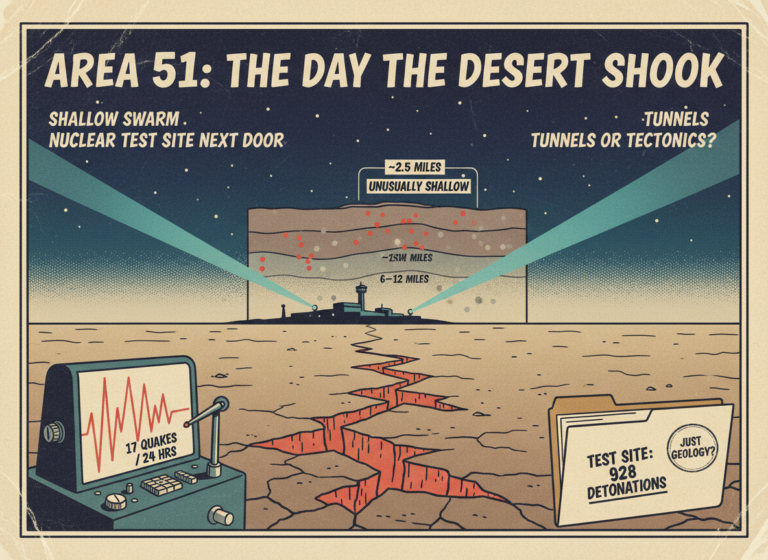
Area 51 Had 17 Earthquakes in One Day. Scientists Have an Explanation. Nobody Fully Believes It.
On April 30, 2026, at least 17 earthquakes struck within 24 hours near the most secretive military base in the United States.…

NASA Admits It May Be Looking for Alien Life the Wrong Way. The Signals Could Already Be Here.
A study published in the International Journal of Astrobiology and flagged by Unexplained Mysteries on May 21, 2026, contains a warning from…

A Stone Jar in Laos Held the Bones of 37 People Across 400 Years. It May Finally Explain What the Plain of Jars Was For.
In the highlands of northeastern Laos, scattered across mountain plateaus and grassy plains, there are thousands of enormous stone jars. The largest…
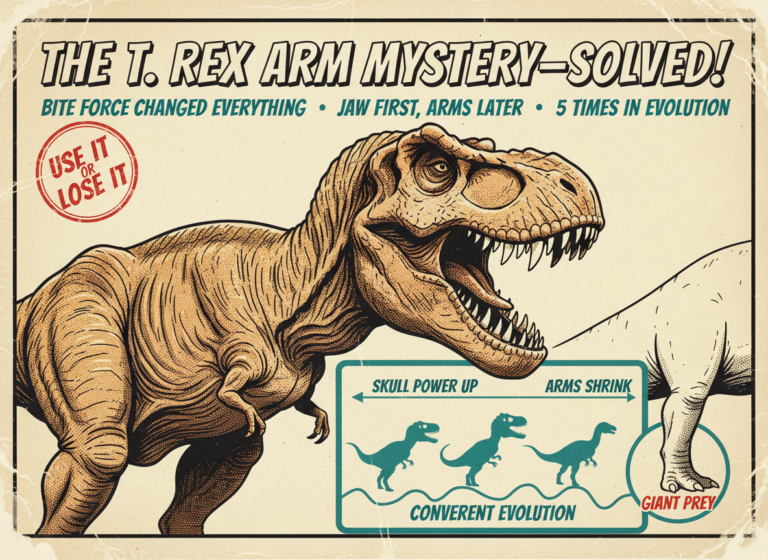
The T. Rex Arm Mystery Is Solved. The Jaws Got So Good That the Arms Became Useless. Then They Got Smaller.
T. rex had the most famous bad arms in the history of life on Earth. Two feet long on a 40-foot animal.…