Original Story
NASA Admits It May Be Looking for Alien Life the Wrong Way. The Signals Could Already Be Here.
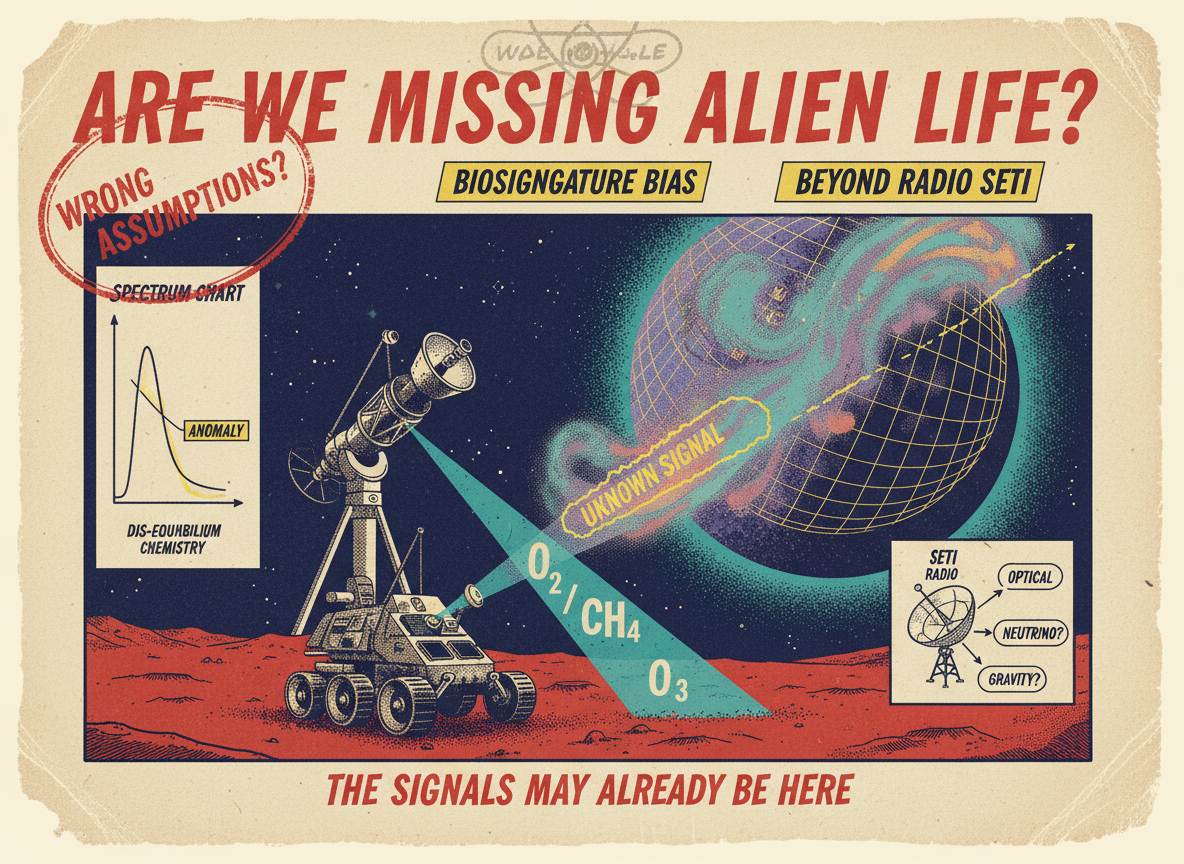
A study published in the International Journal of Astrobiology and flagged by Unexplained Mysteries on May 21, 2026, contains a warning from a team of scientists that is uncomfortable to absorb: the instruments currently being used on space missions to search for signs of extraterrestrial life may be systematically missing the very signals they are looking for. The problem is not a technical failure. It is a conceptual one. Our instruments are designed to look for biosignatures — chemical signs of life — that match the biology we already know. Life on other worlds, if it exists, may not produce those same signatures. In fact, it may produce nothing that any of our current instruments are calibrated to detect. The search for life in the universe, in other words, may be decades into the wrong methodology.
To understand what the paper is actually saying, it helps to start with what biosignatures are and why they matter.
A biosignature is any chemical, physical, or structural signal that indicates the presence of life. On Earth, the clearest biosignatures in our atmosphere are gases like oxygen, methane, and ozone — products of biological processes that would not accumulate in their current concentrations without living systems continuously producing them. NASA’s missions to Mars, the Cassini-Huygens mission to Saturn and its moons, and the James Webb Space Telescope’s atmospheric characterization programs are all, in part, looking for these kinds of chemical signatures in the environments of other worlds.
The problem the new paper identifies is that this approach assumes life elsewhere will produce chemistry similar to life on Earth. That assumption is not obviously wrong — carbon-based biochemistry and water-based solvents are genuinely well-suited to life — but it is an assumption, not a confirmed fact. If life on another world uses a different solvent, a different elemental basis, or a different metabolic pathway, it may produce entirely different waste products. And those waste products may be invisible to instruments calibrated specifically for oxygen, methane, and ozone.
The More Uncomfortable Version of the Problem
The paper does not stop at the biosignature detection gap. It extends the argument to include what the researchers describe as “technosignatures” — signs not of biological life but of technological civilization. Radio waves. Laser pulses. Megastructure-scale engineering. Artificial light on a planet’s night side.
Current SETI — the Search for Extraterrestrial Intelligence — is tuned primarily to narrow-band radio signals in specific frequency ranges, based on the assumption that a technological civilization would use radio communication in the same frequency ranges that humans use. The paper notes that this assumption relies on a specific picture of what technological development looks like and how long it is maintained. A civilization that has moved beyond radio communication — to laser-based optical transmission, gravity wave communication, or something humans have not conceived of — would be completely invisible to current radio-telescope search programs regardless of how powerful those programs were.
The authors use a pointed analogy: searching for alien intelligence with radio telescopes is similar to a civilization that only uses smoke signals trying to detect a city by looking for campfire smoke from orbit. The city is real, the inhabitants are communicating, and none of the smoke-signal detectors will ever find them.
What Should Be Done Instead
The paper proposes expanding the search methodology in several specific directions. More aggressive atmospheric analysis by James Webb and future telescopes, looking for disequilibrium chemistry rather than specific known gases — any chemistry that seems inconsistent with purely abiotic processes, whether or not it matches Earth-life signatures. Expansion of SETI to include optical, neutrino, and gravitational wave bands as detection technology develops. And, most provocatively, a systematic reassessment of unexplained anomalies already in existing datasets — instances where instruments detected something that did not fit known physical or chemical models and was set aside rather than further investigated.
That last proposal is the one that makes the paper relevant to the UFO disclosure context of May 2026. The authors do not mention UAP directly. But the implicit argument — that humans may have been detecting signals they were not conceptually prepared to recognize and were therefore systematically filing under “anomaly” rather than “contact” — has an obvious resonance with the current moment, when the US government has just published 162 declassified records showing eight decades of credible encounters with objects performing physics-defying maneuvers that the government has never satisfactorily explained.
“Our instruments are tools built from our assumptions,” the paper states. “If those assumptions are wrong, our tools will find nothing — not because nothing is there, but because we are not looking correctly.”
The signals might already be here. The methodology for finding them may not exist yet.
Sources: [International Journal of Astrobiology — Scientists Warn That Space Missions May Be Missing Signs of Alien Life (2026)] — Unexplained Mysteries — Space Missions Could Be Missing Signs of Alien Life, Scientists Warn (May 21, 2026)
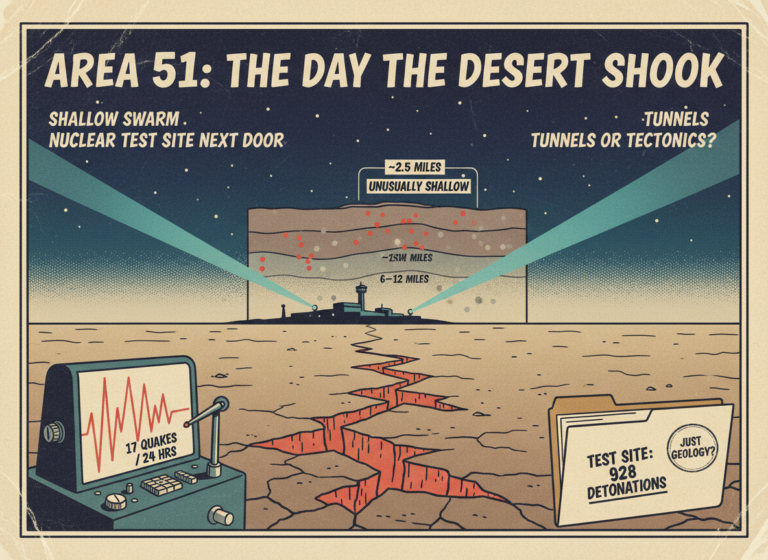
Area 51 Had 17 Earthquakes in One Day. Scientists Have an Explanation. Nobody Fully Believes It.
On April 30, 2026, at least 17 earthquakes struck within 24 hours near the most secretive military base in the United States.…

A Stone Jar in Laos Held the Bones of 37 People Across 400 Years. It May Finally Explain What the Plain of Jars Was For.
In the highlands of northeastern Laos, scattered across mountain plateaus and grassy plains, there are thousands of enormous stone jars. The largest…

Scientists Just Named a New Sea Monster After T. Rex. It Was Twice as Long as a Great White and "Meaner Than Any Mosasaur."
A 43-foot marine reptile that patrolled the shallow seas covering what is now northern Texas 80 million years ago has been formally…

The T. Rex Arm Mystery Is Solved. The Jaws Got So Good That the Arms Became Useless. Then They Got Smaller.
T. rex had the most famous bad arms in the history of life on Earth. Two feet long on a 40-foot animal.…