Original Story
Area 51 Had 17 Earthquakes in One Day. Scientists Have an Explanation. Nobody Fully Believes It.
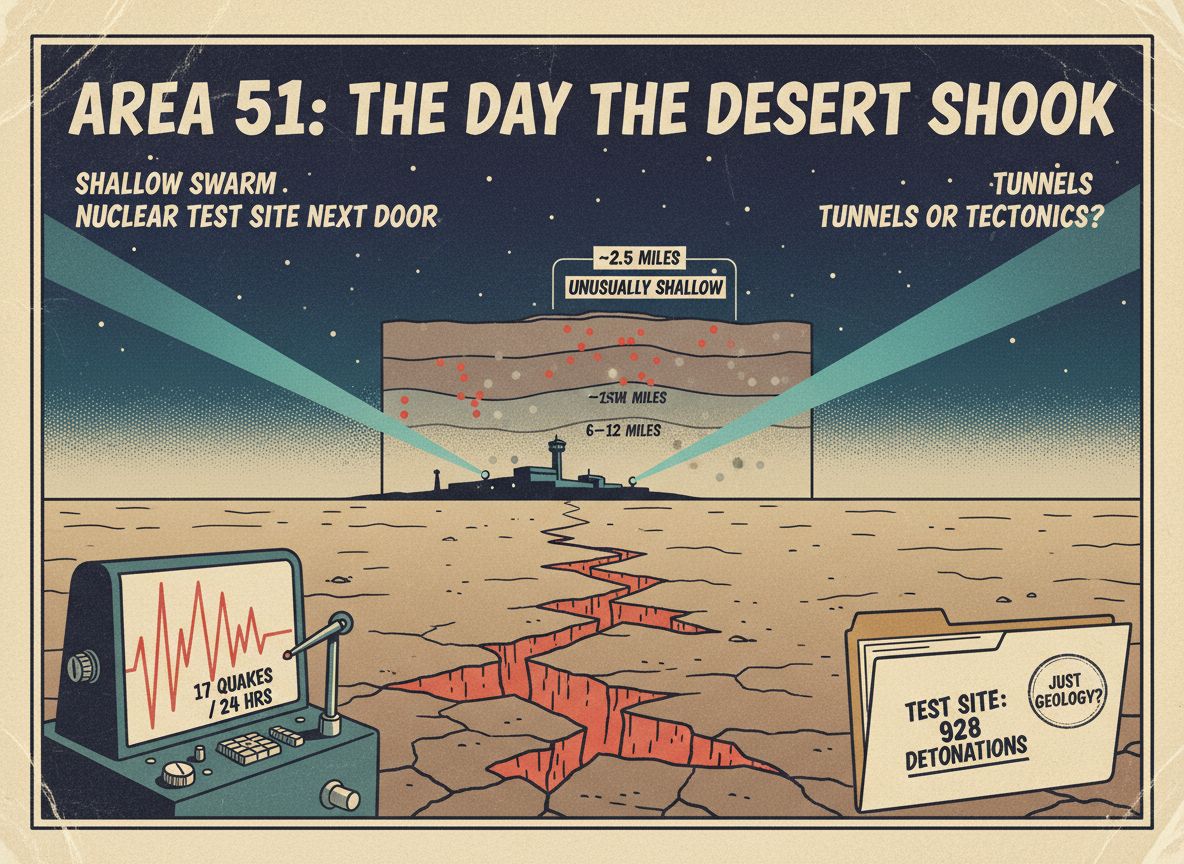
On April 30, 2026, at least 17 earthquakes struck within 24 hours near the most secretive military base in the United States. The quakes were unusually shallow. The Nevada Test Site next door hosted over 900 nuclear tests between 1951 and 1992. President Trump has reportedly discussed restarting underground tests. The USGS says it is normal geology. Amateur sleuths are not convinced.
On April 30, 2026, something started shaking the ground near Area 51.
Over the course of roughly 24 hours, at least 17 earthquakes struck within a few miles of the Nevada Test and Training Range, the classified U.S. Air Force installation known to the world as Area 51 and to insiders as Groom Lake or Dreamland. The quakes ranged in magnitude from 2.5 to 4.4. More than 100 people across the region reported feeling them. None were strong enough to cause structural damage. All of them were unusually shallow.
That last part is what made people pay attention.
Most earthquakes in Nevada and the surrounding region originate between 6 and 12 miles below the surface. These quakes came from approximately 2.5 miles underground. That is shallow enough to prompt questions. Geophysicist Stefan Burns told Popular Science that the strongest event in the cluster struck in “an unusual place to get an earthquake.”
The U.S. Geological Survey provided the geological explanation: Nevada’s crust is slowly stretching apart as part of the Basin and Range Province, a broad region of the American West where tectonic forces are gradually pulling the ground in opposite directions. That stretching creates faults, and faults produce earthquakes. USGS research geologist Christopher DuRuss confirmed this is a known, normal process. The Nevada region regularly produces seismic events as a result.
That explanation is accurate. It is also, given the location and timing, not quite enough to satisfy everyone.
Why This Location Is Never “Just Geology”
Area 51 is not a random stretch of Nevada desert. It is the most secretive military installation in the United States, possibly in the world.
The Nevada National Security Site, which sits directly adjacent to the Groom Lake facility, hosted 928 nuclear test detonations between 1951 and 1992. That includes both atmospheric tests, which were banned by international treaty in 1963, and underground tests, which continued until a voluntary moratorium in 1992. The underground tests were designed specifically to be contained below the surface. They detonated nuclear devices in tunnels and shafts bored into the desert rock, absorbing the blast underground rather than releasing it into the atmosphere.
Underground nuclear tests produce seismic signatures. Monitoring them was, in fact, how the international community verified treaty compliance. The Comprehensive Nuclear-Test-Ban Treaty Organization, which operates a global network of monitoring stations specifically designed to detect nuclear detonations, has equipment sensitive enough to detect explosions as small as a fraction of a kiloton anywhere on Earth.
That network is still running. It would detect an underground nuclear test.
But the existence and sensitivity of that monitoring network does not mean the U.S. could not conduct a test that fell below its detection threshold, or that the monitoring network captures absolutely everything. And the timing of the April 30 cluster carries context that makes the standard geological explanation feel insufficient to a significant portion of the people who follow this area closely.
The Nuclear Testing Connection
President Trump has made public statements about restarting American nuclear testing on multiple occasions. Most recently in October 2025, he raised the subject again. The last remaining nuclear arms treaty between the U.S. and Russia, the New START treaty, expired in February 2026 without a replacement. The legal architecture that governed nuclear testing and monitoring for decades has partially collapsed.
Reversing 40 years of global precedent on underground testing would require significant preparation. Popular Science reported that geologists and arms control experts estimated at least 36 months of infrastructure preparation would be needed at the Nevada Test Site before any test could take place. That would mean preliminary work, whatever form it took, would need to have started by now.
The most prominent internet theory circulating after the April 30 cluster did not center on testing at all, however. It focused on tunneling. The idea that the U.S. government has been constructing underground facilities, tunnels, and possibly what some describe as underground cities using nuclear-powered drilling machines has been a persistent feature of fringe military commentary for decades. Nuclear-powered boring machines, which theoretically could use a small reactor to melt through rock rather than mechanically boring it, have been patented. Whether any such device has ever been built and deployed underground is not publicly confirmed.
Joerg Arnu, who created dreamlandresort.com and has spent years observing and documenting activity near Area 51, put the institutional position simply: “They have years and years and decades of experience hiding things.”
What Actually Causes Shallow Earthquake Clusters
The geological explanation deserves a fair hearing, because it is well-documented.
Nevada is one of the most seismically active states in the contiguous United States. The Basin and Range Province, which covers the state, is defined by parallel mountain ranges and flat valleys created by tectonic stretching. As the crust extends, it thins and fractures along fault lines. These faults produce frequent, shallow earthquakes. The region around Groom Lake sits within this active tectonic environment.
Shallow earthquake swarms, in which multiple quakes occur in a concentrated area over a short period, are a recognized geological phenomenon. They can be triggered by fluid movement in faults, stress redistribution following a larger regional quake, or gradual fault creep. None of these require human activity.
The USGS has seismic monitors throughout Nevada and would have detected any seismic signature inconsistent with natural tectonic activity. There is no indication from the USGS or the CTBTO that the April 30 cluster produced signatures inconsistent with natural causes.
None of that resolves the feeling that a cluster of 17 unusually shallow earthquakes near the most secretive military base in America, during a period when nuclear treaty architecture has collapsed and the president has discussed restarting underground tests, deserves more than a standard geological press release as an explanation.
The ground shook near Area 51. The official answer is Nevada geology. The unofficial answer space remains, as it always has around Groom Lake, wide open.
Sources: Popular Science, Area 51 Just Had 17 Earthquakes in a Single Day, May 1, 2026, The Daily Beast, Area 51 Earthquakes in Nevada Spark Conspiracy Theories, May 1, 2026, NewsNation, Unusually Shallow Earthquakes Strike Near Area 51, April 30, 2026, Yahoo News, Area 51 Had Almost 20 Earthquakes in Just One Day, May 4, 2026, American Thinker, 17 Quakes in 1 Day: What’s Happening at Area 51?, May 4, 2026
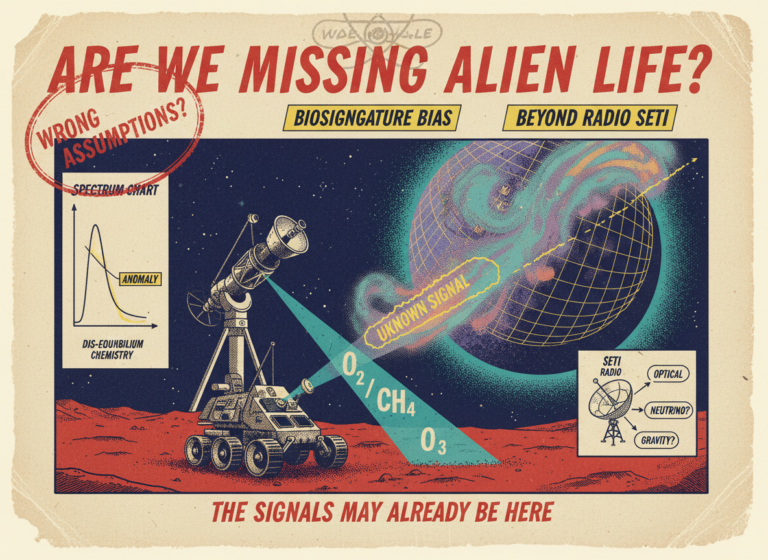
NASA Admits It May Be Looking for Alien Life the Wrong Way. The Signals Could Already Be Here.
A study published in the International Journal of Astrobiology and flagged by Unexplained Mysteries on May 21, 2026, contains a warning from…
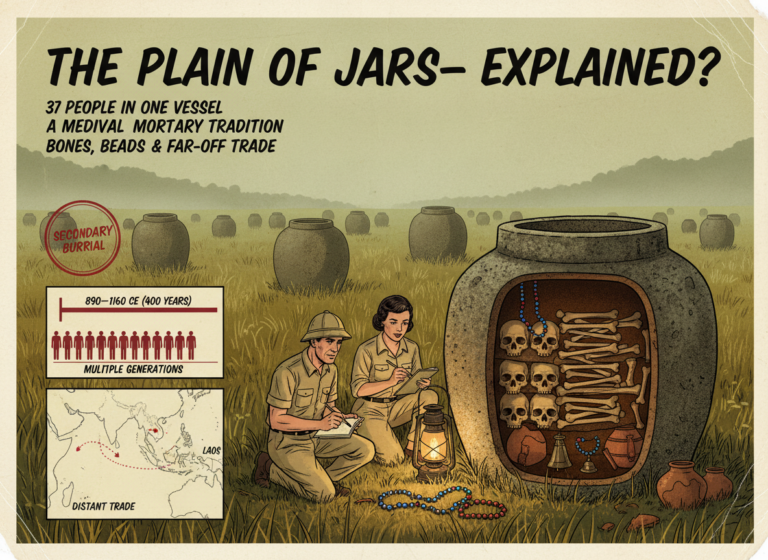
A Stone Jar in Laos Held the Bones of 37 People Across 400 Years. It May Finally Explain What the Plain of Jars Was For.
In the highlands of northeastern Laos, scattered across mountain plateaus and grassy plains, there are thousands of enormous stone jars. The largest…

Scientists Just Named a New Sea Monster After T. Rex. It Was Twice as Long as a Great White and "Meaner Than Any Mosasaur."
A 43-foot marine reptile that patrolled the shallow seas covering what is now northern Texas 80 million years ago has been formally…
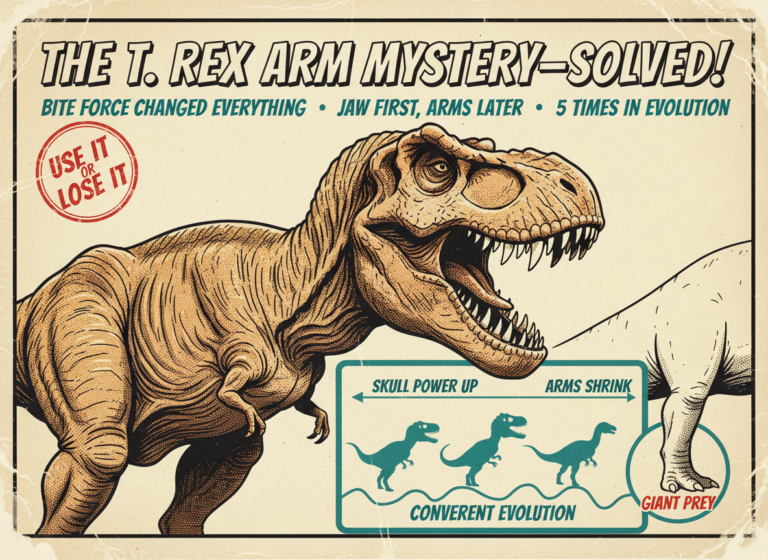
The T. Rex Arm Mystery Is Solved. The Jaws Got So Good That the Arms Became Useless. Then They Got Smaller.
T. rex had the most famous bad arms in the history of life on Earth. Two feet long on a 40-foot animal.…