Original Story
A Stone Jar in Laos Held the Bones of 37 People Across 400 Years. It May Finally Explain What the Plain of Jars Was For.
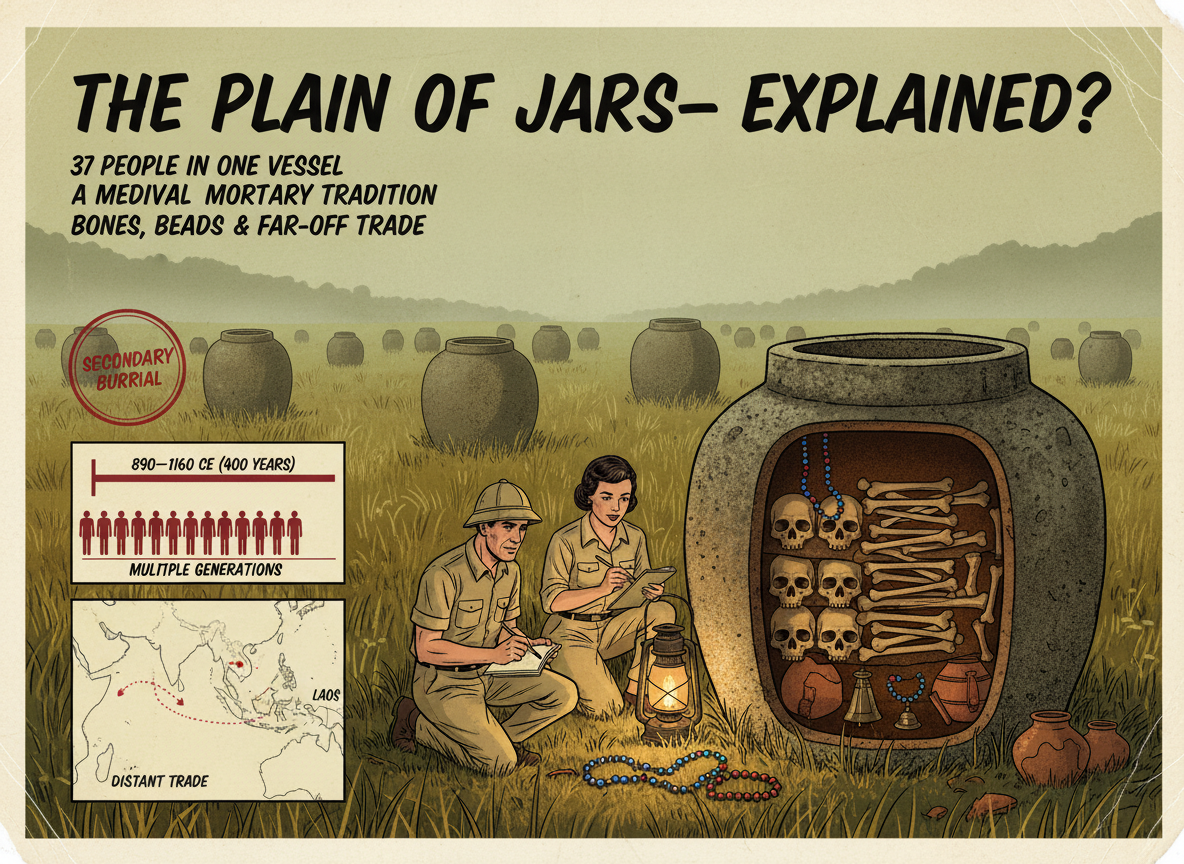
In the highlands of northeastern Laos, scattered across mountain plateaus and grassy plains, there are thousands of enormous stone jars. The largest stand three meters tall — nearly ten feet — and weigh as much as 32 tons. They were carved from single blocks of sandstone and dragged from quarries up to ten kilometers away by people whose identity, exact time period, and cultural practices are almost entirely unknown. The French archaeologist Madeleine Colani conducted the first serious survey of the site in the 1930s and suspected the jars were used for burials. For almost a century after her work, that remained an unconfirmed hypothesis, because almost none of the jars had been found to contain enough remains to prove it definitively. Then a team from Australia and Laos excavated the largest jar at a previously unstudied site called Jar Site 75 — and found 37 people inside it, deposited there across roughly 400 years, from the 9th century to the 13th century CE. A new study published in the journal Antiquity in May 2026 may have cracked the mystery wide open.
Before the new discovery can be fully understood, it helps to know what the Plain of Jars actually looks like and why it has resisted explanation for so long.
The site is not a single location. It is a zone spanning thousands of square kilometers across the Xieng Khouang plateau in north-central Laos, comprising more than 100 individual jar sites, each containing clusters of the massive stone vessels ranging from a handful of jars to more than 600. More than 2,100 jars have been formally documented by UNESCO, which designated the Plain of Jars a World Heritage Site. The jars vary enormously in size. Some are modest, under a meter tall. Others are the three-meter behemoths that dominate photographs of the site.
The scale of the construction effort required to produce them is genuinely staggering. A 32-ton block of sandstone does not move by accident or by small effort. The organization required to quarry it, transport it, and install it in a highland landscape — with tools and logistics from what appears to have been an Iron Age or early medieval culture — represents a community investment comparable to the megalithic stone structures of Europe. And unlike Stonehenge, which has received intensive archaeological study for generations, the Plain of Jars was largely inaccessible for most of the 20th century due to a different kind of hazard: it sits in one of the most heavily bombed regions of Laos from the Vietnam War era, and unexploded ordnance still covers much of the landscape. Systematic excavation has only been possible since 2004, when portions of the site were cleared.
What Was Inside the Jar
The primary jar at Jar Site 75 measures 1.3 meters high and more than 2 meters wide — large enough to walk into if it were accessible — and was found to contain the disarticulated skeletal remains of at least 37 individuals. The remains were not buried all at once. Radiocarbon dating of the bones shows they were deposited over roughly 400 years, between approximately 890 CE and 1160 CE. Multiple generations of dead, placed into the same vessel across four centuries of continuous use.
The disarticulation of the bones is itself significant. Many of the skeletons were not intact — bones had been separated from the rest of the skeleton before being placed in the jar. This is the signature of a practice called secondary burial: bodies were first placed somewhere else to decompose, and then the bones — selected ones, or all of them — were later moved into the permanent stone vessel.
Lead researcher Nicholas Skopal of James Cook University described the discovery’s scope: “The big jar we’ve found is unique, and I’ve seen a lot of jars.” His team also found artifacts inside the primary jar and in surrounding smaller vessels: tools, earthenware ceramics, a copper-based bell, and glass beads. The chemical analysis of those artifacts produced a result that surprised the researchers: some of the materials were made in India and Mesopotamia. A community practicing multi-generational secondary burial in the highlands of Laos in the 10th and 11th centuries was connected by trade to people thousands of miles away.
What the Mystery Still Does Not Answer
The new discovery strengthens the burial hypothesis substantially — the funerary interpretation now has both physical evidence and a plausible cultural framework. But it does not close every question.
The largest jars at the most famous Plain of Jars sites — the clusters around Phonsavan that Colani surveyed — remain unexplained in detail. Were they all used the same way? Different sites across the plateau show different patterns of associated artifacts and skeletal evidence. The practice of secondary burial may have varied in its specifics across different communities and different centuries.
Who made the jars — which culture, which ethnic group — remains open. The 9th to 13th century dates at Jar Site 75 push the culture into what Skopal describes as “more of a medieval culture,” not the Iron Age context that had dominated earlier interpretations. Why jar production eventually stopped, whether due to shifting religious practices, political disruption, or something else, is not known.
A local legend has persisted for centuries: the jars were made by giants to brew rice wine for a celebration after a great battle. Whatever else the 37 people inside the stone jar at Jar Site 75 were, they were not wine. They were a community’s dead, placed there across four hundred years by people who believed something would persist after the body was gone.
Sources: [Antiquity — Skopal et al., The Death Jar: A New Mortuary Tradition at the Plain of Jars, Lao PDR (2026). DOI: 10.15184/aqy.2026.10352] — Live Science — 1,200-Year-Old Giant “Death Jar” in Laos Contains Generations of Human Skeletons (May 2026) — Smithsonian Magazine — A Trove of Bones and Teeth Yields New Clues to the Mystery of Death Jars in Laos (May 2026) — Science News — A Jar Jammed with Human Bones May Solve Laos’ Plain of Jars Mystery (May 2026) — Ancient Origins — A Jar Jammed with Human Bones May Solve Laos’ Mystery (May 2026) — Archaeology Magazine — Massive Jar in Laos Contained Remains of 37 People (May 20, 2026) — James Cook University — Ancient Burial Practices in Laos’ Mysterious Plain of Jars (May 2026) — Unexplained Mysteries — Major Discovery Yields New Clue in Mystery of Plain of Jars in Laos (May 21, 2026)
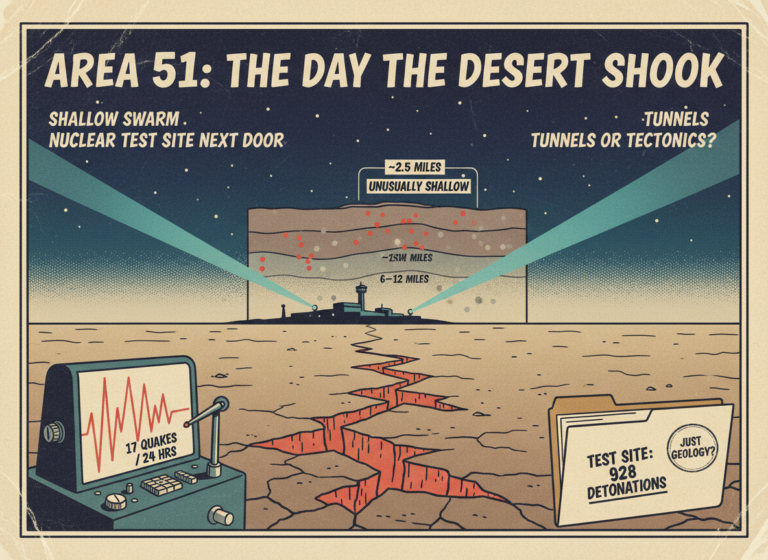
Area 51 Had 17 Earthquakes in One Day. Scientists Have an Explanation. Nobody Fully Believes It.
On April 30, 2026, at least 17 earthquakes struck within 24 hours near the most secretive military base in the United States.…

NASA Admits It May Be Looking for Alien Life the Wrong Way. The Signals Could Already Be Here.
A study published in the International Journal of Astrobiology and flagged by Unexplained Mysteries on May 21, 2026, contains a warning from…

Scientists Just Named a New Sea Monster After T. Rex. It Was Twice as Long as a Great White and "Meaner Than Any Mosasaur."
A 43-foot marine reptile that patrolled the shallow seas covering what is now northern Texas 80 million years ago has been formally…

The T. Rex Arm Mystery Is Solved. The Jaws Got So Good That the Arms Became Useless. Then They Got Smaller.
T. rex had the most famous bad arms in the history of life on Earth. Two feet long on a 40-foot animal.…