Original Story
People in the Congo Are Reporting a Living Dinosaur More Than Ever. Scientists Think They Know Why, and It Is Not What You Want to Hear.
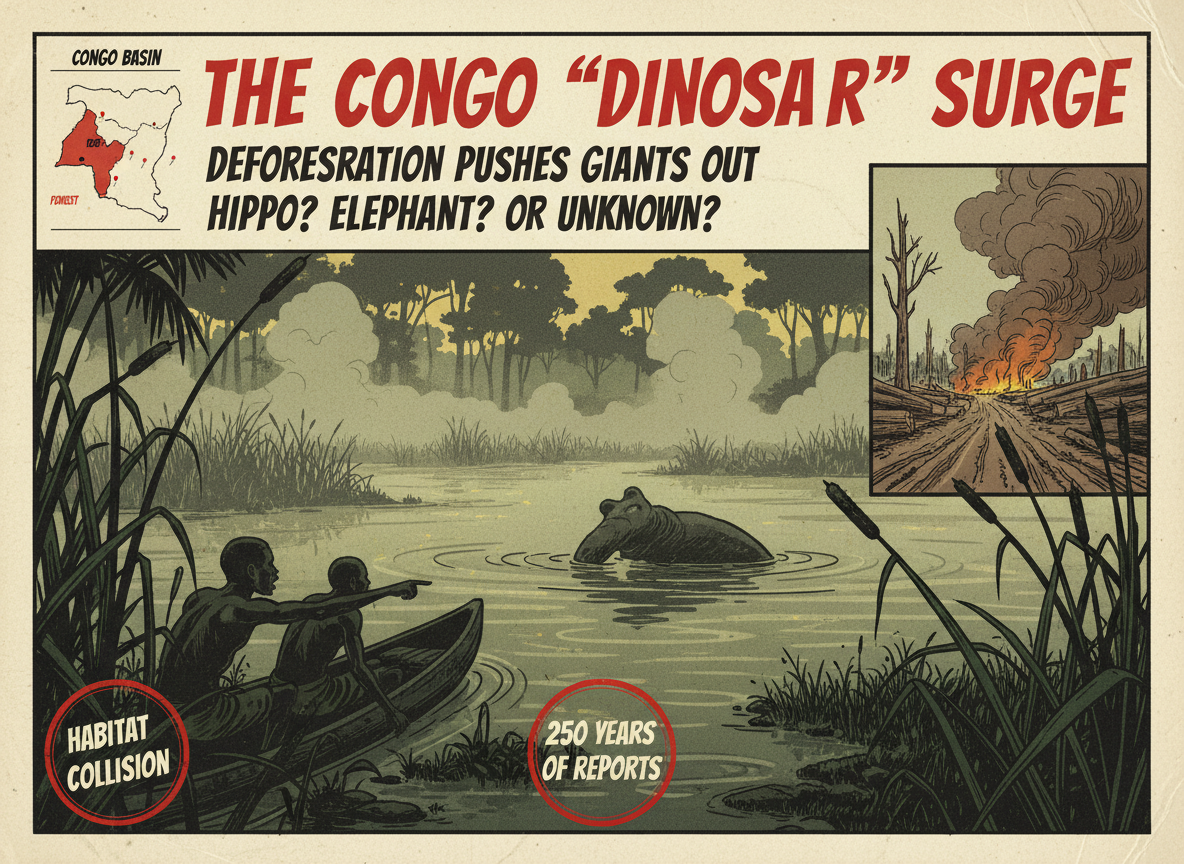
For 250 years, communities across the Congo River Basin have described a massive semi-aquatic creature with the body plan of a sauropod dinosaur. Western expeditions have found the testimony consistent and detailed. In 2025 and 2026, sighting reports are accelerating. Scientists say the surge is directly tied to 23 million hectares of deforestation forcing large, unknown animals into contact with human settlements. It still may not be a dinosaur. But something is happening in those forests.
In the Republic of the Congo, in the Likouala swamp region, there is a creature that locals call Mokele-Mbembe.
The name roughly translates to “the one who stops the flow of rivers” in the Lingala language. The description given by communities throughout the Congo Basin has been remarkably consistent for more than 250 years of recorded accounts. A massive semi-aquatic animal. A long flexible neck. A body the size of an elephant. A tail like an alligator’s. Brownish-gray skin. A creature that can overturn boats and is genuinely feared by the people who live along the rivers and lakes of the region.
The description matches a sauropod dinosaur.
Sauropods, in case you need the reminder, went extinct approximately 66 million years ago along with the non-avian dinosaurs when the asteroid hit. That is the scientific consensus, and it is supported by the global fossil record. No confirmed sauropod remains have been found in Cenozoic geological layers, meaning the layers deposited in the last 66 million years.
And yet, the sightings continue.
More than that: they are accelerating. In 2025 and 2026, researchers and conservationists working in the Congo Basin have reported an increase in Mokele-Mbembe accounts from local communities, specifically from people living in areas where the forest is being cut down at historically unprecedented rates.
Where the Sightings Come From
The earliest documented European accounts of Mokele-Mbembe come from French missionaries working in the region in the late 18th century. These missionaries were not seeking monster stories. They were describing what local communities told them about the natural world, and the creature appears in those accounts as a matter-of-fact feature of the local landscape.
In 1913, German Captain Ludwig Freiherr von Stein zu Lausnitz conducted a survey of German colonial territories in what is now Cameroon and recorded detailed descriptions of the creature from multiple unrelated communities. His report was suppressed by the colonial government, possibly because it was considered embarrassing. It was later recovered and published.
The 20th century produced a series of Western expeditions specifically aimed at finding physical evidence of the creature. The most credible and rigorous was led in 1981 by herpetologist Dr. Roy Mackal, who had previously done serious work on the Loch Ness Monster, and cryptozoologist James Powell. They traveled deep into the Likouala swamp region, conducted extensive interviews with local communities, and collected consistent, detailed testimony from multiple independent witnesses. They found no body, no bones, no photograph. They returned convinced that the witness accounts were genuine reports of something, but unable to say what.
In 1992, a Japanese film crew reportedly captured footage of something large moving through Lake Tele, the area most frequently associated with Mokele-Mbembe sightings. The footage was too poor in quality to be useful as evidence.
Since then, sightings have continued but received little Western media attention. Until recently.
The Deforestation Connection
This is where the 2025-2026 surge in sightings gets its most important context.
According to Czech conservationist Laura Vlachova, who works in and around Odzala-Kokoua National Park in the Republic of the Congo, the increase in Mokele-Mbembe sightings tracks directly with the acceleration of deforestation in the region. The Congo Basin has lost approximately 23 million hectares of forest cover in recent decades, with the rate accelerating year after year. As the forest shrinks, the animals that live in the deep interior, animals that have had essentially no contact with human settlements for generations, are being pushed toward the edges of their habitat.
“In bigger settlements where habitats are being pushed into and people aren’t used to seeing large animals, they’re suddenly encountering them all the time,” Vlachova told National Geographic. “It’s these people who tell me they’ve seen mokele-mbembe. I think what it really shows is how folklore is starting to reflect the reality of a shrinking ecosystem.”
Her explanation, which is the mainstream scientific consensus for the sighting increase, is that people unfamiliar with the large animals of the deep forest are encountering them for the first time as habitat loss pushes those animals into new areas. A hippopotamus moving through unfamiliar terrain at dusk. An elephant moving through flooded forest. A large crocodile in an unexpected location. In each case, a person who has never seen such an animal before, and who has heard the Mokele-Mbembe stories all their life, is providing the cognitive framework that makes those encounters feel like a match.
The long neck that some witnesses describe could be an elephant’s trunk moving through tree cover. The capsized boats associated with Mokele-Mbembe encounters are consistent with territorial hippopotamus behavior, which genuinely kills more people in Africa each year than almost any other animal.
What That Explanation Does Not Fully Account For
The “misidentified large animals” explanation is reasonable and probably accounts for a significant portion of sightings. It does not account for all of them.
The core problem is the consistency of the description across 250 years of witnesses who had no contact with each other and, in many cases, no prior exposure to Western paleontology or dinosaur imagery. The sauropod body plan, which is what Mokele-Mbembe is described as having, is not a generic large animal template. A hippo does not have a long flexible neck and a small head. A crocodile does not have an elephant-like body. The specificity of the traditional description is unusual for something that is supposed to be a composite misidentification of multiple known species.
The fossil record does not support a living sauropod. That is a fact. But the fossil record is not complete. The coelacanth, a fish believed to have been extinct for 65 million years, was found alive in 1938. The megamouth shark, a large deep-water species, was unknown to science until 1976. Large animals have been discovered hiding in plain sight before.
The Paranormal Observer, a community-driven paranormal intelligence platform, noted in May 2026 that the accelerating sightings reports from the Congo Basin have been cross-referenced against the documented deforestation maps. The overlap is significant but not perfect. Some of the highest-credibility accounts continue to come from communities in areas that have not yet seen significant deforestation, meaning the population of people who grew up with deep forest animals and know what they look like.
The Congo Basin remains one of the largest underexplored wilderness areas on Earth. Its swamp regions are genuinely difficult to access. Most of Lake Tele and the Likouala region has never been systematically surveyed by biologists with modern equipment.
If a large, unknown animal did exist in that ecosystem, it would be there that it would be found.
No one has found it yet. But it is worth asking why, after 250 years of consistent, independent, geographically dispersed reports of the same creature with the same body plan, we have not yet conducted a modern, well-equipped, properly funded scientific survey of the one place on Earth most likely to contain it.
Sources: Unexplained Mysteries, Sightings of the Enigmatic Mokele-Mbembe Are Reportedly on the Rise, March 2025, IFLScience, Sightings of the Legendary Mokele-Mbembe Dinosaur of the Congo Are Increasing, March 2025, SYFY Wire, The Congo River Basin’s Dinosaur-Like Mokele-Mbembe, Explained, Paranormal Observer, Congo Basin Cryptid Update, May 6, 2026, New Lines Magazine, The Congo’s Dinosaur of Discord, Spring 2025
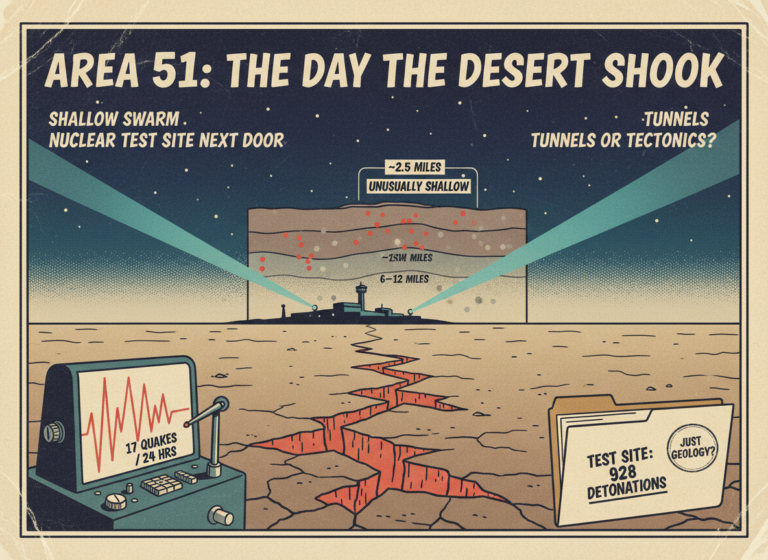
Area 51 Had 17 Earthquakes in One Day. Scientists Have an Explanation. Nobody Fully Believes It.
On April 30, 2026, at least 17 earthquakes struck within 24 hours near the most secretive military base in the United States.…
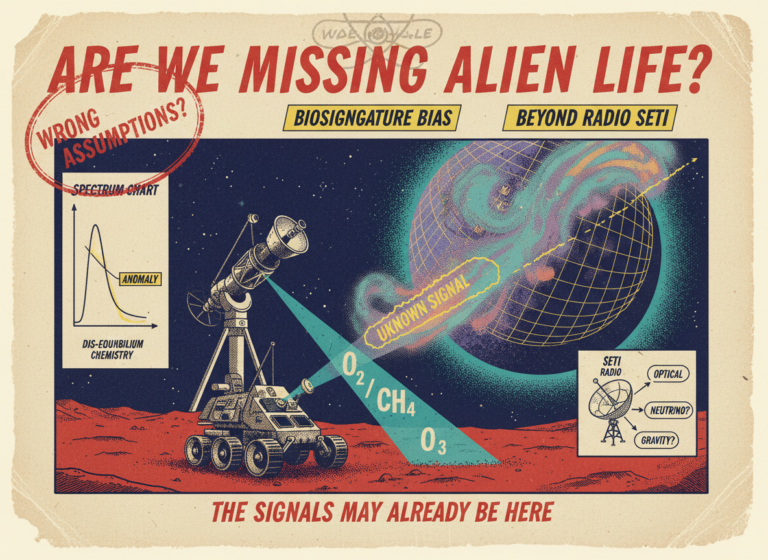
NASA Admits It May Be Looking for Alien Life the Wrong Way. The Signals Could Already Be Here.
A study published in the International Journal of Astrobiology and flagged by Unexplained Mysteries on May 21, 2026, contains a warning from…
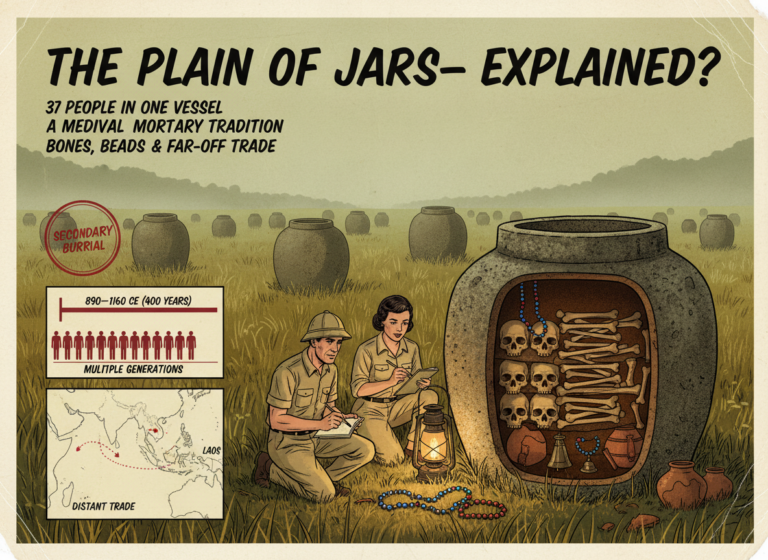
A Stone Jar in Laos Held the Bones of 37 People Across 400 Years. It May Finally Explain What the Plain of Jars Was For.
In the highlands of northeastern Laos, scattered across mountain plateaus and grassy plains, there are thousands of enormous stone jars. The largest…
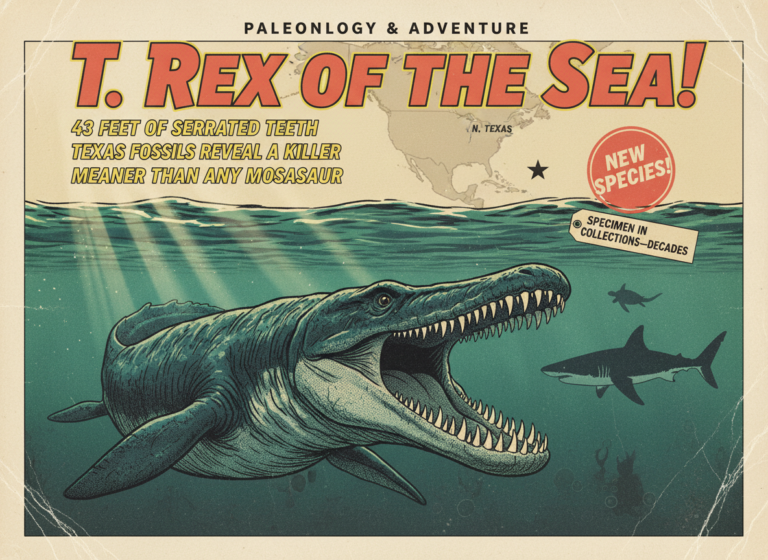
Scientists Just Named a New Sea Monster After T. Rex. It Was Twice as Long as a Great White and "Meaner Than Any Mosasaur."
A 43-foot marine reptile that patrolled the shallow seas covering what is now northern Texas 80 million years ago has been formally…