Original Story
The T. Rex Arm Mystery Is Solved. The Jaws Got So Good That the Arms Became Useless. Then They Got Smaller.
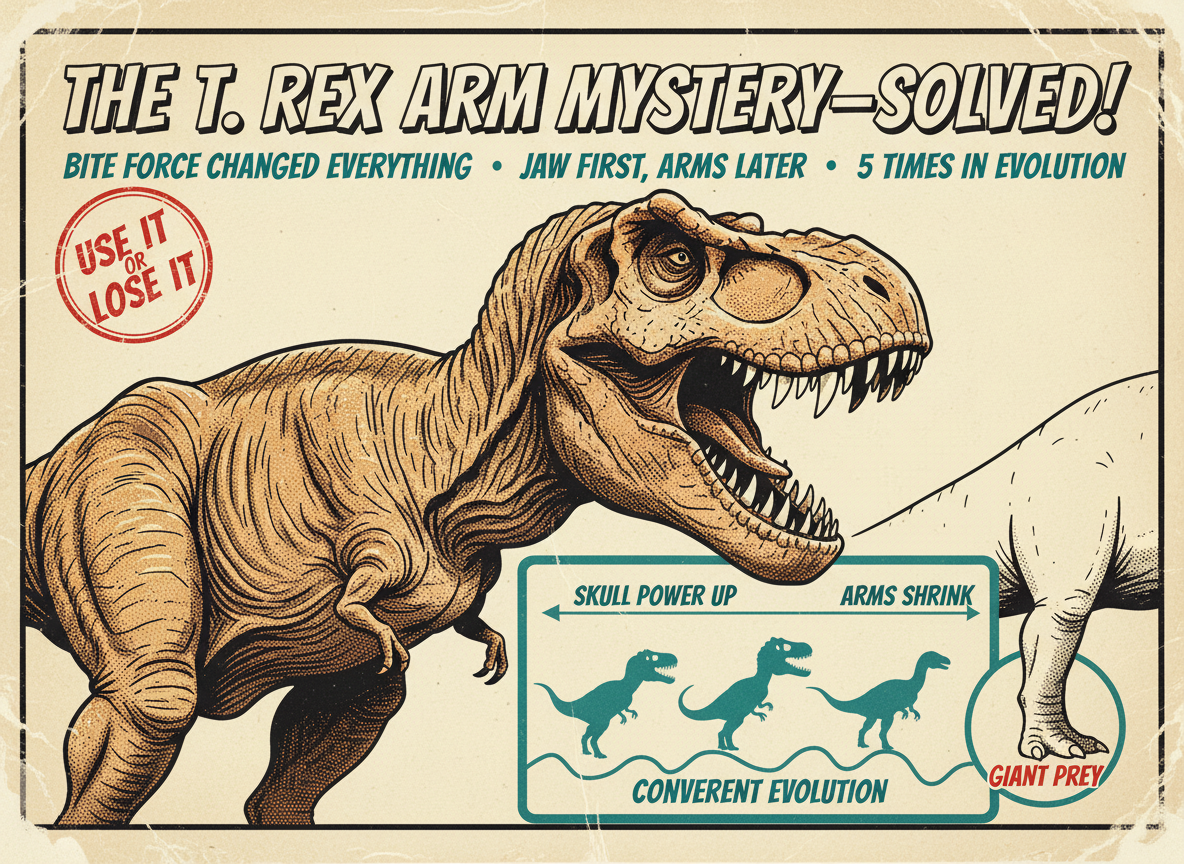
T. rex had the most famous bad arms in the history of life on Earth. Two feet long on a 40-foot animal. Clawed but barely functional at the scale of the body they were attached to. Unable to reach its own mouth. Too short to push itself off the ground from a prone position. For more than a century, paleontologists have been proposing and discarding theories about why. Now a study published May 20, 2026, in the Proceedings of the Royal Society B by a team from University College London and the University of Cambridge has produced what lead author Charlie Scherer describes as the clearest answer yet. It was not one thing. It was the jaw. As giant theropod dinosaurs like T. rex developed increasingly powerful, robust skulls and crushing bite forces to take down increasingly massive prey, their forelimbs stopped being the primary killing tool. Once the arms stopped being needed for killing, evolution stopped maintaining them. “Use it or lose it,” Scherer said. “The arms are no longer useful and reduce in size over time.”
The tiny arms of T. rex have not been mysterious because no one had ideas. The problem has been that too many ideas were plausible and none could be definitively tested against the fossil record. The arms were used for mating displays. The arms were used for holding prey while biting. The arms were used to push the animal upright from the ground. The arms shrank to prevent accidental amputation when multiple tyrannosaurs fed simultaneously on a single carcass — an idea proposed by UC Berkeley paleontologist Kevin Padian in 2022, who reasoned that shorter arms were safer arms when surrounded by the bone-crushing jaws of your fellow pack members. All of these ideas had some merit. None was clearly supported over the others.
The UCL and Cambridge team took a different approach. Instead of asking what T. rex used its arms for, they asked what pattern appears across all the large theropod dinosaurs that evolved reduced forelimbs — and then whether any consistent biological variable predicts when and how that reduction happened.
The Dataset
The research team analyzed 82 theropod species — the broad group of two-legged, mostly meat-eating dinosaurs that includes T. rex, Velociraptor, Carnotaurus, Carcharodontosaurus, Spinosaurus, and ultimately birds. They measured forelimb proportions across this dataset and correlated them with skull robustness — a new metric developed for this study that combined skull dimensions, bone connectivity patterns, and estimated bite force into a single composite score.
The correlation was clear. Across multiple independent lineages of large theropods, short arms and robust skulls reliably appeared together. More specifically, skull robustness and bite force strengthened before the arms shortened significantly. The sequence matters. As lead author Scherer explained: “It would not make evolutionary sense for it to occur the other way round, and for these predators to give up their attack mechanism without having a backup.”
The skull — not the arms — became the primary weapon first. Then the arms shrank.
The Convergent Evolution Finding
What makes the study particularly striking is that this happened multiple times independently. T. rex belongs to the tyrannosaur family. Carcharodontosaurus and its relatives belong to a completely separate family — the carcharodontosaurids. Abelisaurids, a third major group of large theropods, also evolved reduced forelimbs. These three groups are not closely related to each other. They evolved reduced arms through entirely separate evolutionary and developmental pathways.
In tyrannosaurs, the reduction appears to have affected the entire forelimb relatively evenly. In carcharodontosaurids and abelisaurids, the reduction pattern differs — it concentrated more in specific limb segments. Same result, different mechanism. This is the pattern that biologists call convergent evolution: independent lineages arriving at the same structural outcome because the same selective pressure is acting on them.
The selective pressure, in this case, was a world full of very large prey. As sauropods — the enormous, long-necked plant-eating dinosaurs like Brachiosaurus and Diplodocus, which reached lengths of around 100 feet — became more common during the Cretaceous, predators that could handle prey of that scale had a significant advantage. The predators that evolved it were the ones with the strongest skulls and bites. And once a skull is doing all the killing, arms stop earning their metabolic keep.
Evolution does not maintain structures that are not contributing. Maintaining muscle, bone, and nerve supply to a large arm costs energy. If that arm is not providing an equivalent return in survival or reproductive advantage, natural selection favors individuals whose arm development resources are redirected elsewhere. The arms got smaller. Five separate times, across five lineages, the same logic played out.
Whether T. rex’s arms were entirely vestigial or retained some minor function in the animal’s life — mating, balance, supporting eggs during incubation — the UCL study does not rule out. What it establishes is why they shrank in the first place.
It was never really about the arms. It was always about what was happening in the skull.
Sources: [Proceedings of the Royal Society B — Scherer, Steell, Upchurch, Drivers and Mechanisms of Convergent Forelimb Reduction in Non-Avian Theropod Dinosaurs (May 20, 2026). DOI: 10.1098/rspb.2026.0528] — ScienceDaily — T. rex’s Tiny Arms May Have Evolved for a Surprisingly Brutal Reason (May 19, 2026) — Popular Science — Why Were T. rex’s Arms So Tiny? (May 20, 2026) — Daily Galaxy — Scientists Found the Real Reason T. rex Had Tiny Arms (May 20, 2026) — GB News — Palaeontology Breakthrough as Scientists Discover Reason Why T-Rex Had Tiny Arms (May 20, 2026) — Unexplained Mysteries — Why Did Giant Theropod Dinosaurs Like T. rex Have Such Tiny Arms? (May 20, 2026)
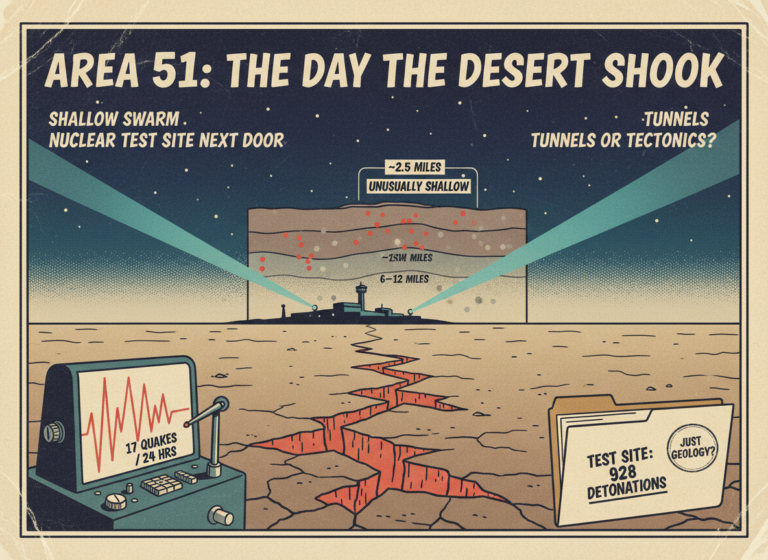
Area 51 Had 17 Earthquakes in One Day. Scientists Have an Explanation. Nobody Fully Believes It.
On April 30, 2026, at least 17 earthquakes struck within 24 hours near the most secretive military base in the United States.…
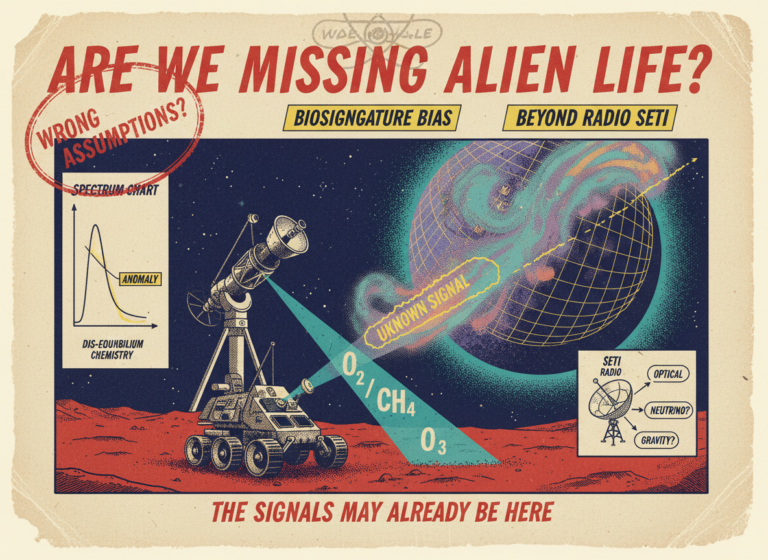
NASA Admits It May Be Looking for Alien Life the Wrong Way. The Signals Could Already Be Here.
A study published in the International Journal of Astrobiology and flagged by Unexplained Mysteries on May 21, 2026, contains a warning from…
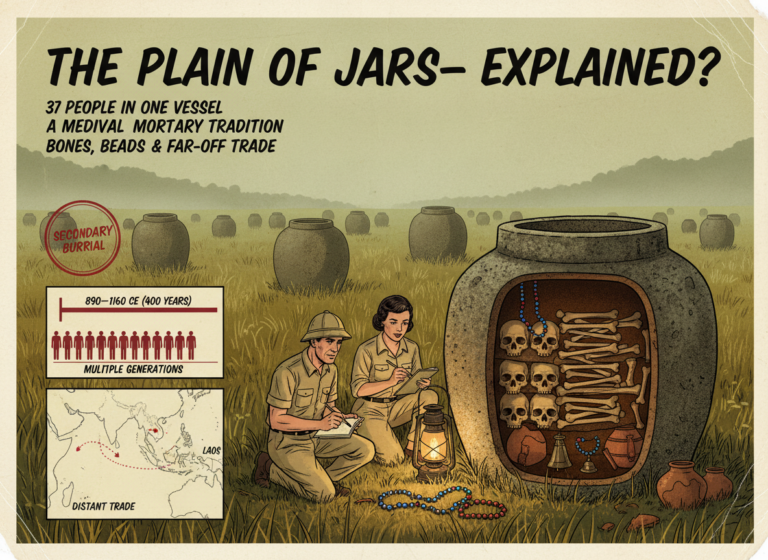
A Stone Jar in Laos Held the Bones of 37 People Across 400 Years. It May Finally Explain What the Plain of Jars Was For.
In the highlands of northeastern Laos, scattered across mountain plateaus and grassy plains, there are thousands of enormous stone jars. The largest…
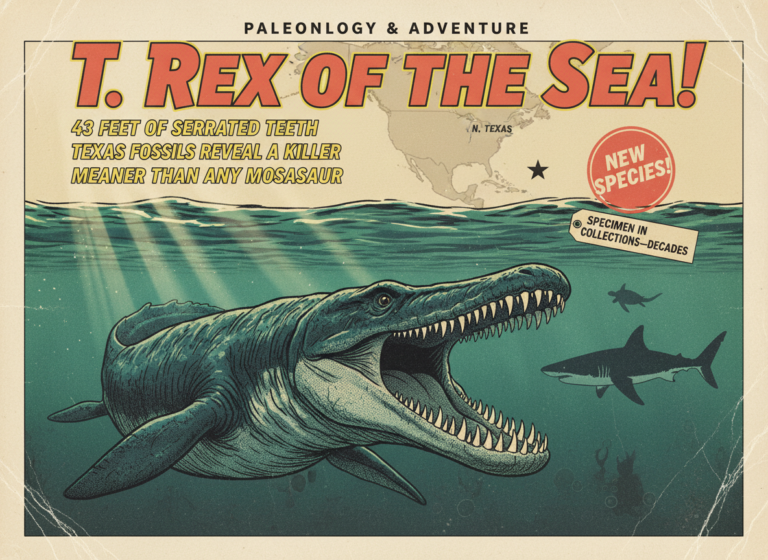
Scientists Just Named a New Sea Monster After T. Rex. It Was Twice as Long as a Great White and "Meaner Than Any Mosasaur."
A 43-foot marine reptile that patrolled the shallow seas covering what is now northern Texas 80 million years ago has been formally…