Original Story
A Scientist Just Pinpointed Where the Ark of the Covenant Is Buried. Here Is Why It Matters.
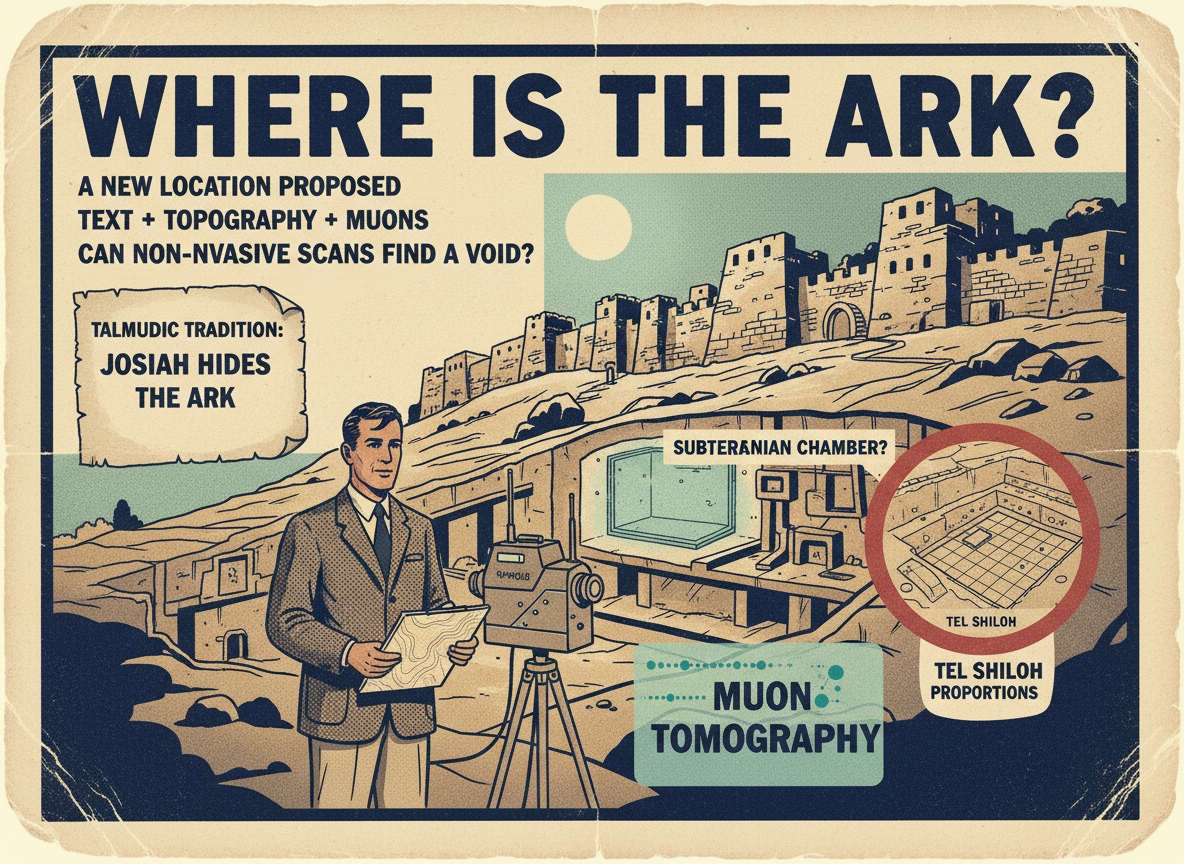
On May 5, 2026, archaeologist Dr. Chris McKinny publicly proposed a specific location for the Ark of the Covenant beneath Jerusalem’s City of David, backed by newly analyzed topographical and textual evidence. He is not alone. Muon detectors, underground scanning technology, and a parallel dig at Tel Shiloh are all pointing at the same ancient mystery from different directions.
For nearly 2,600 years, the location of the Ark of the Covenant has been one of the most contested questions in all of religious history.
The Ark was the gold-covered wooden chest built by Moses to hold the original stone tablets of the Ten Commandments. According to the Bible, it also contained Aaron’s rod and a jar of manna, the miraculous food that kept the Israelites alive in the wilderness. It was stored in the innermost room of Solomon’s Temple in Jerusalem, a chamber so sacred that only the High Priest could enter it, once a year, under strict ritual conditions. The Bible records that people who touched the Ark or looked inside it died.
Then the Babylonians invaded.
In 587 BC, King Nebuchadnezzar’s army sacked Jerusalem, destroyed Solomon’s Temple, and stripped everything from it. The Babylonian scribes were meticulous. They documented the golden lampstands, the silver vessels, the bronze pillars, the bowls, the censers, and dozens of other objects they took from the Temple. The Ark does not appear on that list. Not once. Not anywhere.
That absence is one of the most puzzling single facts in ancient Near Eastern history. The Ark was the most sacred, most valuable, most symbolically powerful object in the Temple. And the Babylonians, who catalogued everything else, apparently did not take it.
Which means something happened to it before they arrived.
Dr. McKinny’s Hypothesis
On May 5, 2026, in an announcement covered by Ancient Origins and Greek Reporter, archaeologist Dr. Chris McKinny put forward a specific, detailed hypothesis for where the Ark is now. McKinny is the creator of the documentary series Legends of the Lost Ark. His hypothesis is not fringe speculation. It is based on newly analyzed topographical evidence combined with detailed study of the biblical and historical texts.
His proposal points to underground areas in the City of David, the ancient district just south of the Temple Mount in Jerusalem. This is not a random location. The City of David sits directly on top of the ridge where Solomon’s Temple originally stood and where the most continuous human habitation in the city’s history has occurred.
McKinny draws on a tradition that appears in Rabbinic sources, specifically the Talmud, which records that King Josiah, who ruled around 620 BC, ordered the Levites to hide the Ark beneath the Temple, in anticipation of the Babylonian invasion. Josiah had seen what was coming. He was a reforming king who knew his kingdom was under existential threat. The Talmud says he had the Ark hidden in a subterranean chamber specifically to prevent it from being carried off to Babylon.
If that is what happened, the Ark did not disappear. It went underground.
The Technology That Could Confirm It
Researchers are not just speculating. They are now exploring the City of David and its surroundings using non-invasive technology that was not available to previous generations of researchers.
The most significant tool is muon detection. Muons are subatomic particles created when cosmic rays from space collide with Earth’s upper atmosphere. They rain down constantly in enormous numbers. Dense materials block them. Less dense materials, including air-filled chambers and tunnels, allow more of them to pass through. By placing detectors beneath or around a structure and mapping where muons pass through more easily, scientists can identify hidden chambers, rooms, or voids without drilling a single hole.
This same technology has been used at the Great Pyramid of Giza, where it identified a previously unknown hidden chamber above the Grand Gallery in 2017. That chamber, called the Big Void, was later confirmed to be real. The technology works.
Applied to the area beneath the City of David and the Temple Mount, muon detection could theoretically reveal whether any large void exists at the depth where the Ark might have been hidden. The political and religious complexities of conducting such a scan directly under or near the Temple Mount are significant, since the site is one of the most sensitive pieces of real estate on Earth. But the technology itself is mature and proven.
The Tel Shiloh Parallel
A separate, parallel dig at Tel Shiloh in the West Bank’s hill country of Ephraim is adding another layer to the story.
Tel Shiloh was the first permanent home of the Ark after the Israelites entered Canaan, the Promised Land. The Bible records that the Ark stayed at Shiloh for roughly 300 to 400 years before it was captured by the Philistines in battle, returned, and eventually brought to Jerusalem by King David. If researchers can find confirmed evidence of the Tabernacle structure at Shiloh, it would establish the full chain of custody for the Ark in physical archaeological terms.
Dr. Scott Stripling, director of excavations at Tel Shiloh for the Associates for Biblical Research, announced significant findings from recent seasons. His team uncovered what they describe as a monumental Iron Age I building oriented east to west, divided in a 2:1 ratio. Those dimensions match the proportions given in Exodus for the Tabernacle itself. Inside, a large internal wall divides the space into two sections, mirroring the Tabernacle’s division between the outer court and the inner Holy of Holies. Pottery from the same layer dates to the general period when the Ark was kept there.
Stripling also said that the gate area exposed during recent digging may be the actual spot at Shiloh’s entrance where the Israelite priest Eli, upon hearing that the Ark had been captured in battle, fell backward, broke his neck, and died, as described in 1 Samuel.
The Spring 2026 excavation season at Tel Shiloh is currently active, with a new on-site laboratory now funded for advanced chemical and structural analysis of recovered materials.
Where the Major Theories Point
There are three serious locations that credible researchers have proposed for the Ark’s current resting place. They do not all agree.
The first is beneath the Temple Mount or the City of David in Jerusalem. This is McKinny’s position and is supported by the Talmudic tradition about Josiah’s concealment. The Babylonian documentation problem, the fact that the Ark is conspicuously absent from Nebuchadnezzar’s plunder lists, fits this theory well. The Ark was hidden before the invasion, it has been under the city ever since.
The second is Ethiopia. The Ethiopian Orthodox Tewahedo Church maintains with absolute institutional conviction that the Ark is in the city of Aksum, inside a treasury chapel attached to the Church of Our Lady Mary of Zion. Their tradition, recorded in the ancient text called the Kebra Nagast, states that the Ark was taken to Ethiopia by Menelik I, the son of King Solomon and the Queen of Sheba. Every Orthodox church in Ethiopia contains a replica of the Ark, and a single guardian monk devotes his entire life to protecting the original, dying in his post when his time comes. This is not casual folklore. It is a 700-year institutional commitment with a specific physical object at its center.
The third theory, drawn from the Deuterocanonical text 2 Maccabees, is that the prophet Jeremiah hid the Ark in a cave on Mount Nebo in what is now Jordan, and that it will remain hidden until God chooses to reveal it.
None of these theories has been disproven by physical archaeology. None has been confirmed.
The Spring 2026 excavation at Tel Shiloh is digging deeper. The muon detection technology is available and proven. And Dr. McKinny has now put a specific address into the public record. The search has never been more technically capable of finding an answer.
Sources: Ancient Origins, The Most Dangerous Object in History Has Been Found, May 5, 2026, Greek Reporter, New Technology Revives Search for the Ark of the Covenant Beneath Jerusalem, April 22, 2026, Jerusalem Post, Ark of the Covenant Found? Monumental Ruins at Tel Shiloh, Wikipedia, Ark of the Covenant, Where Is the Ark of the Covenant, neuralgrimoire.com, 2026
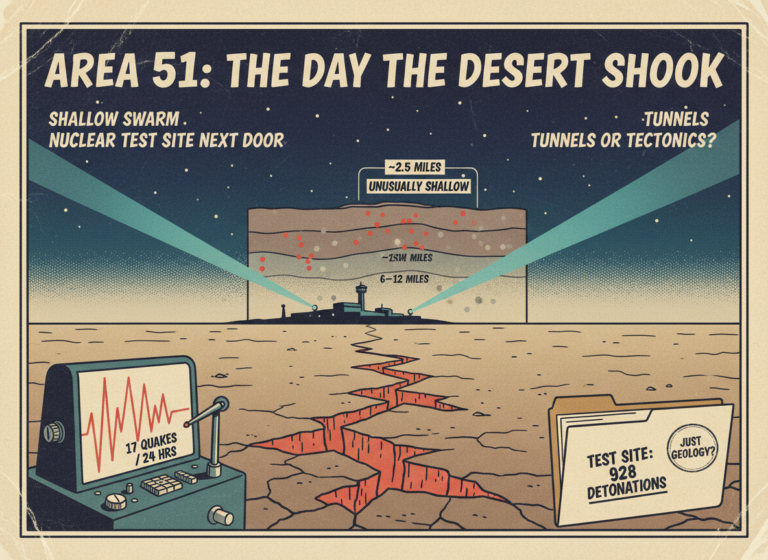
Area 51 Had 17 Earthquakes in One Day. Scientists Have an Explanation. Nobody Fully Believes It.
On April 30, 2026, at least 17 earthquakes struck within 24 hours near the most secretive military base in the United States.…
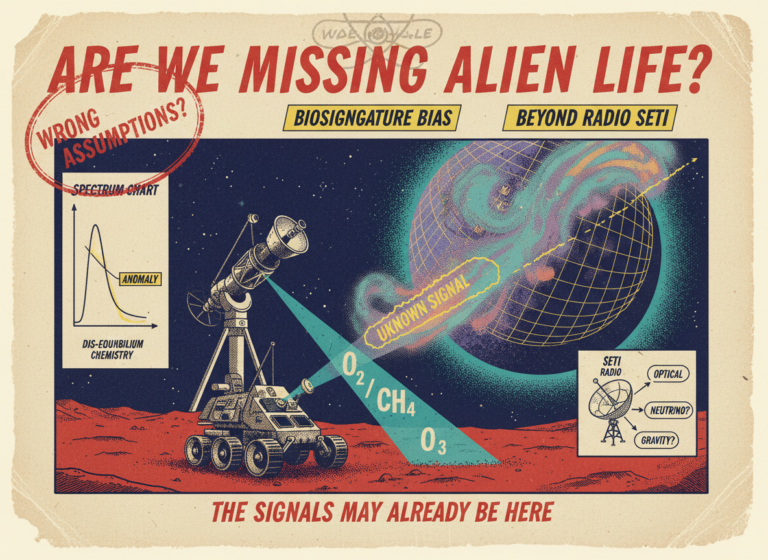
NASA Admits It May Be Looking for Alien Life the Wrong Way. The Signals Could Already Be Here.
A study published in the International Journal of Astrobiology and flagged by Unexplained Mysteries on May 21, 2026, contains a warning from…
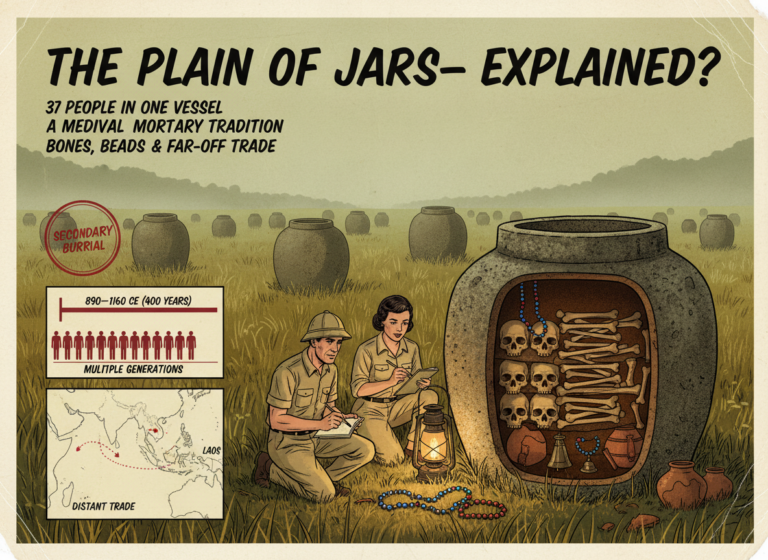
A Stone Jar in Laos Held the Bones of 37 People Across 400 Years. It May Finally Explain What the Plain of Jars Was For.
In the highlands of northeastern Laos, scattered across mountain plateaus and grassy plains, there are thousands of enormous stone jars. The largest…
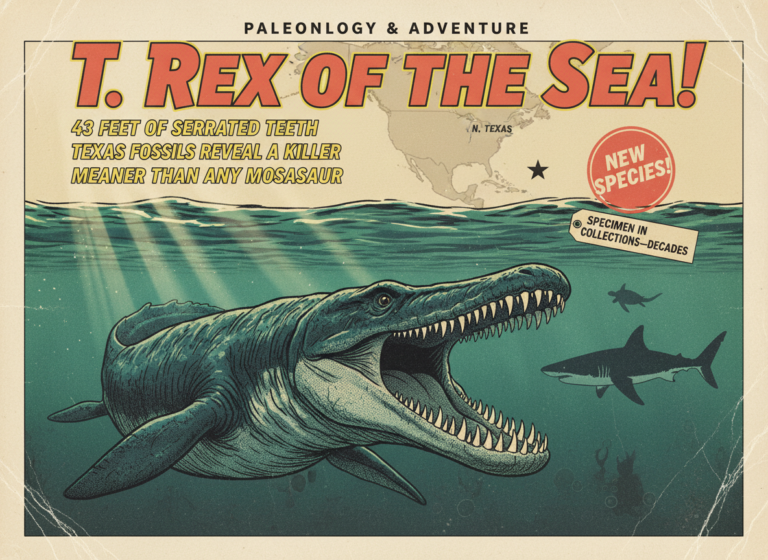
Scientists Just Named a New Sea Monster After T. Rex. It Was Twice as Long as a Great White and "Meaner Than Any Mosasaur."
A 43-foot marine reptile that patrolled the shallow seas covering what is now northern Texas 80 million years ago has been formally…