Original Story
A Neanderthal Had a Toothache 59,000 Years Ago. Someone Drilled It Out With a Stone Tool.
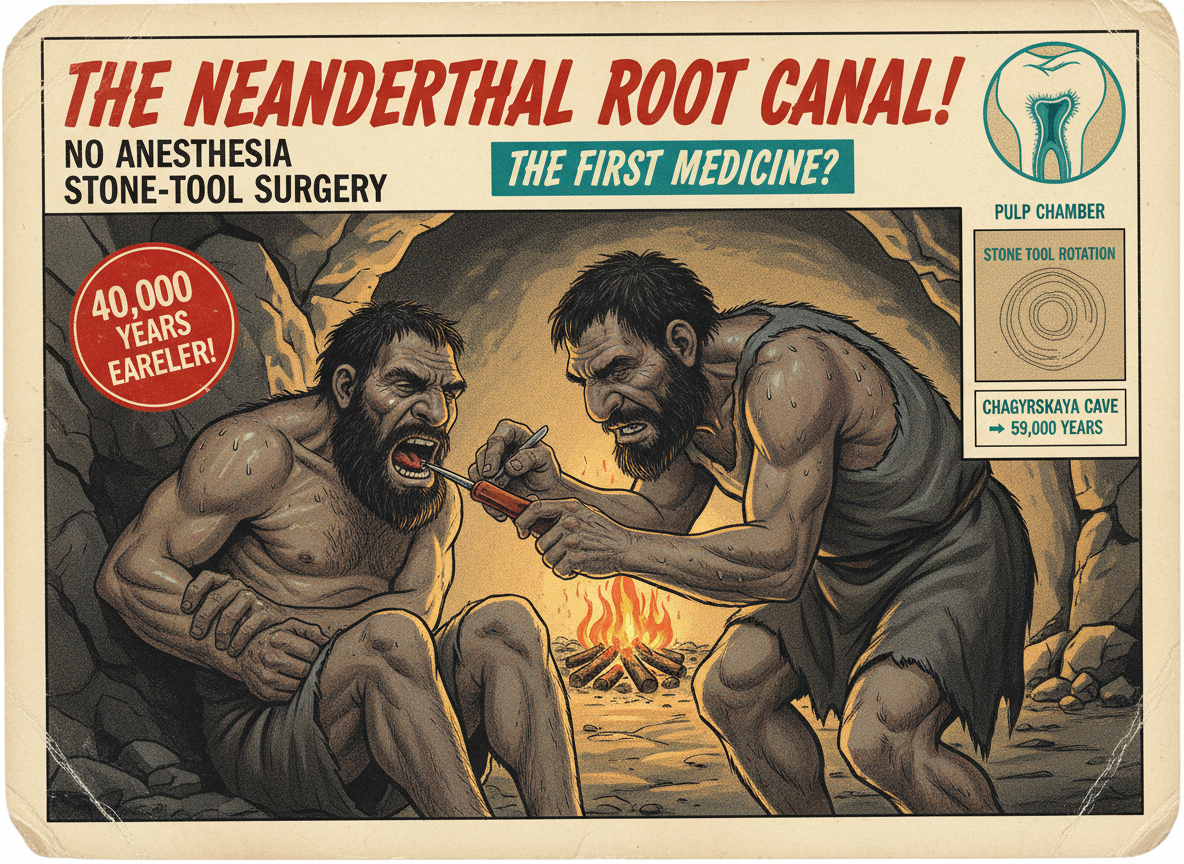
A tooth found in a Siberian cave just rewrote the history of medicine. Scientists confirmed on May 13, 2026, that a Neanderthal received what amounts to a primitive root canal 59,000 years ago, predating any previously known medical procedure by 40,000 years. No anesthesia. No instruments beyond a pointed stone. The patient survived.
Somewhere in what is now southwestern Siberia, about 59,000 years ago, a Neanderthal had a serious problem with a tooth.
The infection had eaten through the enamel and reached the pulp, which is the soft inner tissue of the tooth packed with nerves and blood vessels. Anyone who has had a bad cavity knows what that feels like. This Neanderthal was looking at something much worse. The infection, left untreated, would have spread to the jaw, then to the skull, then to the bloodstream. It could have been fatal.
Someone decided to do something about it.
On May 13, 2026, scientists published a study in the peer-reviewed journal PLOS One describing a 59,000-year-old Neanderthal molar recovered from Chagyrskaya Cave in Russia’s Altai Mountains. The tooth, catalogued as Chagyrskaya 64, has a deep, deliberate hole drilled through its chewing surface all the way into the pulp chamber. Micro-CT scans and scanning electron microscopy identified microscopic radial grooves, the kind made by a pointed tool being rotated between two fingers, cutting and scraping out the infected tissue.
The research team then did something remarkable to confirm their theory: they replicated the procedure on modern human teeth using narrow jasper stone tools found in the same cave. It worked. After 35 to 50 minutes of careful, continuous drilling, the ancient technique successfully reproduced the same geometry and abrasion patterns seen in the Neanderthal tooth.
“Basically a root canal,” said John Olsen, an archaeologist at the University of Arizona and a co-author of the report.
This pushes back the earliest known evidence of any medical procedure by approximately 40,000 years.
What the Tooth Actually Shows
The tooth, Chagyrskaya 64, is an upper third molar. It was found in a sediment layer from between 49,000 and 70,000 years ago, placing it solidly in a period when Neanderthals were the dominant hominins in this region of Siberia.
When researchers first cleaned the tooth, a deep, irregular hole caught their attention immediately. “At the very beginning, she suspected that the cavity inside the tooth, it’s not very natural,” said Ksenia Kolobova, an archaeologist at the Institute of Archaeology and Ethnography at the Russian Academy of Sciences. A colleague with dental anthropology expertise confirmed that suspicion.
The hole was not just a cavity in the ordinary sense. It extended all the way into the pulp chamber, which is the protected inner space of a tooth containing the nerve. In modern dentistry, that is exactly the target of a root canal procedure: drill into the pulp, remove the infected tissue, relieve the pressure, and stop the spread of infection.
The wear patterns around the hole are also significant. They show that the Neanderthal used the tooth again after the procedure. The patient did not just survive having a stone tool drilled into their infected tooth. They chewed with that tooth afterward. The hole was there, healed around and smoothed over by use. Dental professor Justin Durham, who reviewed the evidence for researchers, called the Neanderthal’s work “a decent job.”
The Procedure Would Have Been Agonizing
The researchers were not shy about this part.
“When Lydia experimentally replicated the procedure on modern human teeth, she needed concentration and fine motor control,” Kolobova said. “In real life, the tooth was in the mouth, and inflammation and swelling would have created additional difficulties, clearly making the situation even more complex. However, a Neanderthal 59,000 years ago achieved essentially the same result with a stone tool and without anesthesia.”
There are no traces of plant residues on the tooth, which means we cannot confirm whether the patient received any natural pain relief. However, researchers note that Neanderthals at other sites have been found to have used medicinal plants. Some sites have yielded evidence of chamomile, yarrow, and other botanicals with documented anti-inflammatory properties. Whether any plant remedy was used at Chagyrskaya remains unknown, but the tools for rudimentary pain management existed in the Neanderthal toolkit.
The procedure itself required someone with specific knowledge and fine motor control to perform it on someone else, in that person’s mouth, while that person held still, probably in significant pain, for 35 to 50 minutes.
“If I’m the one with the bad tooth,” said Olsen, “who am I going to trust to do this?”
That question points to something much larger than dentistry.
What This Says About Neanderthals
The standard image of Neanderthals has been changing for decades, and findings like this accelerate that change dramatically.
Neanderthals buried their dead, sometimes with flowers and ochre. They made jewelry from eagle talons and seashells. They used pigments, possibly for body decoration or ritual purposes. They made complex tools. DNA analysis has confirmed they interbred with modern humans, producing offspring, meaning they were compatible enough with us to create viable children. And now they performed what amounts to the world’s first known surgical procedure.
The Chagyrskaya 64 finding requires several things to be true simultaneously. The practitioner had to recognize that the tooth was infected and causing the patient harm. They had to know, or believe, that drilling into it would help rather than make things worse. They had to have the fine motor skills to execute the procedure with a stone tool. And the patient had to trust the practitioner enough to sit still through the pain.
“It suggests that the roots of invasive medicine and surgery do not belong exclusively to Homo sapiens,” said researcher Davide Oxilia of the University of Bologna, who was not involved in the study, “but are part of a broader legacy shared with our closest relatives.”
Study co-author Andrey Krivoshapkin put it another way: the procedure requires a level of reasoning that goes beyond instinct, accepting short-term suffering for a future benefit. That is a sophisticated cognitive calculation. It is the kind of thinking that defines medical intervention across all of human history.
A Neanderthal was doing it 59,000 years ago with a piece of jasper.
Researcher Lydia Zotkina said that since studying this tooth, she thinks about the Neanderthal patient every time she goes to the dentist. “What struck me, and continues to strike me, is what an incredibly strong-willed person this Neanderthal must have been. He must have surely understood that although the pain of the procedure was greater than the pain of the inflammation, it was only temporary and had to be endured.”
Sources: NPR, Neanderthals May Have Drilled Out a Cavity 59,000 Years Ago, May 13, 2026, Washington Post, A 59,000-Year-Old Tooth Reshapes What We Know About Neanderthal Dentistry, May 13, 2026, CNN, 59,000-Year-Old Neanderthal Tooth Shows Earliest Evidence of Dentistry, May 13, 2026, Newser, Neanderthal Root Canal Pushes Back Origins of Dentistry, May 13, 2026, Zubova et al., PLOS One, 2026, DOI:10.1371/journal.pone.0347662
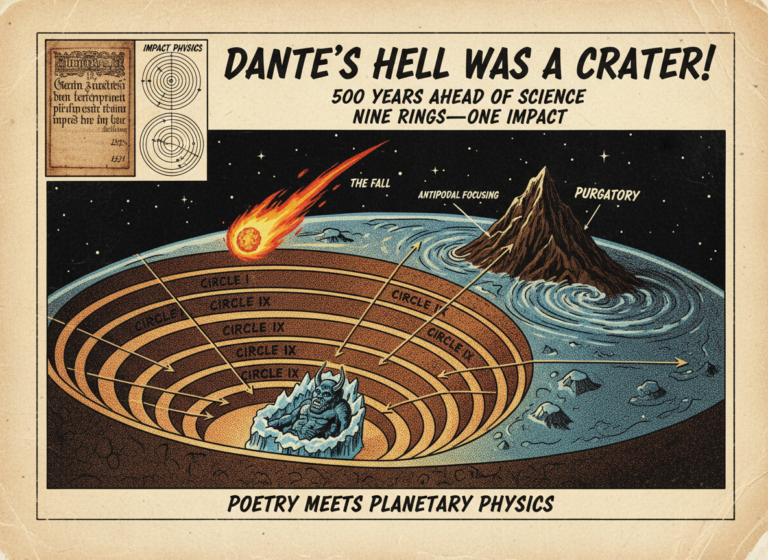
A Medieval Poet Described Hell as a Planetary Impact Crater 500 Years Before Science Had the Concept. Researchers Just Worked Out the Physics.
A new study presented at the European Geosciences Union General Assembly in Vienna in May 2026 makes a case that is extraordinary…
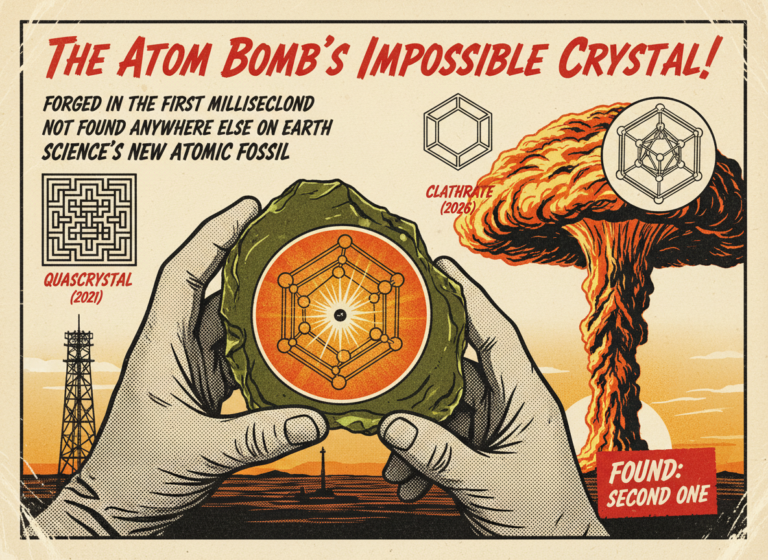
The First Nuclear Bomb Forged a Crystal That Doesn't Exist Anywhere Else on Earth. Scientists Just Found a Second One.
On July 16, 1945, at 5:29 a.m. in a remote stretch of desert in southern New Mexico, the United States Army detonated…
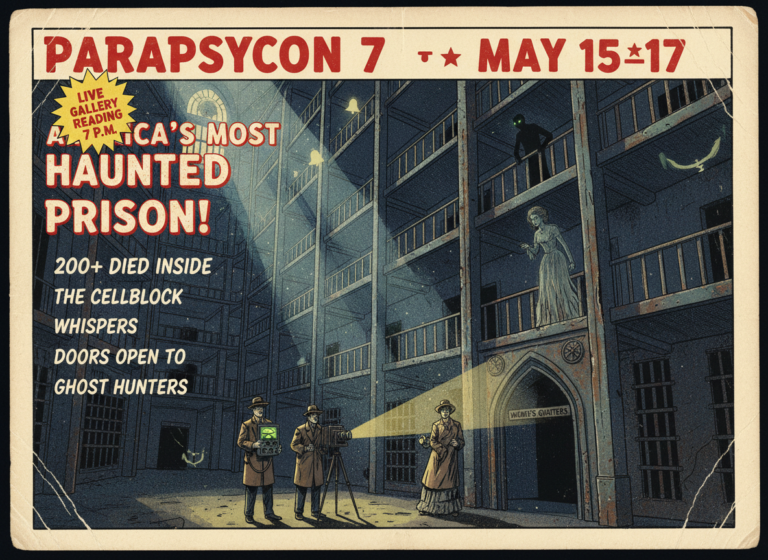
The Most Haunted Prison in America Opens Its Doors to Ghost Hunters Last Night. Over 200 People Died Inside.
The Ohio State Reformatory in Mansfield, Ohio, has been called the most haunted prison in America — and last night, May 14,…

An Astrophysicist Reviewed the Pentagon's UFO Files. He Called Them "Just More Fuzzy Blob Videos." Here Is What He Actually Saw.
On May 13, 2026, NPR aired a segment in which astrophysicist Adam Frank, professor at the University of Rochester and author of…