Original Story
A Medieval Poet Described Hell as a Planetary Impact Crater 500 Years Before Science Had the Concept. Researchers Just Worked Out the Physics.
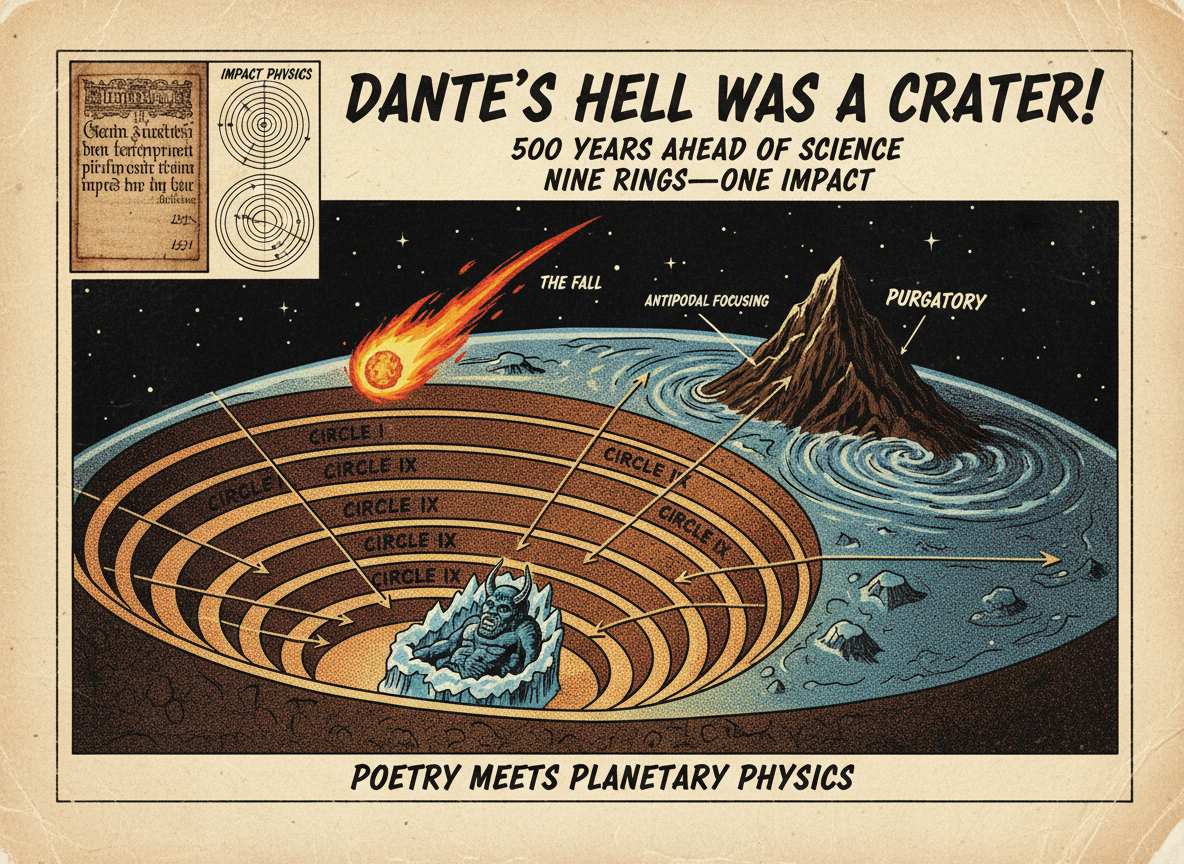
A new study presented at the European Geosciences Union General Assembly in Vienna in May 2026 makes a case that is extraordinary enough to be worth taking seriously and unusual enough that you might initially assume it was a joke. It is not. Timothy Burbery, an English professor at Marshall University in West Virginia, has compared the physical description of Hell in Dante Alighieri’s 14th-century poem Inferno to modern planetary science — specifically to the physics of large-scale asteroid impact events — and found that Dante’s description of Satan’s fall, the shape of Hell, and the origin of Purgatory corresponds with impressive precision to what scientists now understand happens when a very large object strikes a planet at high velocity. The nine circles of Hell, in this reading, are not spiritual metaphor. They are a crater. The poem was finished in 1321. The scientific field of meteoritics did not develop until the late 19th and early 20th centuries. Dante got there 500 years early.
First, the structure of the poem. In Inferno, the first section of the Divine Comedy, the poet Dante descends into Hell, which he describes as a vast, inverted conical pit beneath the surface of the Earth, tapering downward through nine concentric circles of decreasing size toward the center of the planet, where Satan is imprisoned in ice at the very core. At the bottom of the funnel, Dante and his guide Virgil climb down the body of Satan himself, pass through the center of the Earth, and emerge on the other side — where they find Mount Purgatory rising from the ocean in the Southern Hemisphere.
Dante’s own explanation for this geography, given within the poem, is that Satan’s fall from heaven struck the Earth’s surface with such force that it drove him into the planet’s core, and the mass of earth displaced by the impact fled from Satan’s presence and rose to form Mount Purgatory on the opposite side of the globe.
This is, as Burbery points out at the EGU, a description of a planetary impact.
The Physics Match
When a large asteroid strikes a planet at sufficiently high velocity — the kind of event that created the 110-mile Chicxulub crater in Mexico 66 million years ago — the results are specific and predictable. The impactor drives deep into the crust, compressing and then remelting rock in a way that produces a distinctive conical shape in the immediate vicinity of the strike. As the compressed material rebounds and flows outward, it forms a series of concentric terraced rings around the central pit — what planetary geologists call a multi-ring impact basin. These structures are visible on the Moon, Venus, and other bodies throughout the solar system.
Burbery argues that Dante’s nine descending concentric circles match the ring structure of a multi-ring impact basin with a degree of geometric correspondence that is difficult to explain as coincidence. He also notes that Dante’s Satan does not vaporize on impact — he survives as an intact body embedded in the planet. This resembles the behavior of large meteorites that penetrate the atmosphere and strike the ground without ablating completely, of which the largest known example on Earth is the Hoba meteorite in Namibia, a 60-ton mass of nickel-iron that hit without vaporizing.
The displacement of material to form Mount Purgatory on the opposite hemisphere corresponds to what geologists call antipodal focusing — the concentration of seismic energy from a large impact at the point diametrically opposite the strike, which can produce geological uplift on the far side of a planet from the crater. NASA’s DART mission in 2022, which deliberately altered an asteroid’s orbit to test planetary defense technology, was a direct application of the scientific understanding of impact physics that Burbery argues Dante intuitively anticipated.
What Burbery Thinks Happened
Burbery is not arguing that Dante had secret knowledge of asteroid physics or access to future science. His interpretation falls within a field called geomythology — the study of how human stories and myths sometimes preserve observations of real natural events, encoded in cultural and religious narratives because the culture had no other framework for understanding what they had seen or imagined.
During Dante’s time, the dominant understanding of the cosmos was Aristotelian: the heavens were perfect, eternal, and unchanging. Meteors and comets were considered atmospheric phenomena, not objects from space. The idea that stones fell from the sky was not scientifically mainstream until the early 19th century. And yet Dante imagined a celestial object striking the Earth with enough force to restructure the planet’s interior and form mountain ranges from displaced mass on the other side of the world.
“By describing a violent celestial impact with real physical consequences,” Burbery argues, “Dante may have helped challenge those older ideas, even if only through poetry and imagination.” The poem was written in a culture that officially rejected the possibility of objects striking Earth from space. And it describes, in structural and geometric detail, what happens when one does.
Sources: ScienceDaily — Scientists Say Dante’s Inferno Described an Asteroid Impact 500 Years Before Modern Science (May 10, 2026) — The Debrief — Did Dante’s Inferno Predict Impact Physics Hundreds of Years Before Its Invention? (May 2026) — Knowridge — Dante’s Inferno May Have Predicted Asteroid Impacts 500 Years Early (May 2026) — Ancient Origins — Study Argues Dante’s Inferno Mapped a Planetary Impact 500 Years Before Science (May 2026) — Heritage Daily — Dante’s Inferno May Have Predicted Planetary Impact Physics Centuries Before Modern Science (May 2026) — The Brighter Side of News — Dante’s Inferno Suggests Hell and Purgatory Mirror the Physics of a Massive Asteroid Impact (May 2026) — Unexplained Mysteries — Does Dante’s Inferno Describe a Catastrophic Asteroid Impact? (May 14, 2026)
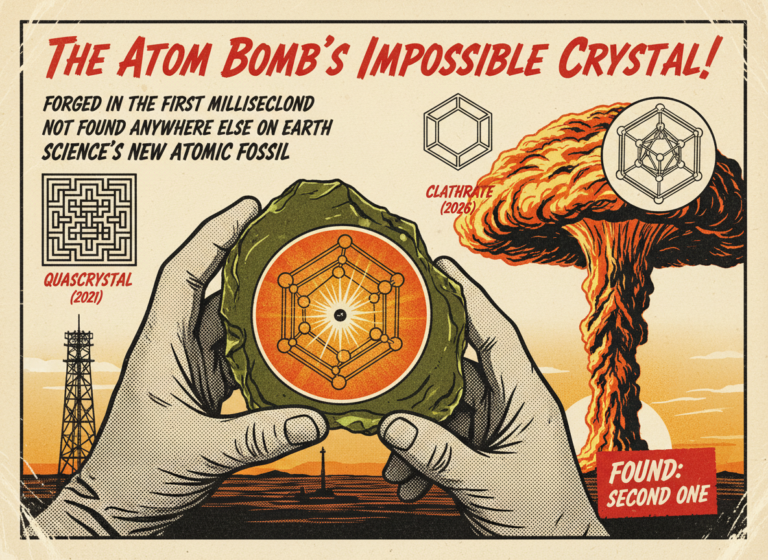
The First Nuclear Bomb Forged a Crystal That Doesn't Exist Anywhere Else on Earth. Scientists Just Found a Second One.
On July 16, 1945, at 5:29 a.m. in a remote stretch of desert in southern New Mexico, the United States Army detonated…
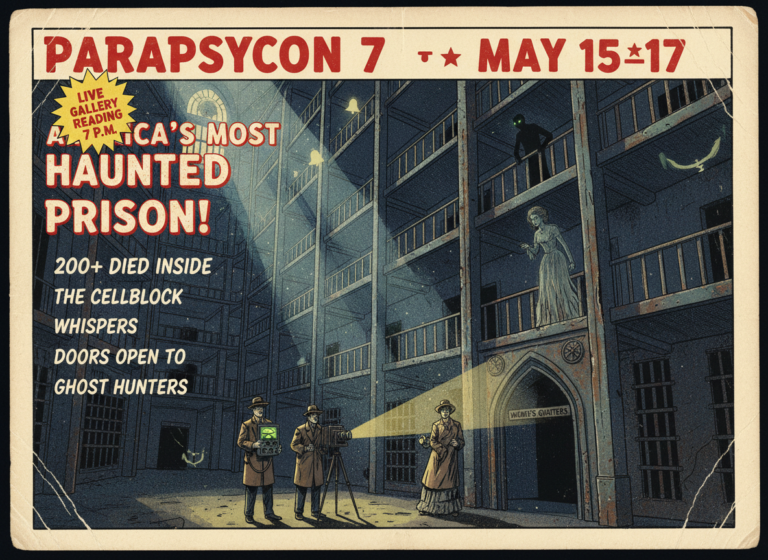
The Most Haunted Prison in America Opens Its Doors to Ghost Hunters Last Night. Over 200 People Died Inside.
The Ohio State Reformatory in Mansfield, Ohio, has been called the most haunted prison in America — and last night, May 14,…

A Neanderthal Had a Toothache 59,000 Years Ago. Someone Drilled It Out With a Stone Tool.
A tooth found in a Siberian cave just rewrote the history of medicine. Scientists confirmed on May 13, 2026, that a Neanderthal…
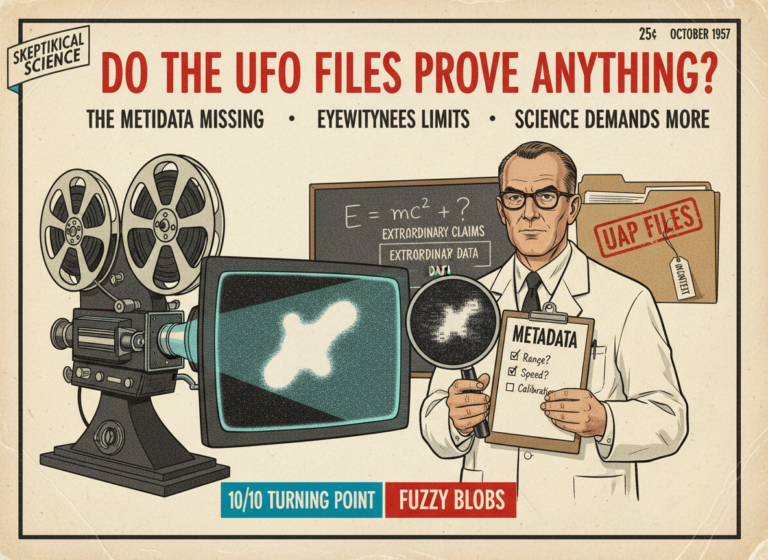
An Astrophysicist Reviewed the Pentagon's UFO Files. He Called Them "Just More Fuzzy Blob Videos." Here Is What He Actually Saw.
On May 13, 2026, NPR aired a segment in which astrophysicist Adam Frank, professor at the University of Rochester and author of…