Original Story
The First Nuclear Bomb Forged a Crystal That Doesn’t Exist Anywhere Else on Earth. Scientists Just Found a Second One.
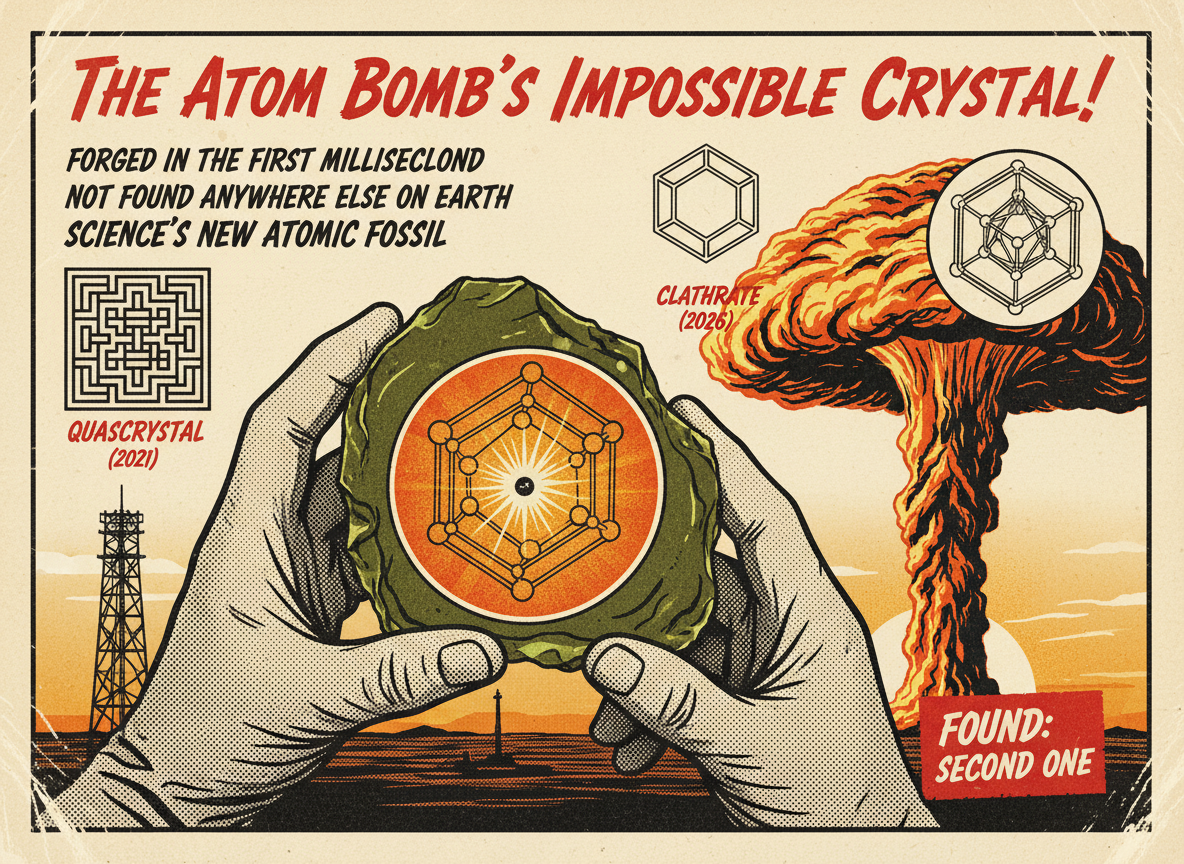
On July 16, 1945, at 5:29 a.m. in a remote stretch of desert in southern New Mexico, the United States Army detonated the world’s first nuclear bomb. The device — code-named the Gadget, a plutonium implosion weapon — was mounted on a 100-foot steel tower packed with copper wire, copper sheathing, recording instruments, and coaxial cables. The explosion released the equivalent energy of 21,000 tons of TNT in less than a millisecond. The tower, its instruments, and the top layer of the desert sand were vaporized, then rained back down as a new material that had never existed before — a faintly radioactive glass named trinitite, after the test site. For more than 80 years, scientists have been finding strange things inside it. The latest discovery, published in the Proceedings of the National Academy of Sciences on May 11, 2026, is a crystal structure called a clathrate — something that, under normal Earth conditions, should not be there.
To understand why the crystal is unusual, it helps to know what a clathrate is and what it takes to make one.
A clathrate is a specific type of crystal structure where atoms arranged in a cage-like lattice trap other atoms inside them. The newly identified Trinity clathrate consists of silicon atoms arranged in interlocking geometric cages — specifically dodecahedral cages with 12 faces and tetrakaidecahedral cages with 14 faces — which trap individual calcium atoms inside, with traces of copper and iron also present. The molecular formula is calcium-copper-silicon.
What makes this particular structure unusual is that clathrates form only under a very narrow and specific combination of temperature, pressure, and cooling rate. Get the temperature wrong, get the pressure wrong, cool it too slowly, or let it sit at a moderate temperature for too long, and the clathrate structure collapses or never forms in the first place. The conditions required are, in geological terms, exotic.
The Trinity nuclear test generated temperatures exceeding 1,500 degrees Celsius and pressures exceeding one million pounds per square inch — briefly, in the fraction of a second before the fireball expanded and everything cooled. Those extreme conditions, in the material immediately surrounding the bomb’s tower, produced the new crystal before the heat and pressure dissipated. The clathrate is a frozen record of the first millisecond of the nuclear age.
“Extreme, transient conditions produced by nuclear detonations can generate solid-state phases inaccessible to conventional synthesis,” wrote lead author Luca Bindi of the University of Florence — which is to say, we cannot make this crystal in any laboratory on Earth under normal conditions.
The First Unusual Discovery: The Quasicrystal
The clathrate is not the first strange structure found in red trinitite. In 2021, Bindi and the same research team — which includes Paul Steinhardt of Princeton, one of the world’s foremost authorities on unusual crystal structures — reported a different impossible material in the same red trinitite: a quasicrystal.
A quasicrystal is one of the most counterintuitive things in all of materials science. Normal crystals have atomic structures that repeat at regular, periodic intervals — salt, quartz, and diamond are examples. Quasicrystals have an ordered atomic structure that never quite repeats. Their atoms are arranged symmetrically but not periodically — like a Penrose tiling, which covers a surface with a pattern that follows a rule but never recurs exactly. For decades, this was considered mathematically impossible in crystalline matter. The discovery of quasicrystals earned Daniel Shechtman the Nobel Prize in Chemistry in 2011. Before trinitite, the only known naturally formed quasicrystal came from a meteorite, likely produced during a violent asteroid collision in the early solar system.
Trinity produced a quasicrystal, and now a clathrate, from sand and copper wires in New Mexico in 1945.
Why Both Matter for Science
The new study investigated whether the clathrate and the quasicrystal were related — whether one might have been a precursor to the other. The answer, from mathematical modeling using density functional theory, was no. They are distinct structures formed under related but separate conditions. Their coexistence in the same material tells scientists something important about what was happening physically in the microseconds of the explosion.
More broadly, Bindi and his colleagues argue that trinitite and similar materials produced by extreme events — nuclear detonations, lightning strikes, meteorite impacts — represent natural laboratories where matter is forced beyond the limits of what conventional chemistry can produce. “This work underscores how rare, high-energy events serve as natural laboratories for producing unexpected crystalline matter,” the team wrote in PNAS.
The crystal inside the red trinitite will also have practical applications for materials science, where clathrates are already prized in high-tech uses including lithium-ion battery architectures, solar cells, and quantum computing components. The Trinity version is, for now, one of a kind. Scientists still cannot replicate it.
Sources: [PNAS — Bindi et al., Extreme Nonequilibrium Synthesis of a Ca-Cu-Si Clathrate During the Trinity Nuclear Test (May 11, 2026). DOI: 10.1073/pnas.2604165123] — Live Science — Extreme Crystal That Formed in 1945 Nuclear Bomb Test Is Unlike Anything Scientists Have Seen (May 13, 2026) — Scientific American — Strange Crystals Found Inside Wreckage from the First Nuclear Bomb Test (May 2026) — Gizmodo — Physicists Discover Previously Unknown Crystal Forged During Manhattan Project’s Trinity Test (May 11, 2026) — Phys.org — 80 Years After the Trinity Nuclear Test, Scientists Identify New Molecule-Trapping Crystal (May 12, 2026) — ZME Science — The First Atomic Bomb Made a Crystal Scientists Had Never Seen Before (May 12, 2026) — Unexplained Mysteries — Impossible Crystal Found at Site of World’s First Nuclear Weapons Test (May 13, 2026)
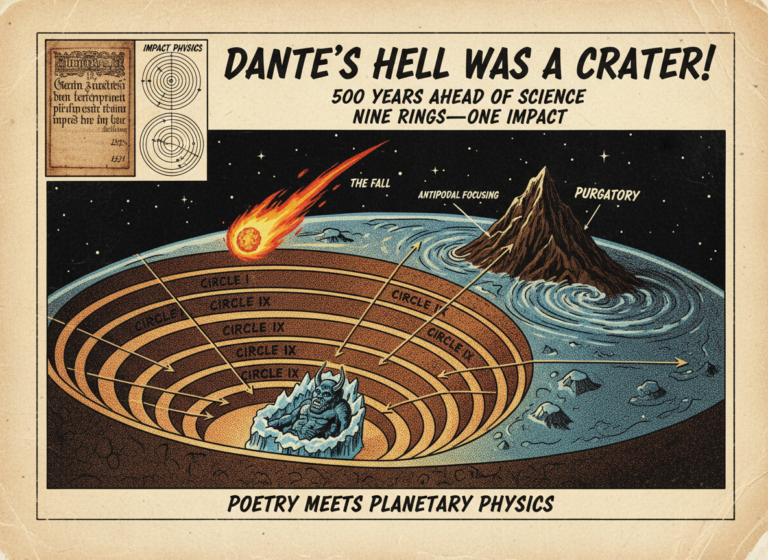
A Medieval Poet Described Hell as a Planetary Impact Crater 500 Years Before Science Had the Concept. Researchers Just Worked Out the Physics.
A new study presented at the European Geosciences Union General Assembly in Vienna in May 2026 makes a case that is extraordinary…
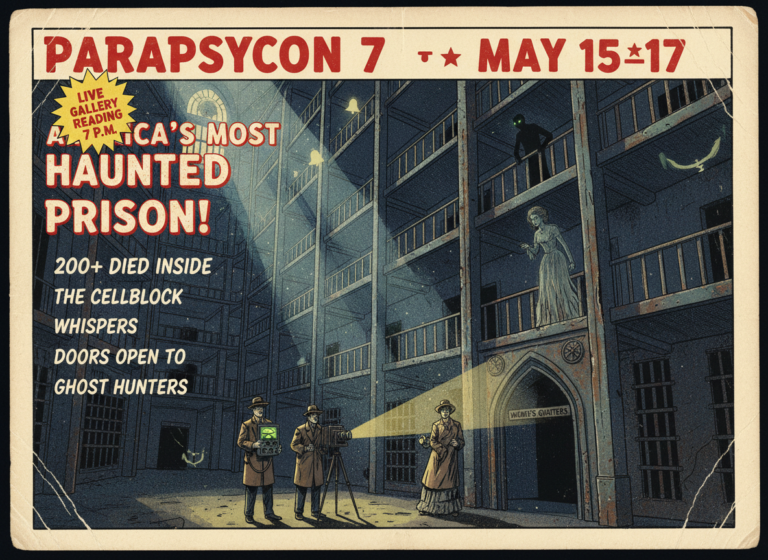
The Most Haunted Prison in America Opens Its Doors to Ghost Hunters Last Night. Over 200 People Died Inside.
The Ohio State Reformatory in Mansfield, Ohio, has been called the most haunted prison in America — and last night, May 14,…

A Neanderthal Had a Toothache 59,000 Years Ago. Someone Drilled It Out With a Stone Tool.
A tooth found in a Siberian cave just rewrote the history of medicine. Scientists confirmed on May 13, 2026, that a Neanderthal…
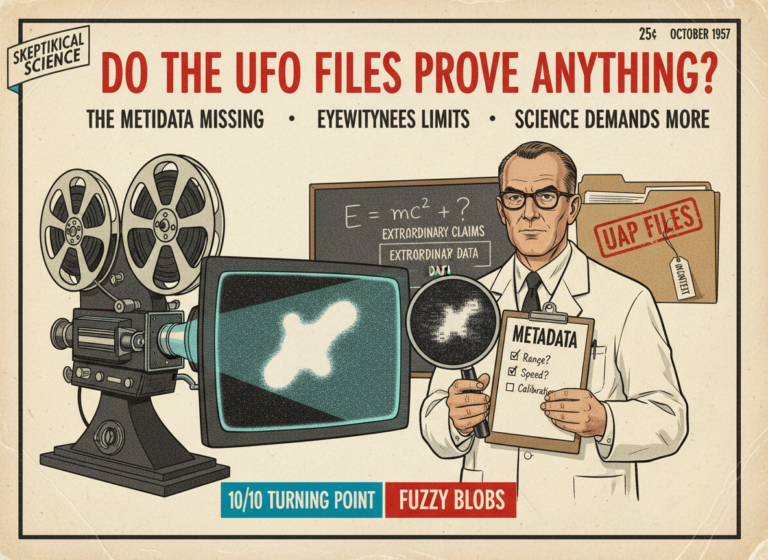
An Astrophysicist Reviewed the Pentagon's UFO Files. He Called Them "Just More Fuzzy Blob Videos." Here Is What He Actually Saw.
On May 13, 2026, NPR aired a segment in which astrophysicist Adam Frank, professor at the University of Rochester and author of…