Original Story
An Army Combat Engineer Saw Three Nine-Foot Hominids in Oregon in 1993. He Has Spent His Retirement Looking for More.
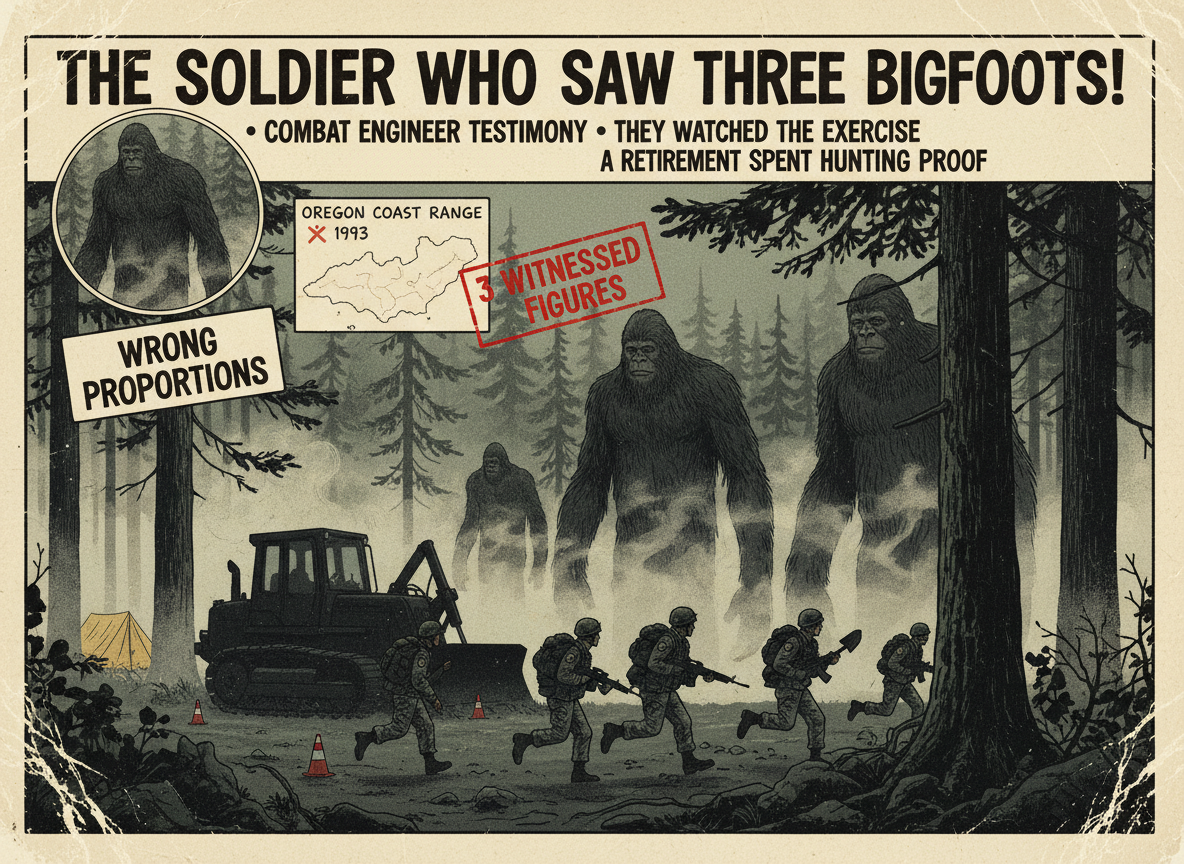
In 1993, Staff Sergeant Todd Neiss was participating in a military exercise in the Oregon Coast Range with the Army’s 1249th Combat Engineer Battalion. He saw three large hominids at the edge of the training area. They were bipedal, covered in dark hair, and between eight and nine feet tall. Their limb proportions were wrong for a human — the arm length was too long, the body proportions too wide through the torso. “Their silhouette was completely disproportionate in terms of the arm length and even the length of the legs as it pertains to a human torso,” Neiss recalled in a recent Fox and Friends First appearance, which was subsequently covered by the Daily Mail and flagged on Unexplained Mysteries on May 7, 2026. The creatures appeared to be watching the military exercise with what Neiss described as curiosity, not aggression. The encounter changed his life. Upon retiring from the military, Neiss founded a nonprofit organization dedicated to Bigfoot research. He has been tracking sightings across the United States ever since.
Staff Sergeant Neiss spent his military career in combat engineering — the branch responsible for construction, demolition, and obstacle operations in hostile environments. He was not a person who habitually reported unexplained phenomena, and by his account he was not prone to misidentifying things. Trained observers in the military learn to assess targets accurately and quickly. Combat engineers in particular are trained in physical assessment of terrain features and structural forms. When Neiss says three large hominids were standing at the edge of the training area and watching the exercises, he is applying that observational framework.
What he noticed most was the proportion. A large human male, seen at distance in poor light, might be confused with a wide variety of things. But the specific anatomical signature he describes — arm length disproportionate to torso, leg-to-body proportions inconsistent with human anatomy — is harder to attribute to a misidentification of a known species. No known North American animal has that specific combination of features at nine feet tall. A bear standing upright is typically five to seven feet and has short forelimbs relative to its body. An elk is quadrupedal. A large human in heavy gear does not have arm length that reads as wrong from a trained military observer.
Neiss says the creatures seemed calm. They watched. They did not approach or react aggressively. After a period of observation, they moved off.
What He Founded and Why
The American Primate Conservancy is the organization Neiss established after his retirement. Its focus is on collecting, documenting, and investigating Bigfoot sighting reports across the United States, applying a structured methodology rather than the more informal approach of casual researchers. Neiss has committed the post-military portion of his career to taking the subject seriously in the way that he felt it was not being taken seriously.
His most recent public appearance was prompted by a renewed wave of Bigfoot sightings in Ohio. According to Neiss, Ohio ranks fourth among all states in documented Bigfoot encounters — a fact that surprises many people who associate the phenomenon primarily with the Pacific Northwest where his own sighting occurred. The Ohio accounts from March 2026 included unusually large footprints, some measuring roughly 17 inches in length — well beyond any human foot — found in wooded areas and residential yards in the northeastern part of the state.
“Ohio is actually, believe it or not, ranked number four of all the states in the United States that have sightings,” Neiss said on Fox and Friends First. “This isn’t the first time we’ve seen something like this.”
The Evidence Problem
The central question that follows every Bigfoot discussion is the one Neiss addressed directly: with over three billion high-resolution camera-equipped smartphones in circulation globally, why has no undisputed photographic evidence been produced?
Neiss’s answer is straightforward and consistent with what most serious cryptid researchers argue. “They’re just a very rare species,” he said. “It’s just the odds of getting one to fall just right through that particular picture zone. It’s very, very difficult.”
The population argument is worth taking at face value for a moment. If a species exists in genuinely low numbers — dozens or low hundreds of individuals across a continent of millions of square miles of forested wilderness — and is highly mobile, behaviorally cautious around humans, and primarily nocturnal or crepuscular, the odds of a casual human with a smartphone being in the right position, at the right moment, with sufficient light, are genuinely low. This is not a satisfying answer to the skeptic, but it is a mathematically coherent one.
Neiss has been looking for better evidence than his own memory for more than thirty years. He has not found it yet. The three figures he watched in the Oregon Coast Range in 1993 have not been explained away.
Sources: Mail Online / Daily Mail — Todd Neiss Bigfoot Ohio Sightings (May 7, 2026) — NewsBreak / Daily Mail — Army Veteran’s Chilling Bigfoot Encounter Resurfaces as Creatures Emerge in Ohio (May 2026) — Unexplained Mysteries — Mystery Hominid Encounter Had Profound Effect on Military Veteran (May 7, 2026)

A Medieval Poet Described Hell as a Planetary Impact Crater 500 Years Before Science Had the Concept. Researchers Just Worked Out the Physics.
A new study presented at the European Geosciences Union General Assembly in Vienna in May 2026 makes a case that is extraordinary…

The First Nuclear Bomb Forged a Crystal That Doesn't Exist Anywhere Else on Earth. Scientists Just Found a Second One.
On July 16, 1945, at 5:29 a.m. in a remote stretch of desert in southern New Mexico, the United States Army detonated…

The Most Haunted Prison in America Opens Its Doors to Ghost Hunters Last Night. Over 200 People Died Inside.
The Ohio State Reformatory in Mansfield, Ohio, has been called the most haunted prison in America — and last night, May 14,…

A Neanderthal Had a Toothache 59,000 Years Ago. Someone Drilled It Out With a Stone Tool.
A tooth found in a Siberian cave just rewrote the history of medicine. Scientists confirmed on May 13, 2026, that a Neanderthal…