Original Story
Science Just Confirmed That Humans Moved the Stones at Stonehenge. Here Is How Far They Carried Them.
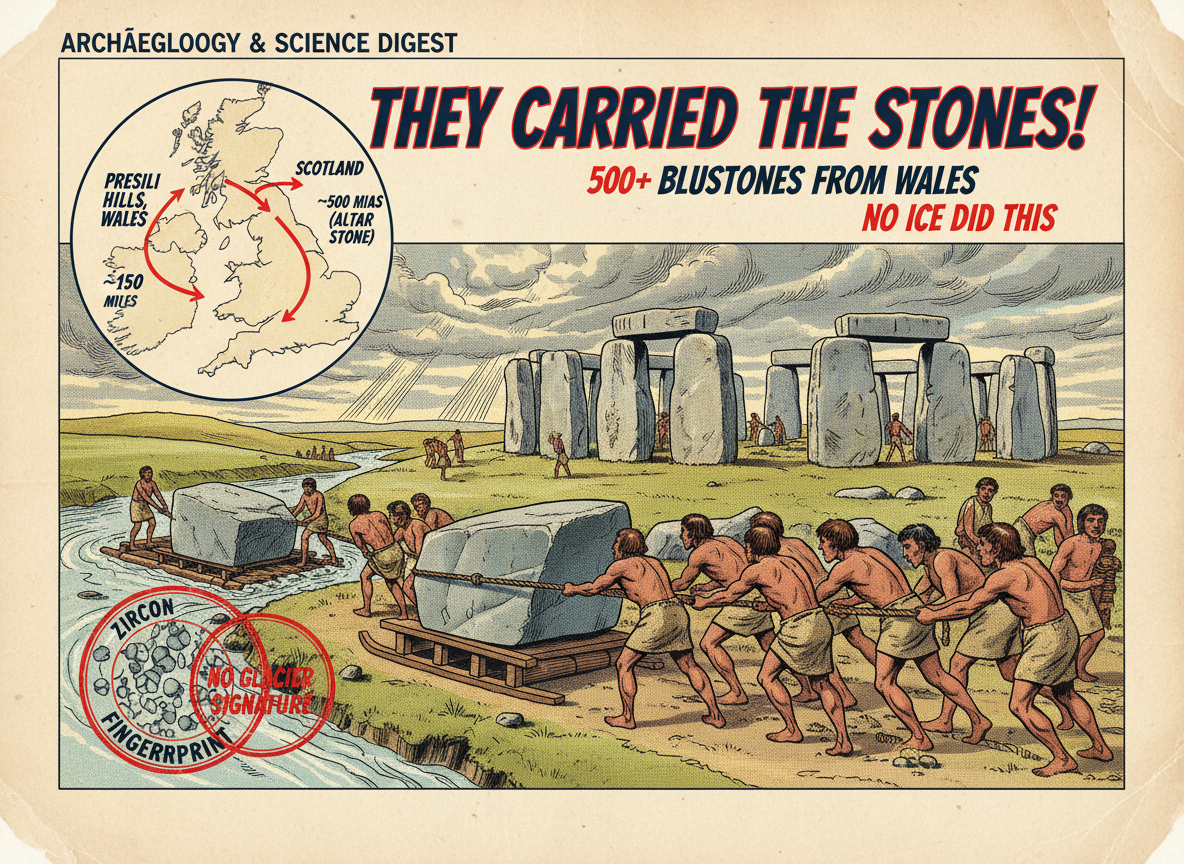
A study published in January 2026 used mineral fingerprinting on 500-plus crystals from riverbeds near Stonehenge and found no evidence that glaciers ever transported the famous bluestones to the site. The stones were carried by people, on purpose, across distances that still stagger researchers today.
Stonehenge has been standing in the English countryside for approximately 5,000 years. Millions of people have visited it. Hundreds of scientists have studied it. And for over a century, one of the most basic questions about the site, how did those enormous stones get there, has been the subject of genuine, ongoing debate.
In January 2026, a study from Curtin University in Australia moved that debate significantly forward.
The researchers used a technique called detrital zircon-apatite fingerprinting to analyze river sands near Salisbury Plain, where Stonehenge stands. The method works like geological detective work. When a glacier travels across a landscape, it picks up rocks and deposits mineral grains along its path. Those grains leave a signature in the sediment of rivers and streams downstream. If glaciers had ever carried the famous bluestones from Wales or Scotland to Stonehenge, the evidence of those minerals would still be sitting in the rivers near the site today.
The researchers examined more than 500 zircon crystals from those riverbeds. They found none of the mineral signatures that would be expected if glaciers had done the heavy lifting.
“If glaciers had carried rocks all the way from Scotland or Wales to Stonehenge, they would have left a clear mineral signature on the Salisbury Plain,” said lead author Dr. Anthony Clarke. “Those rocks would have eroded over time, releasing tiny grains that we could date and trace. We looked for those grains. We did not find any.”
The conclusion is straightforward: glaciers did not bring the stones to Stonehenge. People did.
How Far Is That, Exactly?
This is where the story becomes staggering in a way that numbers can capture better than descriptions.
Stonehenge is built from two main types of stone. The larger sarsen stones, some of which weigh up to 25 tons, came from Marlborough Downs, about 25 miles away. The smaller bluestones, which are the focus of the 2026 study, came from the Preseli Hills in Wales. The distance from the Preseli Hills to Stonehenge is approximately 150 miles as the crow flies. Over actual terrain, with rivers, hills, and woodland in the way, the effective travel distance was considerably longer.
A 2024 study, which the January 2026 paper builds upon, traced the six-ton Altar Stone at the center of Stonehenge all the way to Scotland, making it the farthest-traveled stone at the site. Scotland to Stonehenge is roughly 500 miles.
These were Neolithic people. They had no metal tools. No wheels capable of moving multi-ton loads. No horses or oxen in large numbers. They had human labor, wooden rollers, ropes, rafts, and organization.
The sheer scale of human effort required to move stones of this size and weight across this distance is something modern engineering projects would take seriously. A six-ton stone carried 500 miles by people on foot, over terrain, without modern machinery, is an undertaking that requires planning, resources, coordination, and a reason compelling enough to motivate generations of labor.
Nobody knows what that reason was.
Why This Finding Matters for the Bigger Mystery
The glacier transport theory was, for many researchers, the most comforting explanation for Stonehenge. It allowed the stones to arrive without demanding that we explain the extraordinary human logistics involved. Natural ice movement brought the rocks close, and people finished the job over shorter distances.
The 2026 study removes that comfort. The mineral record in the riverbeds near Stonehenge is clear. Glaciers did not pass through. Whatever brought those stones from Wales and Scotland to Salisbury Plain was not natural drift. It was intentional human effort.
That shifts the question from “how did the stones get here” to “why did people decide to do this.” And that question is significantly harder.
The site was built and modified over roughly 1,500 years, from approximately 3000 BC to 1500 BC. Different groups of people, across multiple generations, kept working on it. The first stage was a circular earthwork. Then wooden posts. Then the stone circles were added in phases. The whole project represents a multi-generational commitment of community resources to a single site.
Similar building traditions existed across prehistoric Europe and the British Isles. Megalithic monuments, which means large stone structures, appear from Ireland to Malta to Scandinavia. In Turkey, Göbekli Tepe was built 7,000 years before Stonehenge. In France, Carnac contains rows of thousands of standing stones extending for miles. None of these projects had any obvious material payoff. They did not produce food. They did not create shelter. They appear to have served ritual, astronomical, or social purposes that we can only partially reconstruct from the physical evidence.
What the 2026 study confirms is that the people who built Stonehenge made a choice. A long, difficult, expensive choice that required enormous effort from many people across generations. The stones did not arrive by accident. Every one of them was carried by human hands, from distances that should have made the project impossible.
The fact that it was not impossible, that it happened, raises the same question that Stonehenge has always raised: what did those people know, or believe, that made it worth doing?
Sources: ScienceDaily, A Century-Old Stonehenge Mystery May Finally Be Solved, January 27, 2026, Communications Earth and Environment, Detrital Zircon-Apatite Fingerprinting Challenges Glacial Transport of Stonehenge’s Megaliths, 2026, Wikipedia, Stonehenge, Wikipedia, Preseli Hills
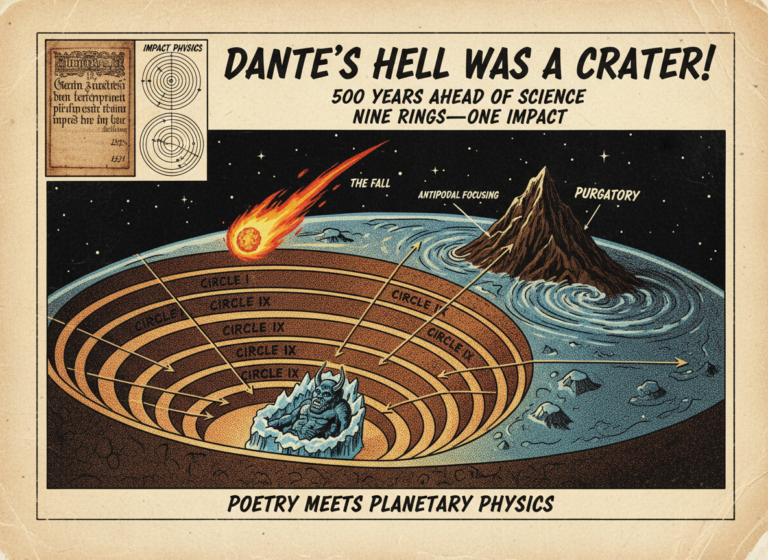
A Medieval Poet Described Hell as a Planetary Impact Crater 500 Years Before Science Had the Concept. Researchers Just Worked Out the Physics.
A new study presented at the European Geosciences Union General Assembly in Vienna in May 2026 makes a case that is extraordinary…
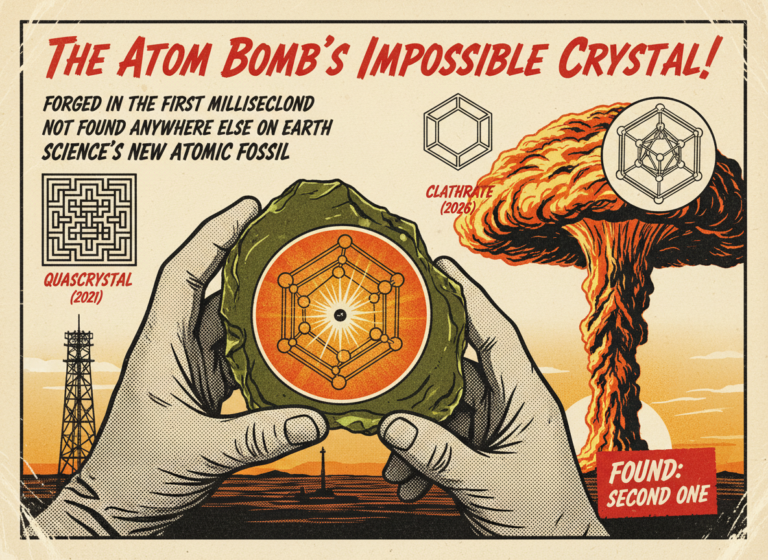
The First Nuclear Bomb Forged a Crystal That Doesn't Exist Anywhere Else on Earth. Scientists Just Found a Second One.
On July 16, 1945, at 5:29 a.m. in a remote stretch of desert in southern New Mexico, the United States Army detonated…

The Most Haunted Prison in America Opens Its Doors to Ghost Hunters Last Night. Over 200 People Died Inside.
The Ohio State Reformatory in Mansfield, Ohio, has been called the most haunted prison in America — and last night, May 14,…

A Neanderthal Had a Toothache 59,000 Years Ago. Someone Drilled It Out With a Stone Tool.
A tooth found in a Siberian cave just rewrote the history of medicine. Scientists confirmed on May 13, 2026, that a Neanderthal…