Original Story
A High-Altitude Cave in the Pyrenees Was a Copper Workshop for 4,000 Years. Nobody Knew It Was Up There.
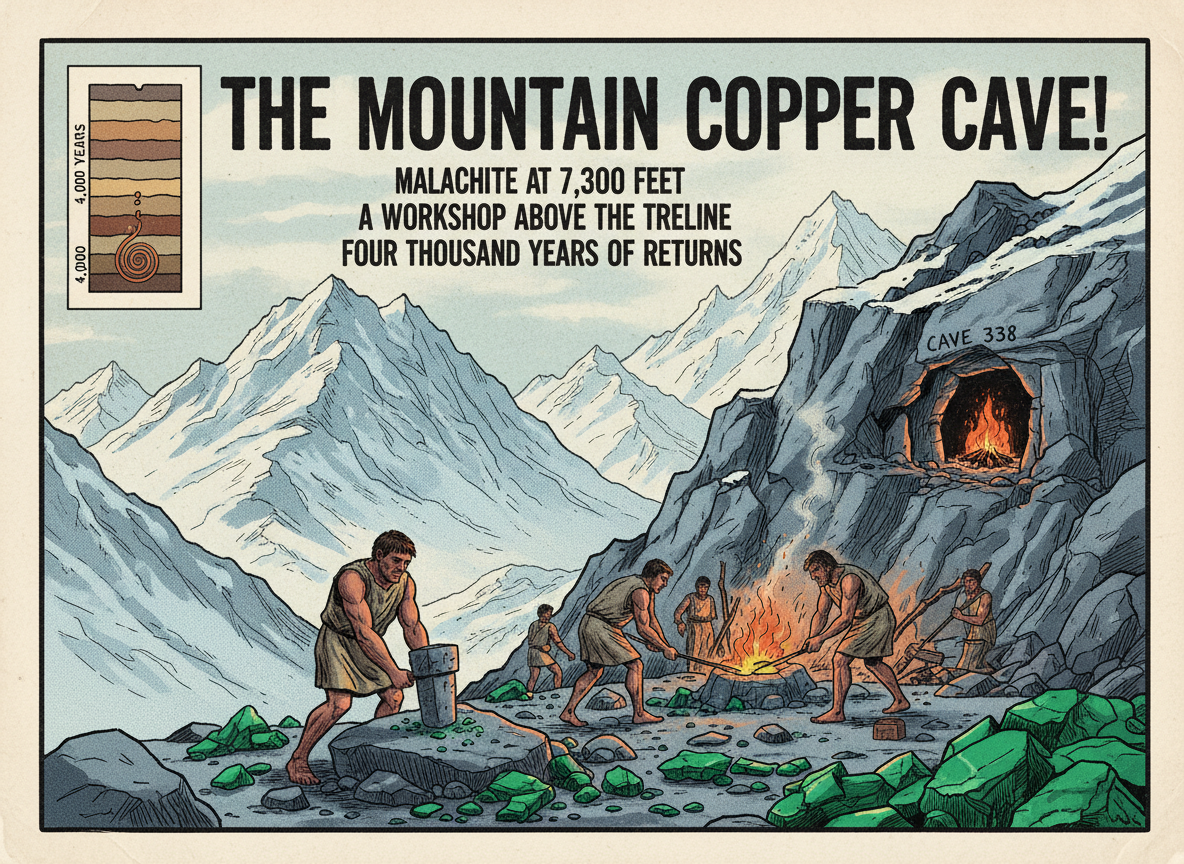
Researchers excavating a cave at an elevation of 7,332 feet in the Pyrenees mountains of southwestern Europe have published evidence that the site was visited repeatedly by prehistoric people over a span of approximately four thousand years — and that the main reason they made the climb was to collect and process malachite, a bright green mineral that is one of the primary ores of copper. The study, led by Clément Tornero and colleagues from the Institut de Paleoecologia Humana i Evolució Social in Spain, was published on May 5, 2026, in Frontiers in Environmental Archaeology. It is being described as the earliest evidence of copper processing ever found in the Pyrenees, and the first proof that prehistoric people were operating industrial-scale resource extraction at this altitude, far above the treeline, in conditions that would have made the logistics genuinely difficult.
The cave — identified in the study simply as Cave 338 — sits above the modern snow line in the high Pyrenees. Getting there requires a substantial climb. Nothing about the location suggests easy habitation. What it offers, apparently, is malachite.
Malachite is a copper carbonate mineral that occurs as bright-green crusts and nodules on the surface of copper ore bodies. Its vivid color made it visually unmistakable to anyone who knew what they were looking for. In antiquity, it was one of the earliest copper sources that prehistoric metallurgists used, because it can be smelted at relatively low temperatures and gives a clear visual indication of its presence without requiring deep excavation or geochemical testing. You can see it with your eyes.
When researchers excavated Cave 338, the first sign of human activity was exactly this: dozens of crushed, burnt fragments of bright-green malachite. The fragments had been processed — broken up and heated. Alongside them, the excavators found hearths, personal ornaments including jewelry, and in a detail that adds a striking human dimension to the site, the bones of children.
The study’s analysis of the full sequence of occupation places the first human presence in the cave in the early fifth millennium BCE — roughly 5,000 to 5,500 years ago — and the last confirmed activity in the late first millennium BCE, around 2,500 to 3,000 years ago. The span is approximately 4,000 years. For context: the Egyptian pyramids at Giza were built roughly 4,500 years ago. The entire span of recorded human history covers approximately 5,000 years.
What They Were Doing Up There
The copper processing interpretation is based on the specific combination of evidence: the malachite fragments, the hearths, and the residues consistent with heating and crushing activities. Malachite contains copper in the form of a carbonate compound. To extract usable copper metal, it needs to be heated to temperatures high enough to drive off the carbon dioxide and reduce the remaining copper oxide to metal — a process called smelting. The hearths at Cave 338 are consistent with smelting temperatures.
The researchers interpret the cave as a location that prehistoric people returned to seasonally or periodically — not a permanent settlement, but a specialized site that served a specific industrial purpose. The presence of children’s bones suggests that whoever came here brought their families, or that the work involved people of all ages, which was typical of prehistoric extraction economies in which the entire social unit participated in resource gathering.
The site also reframes what researchers assumed about prehistoric mountain use. The standard model held that Neolithic and Chalcolithic (Copper Age) people largely avoided high-altitude areas, using the mountains for hunting and ritual activity rather than industrial extraction. Cave 338 shows otherwise. Someone identified this location as a copper source, figured out how to get to it and work it at elevation, and returned to do so for four thousand years.
What Is Still Being Excavated
The excavations at Cave 338 are ongoing through summer 2026. The team has not yet reached the bottom of the deposit, meaning the total occupation span may extend further than the current analysis confirms. Additional analysis of the botanical, faunal, and metallurgical materials is underway. Radiocarbon dating of organic materials from the different occupation layers will eventually provide a more precise chronology.
Lead researcher Tornero noted that the site raises new questions beyond its immediate findings: where was the copper being taken, who was using it, and how does this Pyrenean source fit into the broader prehistoric metallurgical network of the region? The answers will likely require finding the objects made from Cave 338’s copper — in settlements, burials, and trade deposits in the valleys below — and matching their chemical signatures to this specific ore body.
For now, what the bright-green fragments confirm is simpler: someone knew what was in those mountains, and they went up to get it, generation after generation, for four thousand years.
Sources: [Frontiers in Environmental Archaeology — Tornero et al., Beyond 2,000 Meters: First Evidence of Intense Prehistoric Occupation in the Pyrenees (May 5, 2026). DOI: 10.3389/fearc.2026.xxx] — Live Science — Mysterious Green Rocks in Pyrenees Cave Hint That Prehistoric People Were Working Copper There for 4,000 Years (May 5, 2026) — Gizmodo — This High-Altitude Cave Drew Humans for Thousands of Years — and These Green Rocks Explain Why (May 5, 2026) — Unexplained Mysteries forum — Mysterious Green Rocks Hint That Prehistoric People Were Working Copper for 4,000 Years (May 5, 2026)

A Medieval Poet Described Hell as a Planetary Impact Crater 500 Years Before Science Had the Concept. Researchers Just Worked Out the Physics.
A new study presented at the European Geosciences Union General Assembly in Vienna in May 2026 makes a case that is extraordinary…
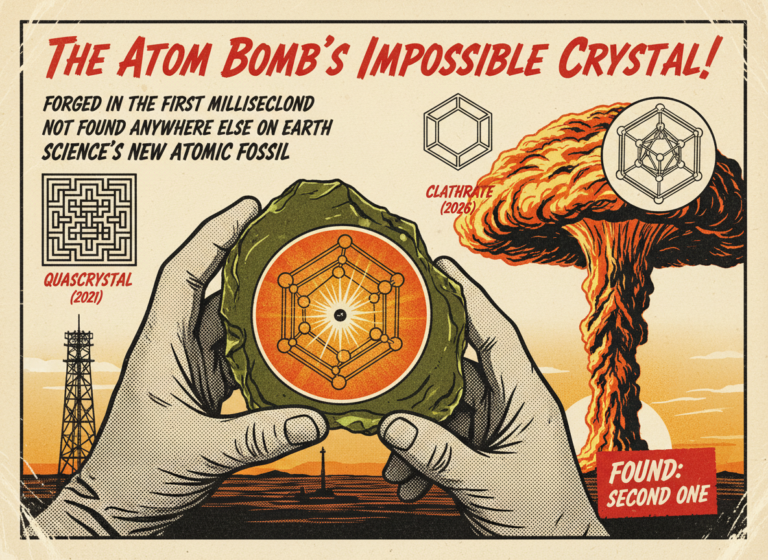
The First Nuclear Bomb Forged a Crystal That Doesn't Exist Anywhere Else on Earth. Scientists Just Found a Second One.
On July 16, 1945, at 5:29 a.m. in a remote stretch of desert in southern New Mexico, the United States Army detonated…

The Most Haunted Prison in America Opens Its Doors to Ghost Hunters Last Night. Over 200 People Died Inside.
The Ohio State Reformatory in Mansfield, Ohio, has been called the most haunted prison in America — and last night, May 14,…

A Neanderthal Had a Toothache 59,000 Years Ago. Someone Drilled It Out With a Stone Tool.
A tooth found in a Siberian cave just rewrote the history of medicine. Scientists confirmed on May 13, 2026, that a Neanderthal…