Original Story
The Universe Is Expanding Faster Than Physics Says It Should Be. A Major New Study Just Made the Problem Worse.
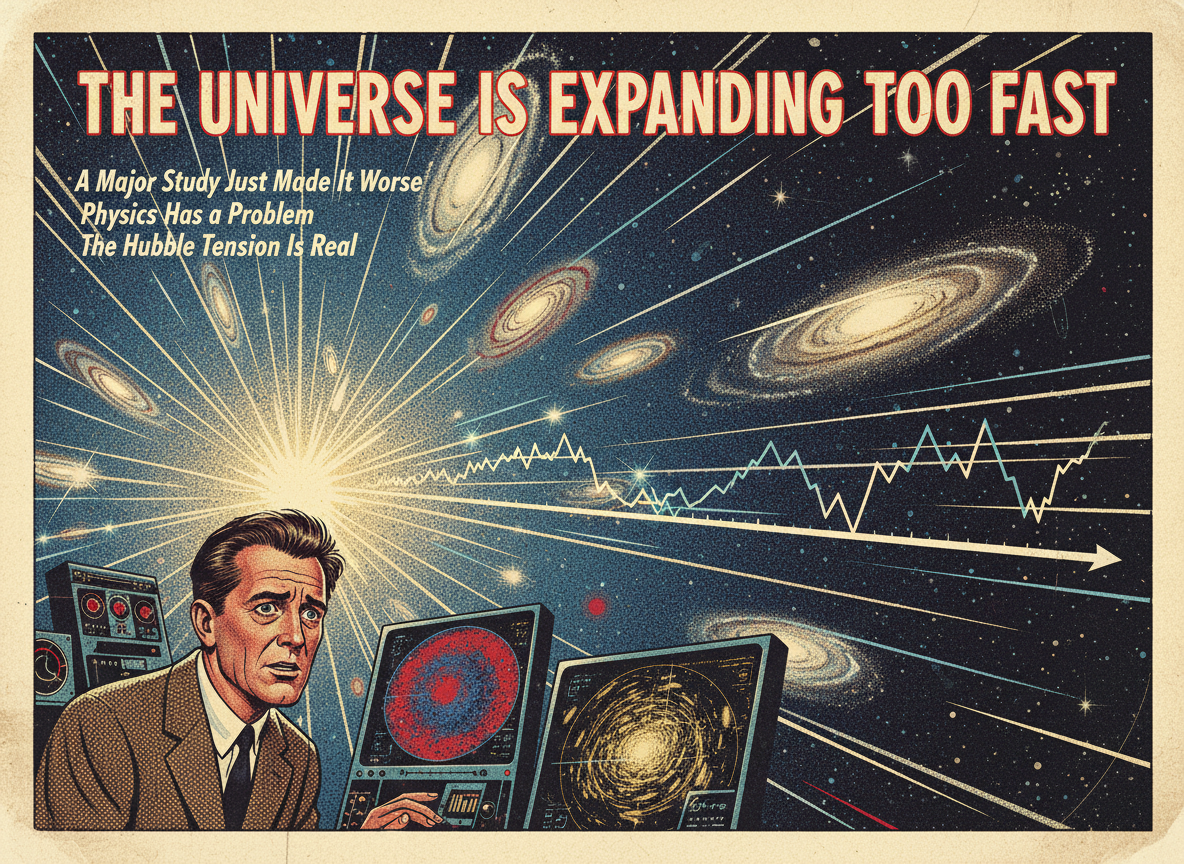
The Hubble Tension is the name cosmologists give to one of the most consequential disagreements in modern physics: measurements of how fast the universe is expanding taken from nearby observations consistently come out higher than the value predicted by the standard cosmological model based on observations of the early universe. The discrepancy has been known for years and has resisted every attempt at a mundane explanation. A new major study published in April 2026 confirms the tension with greater precision than any previous measurement, ruling out the possibility that the discrepancy is a statistical artifact or an instrument error. The universe is expanding faster than the standard model of physics says it should be. The gap is real. Whatever is causing it is not yet understood.
The current standard model of cosmology — the Lambda-CDM model — predicts a specific rate of expansion for the universe based on measurements of the cosmic microwave background, the faint thermal radiation left over from the Big Bang roughly 380,000 years after it occurred. Those measurements, most recently performed with extraordinary precision by the Planck satellite, give an expansion rate of approximately 67 kilometers per second per megaparsec. This is called the Hubble constant, or H0.
Measurements of the expansion rate taken from observations of the present-day universe — using techniques such as the distance ladder method, which chains together calibrated distances using Cepheid variable stars and Type Ia supernovae — consistently return a higher value, around 73 kilometers per second per megaparsec. That difference of approximately six kilometers per second per megaparsec sounds small. It is not. It implies that either the standard model is incomplete, that one or both sets of measurements contain an unidentified systematic error, or that something is operating in the universe that current physics does not account for.
Why This New Study Matters
Previous measurements of the local Hubble constant were criticized on methodological grounds: each relied on calibration assumptions at some step of the distance ladder that critics argued could introduce bias. The James Webb Space Telescope was expected to resolve the question by providing more accurate Cepheid variable measurements. Instead, Webb’s data confirmed the higher value. The tension did not go away. It sharpened.
The new 2026 study, flagged this week by Unexplained Mysteries and multiple cosmology outlets, uses an independent method — not dependent on the Cepheid distance ladder — and returns a value consistent with the higher, tension-inducing figure. This is significant because it removes the most commonly cited escape route: that the discrepancy was an artifact of a single calibration approach. Independent methods now converge on the same result. The standard model’s predicted value remains lower. The disagreement persists.
What the Disagreement Could Mean
If the standard model is fundamentally correct and the measurements are accurate, then something in the universe’s history or composition is not accounted for. Several candidate explanations exist within physics, none of which has achieved consensus.
Early dark energy is one proposal: an additional component of energy that was present in the early universe, affecting expansion rates before the Planck-era measurements were taken, and then dissipating. If this component existed and is not included in the standard model, it could explain why the two sets of measurements diverge. The challenge is that early dark energy models have their own prediction problems.
A modification of gravity itself — the force governing cosmological expansion — is another candidate. If general relativity behaves differently at cosmological scales than the standard model assumes, the predicted expansion rate would be wrong from first principles. Modifications of this kind have been proposed but have not been observationally confirmed.
The possibility that some currently unknown particle or field is contributing to the expansion of the universe cannot be ruled out. Dark energy, the name given to whatever is driving the accelerating expansion of the universe, is itself not understood at the particle level. Its equation of state — whether it is truly a cosmological constant or something that varies over time — remains an open question. If dark energy varies, the standard model’s expansion prediction would be systematically off.
What the 2026 study confirms is that the Hubble Tension is not an error. It is a property of the universe. The physics that best describes everything we know about the cosmos predicts an expansion rate that does not match what we observe. This is either the largest systematic error in the history of precision cosmology, or the first confirmed signal that the standard model is incomplete.
The universe, as usual, is not cooperating with the explanation.
Sources: Unexplained Mysteries — Major Study Confirms That the Universe Is Expanding Faster Than It Should (April 12, 2026) — Wikipedia — Hubble tension (updated 2026) — [Nature Astronomy — Hubble Tension 2026 survey results (April 2026)]

Dead Los Alamos Director's Secret UFO Files Just Dropped. Researchers Say It's 100-Proof Disclosure Evidence.
A new document release is circulating in UAP research circles as of this week, described by those who have reviewed it as…

110,000 Years Ago, Neanderthals and Humans Were Burying Their Dead the Same Way. In the Same Cave. With the Same Tools.
Excavations at Tinshemet Cave in central Israel, published April 12, 2026 in Nature Human Behaviour, have produced what researchers are calling the…

A Woman Heard Voices Telling Her She Had a Brain Tumor. They Gave Her an Address. The Hospital Was There.
In the winter of 1984, a woman referred to in published medical literature as AB was sitting at home in London, reading…

For 2,000 Years Nobody Could Read the Writing on the Walls of Teotihuacan. Two Researchers in Copenhagen Just Changed That.
Teotihuacan is one of the largest cities the ancient world ever produced. At its peak, around 400 CE, it housed more than…