Original Story
A Woman Heard Voices Telling Her She Had a Brain Tumor. They Gave Her an Address. The Hospital Was There.
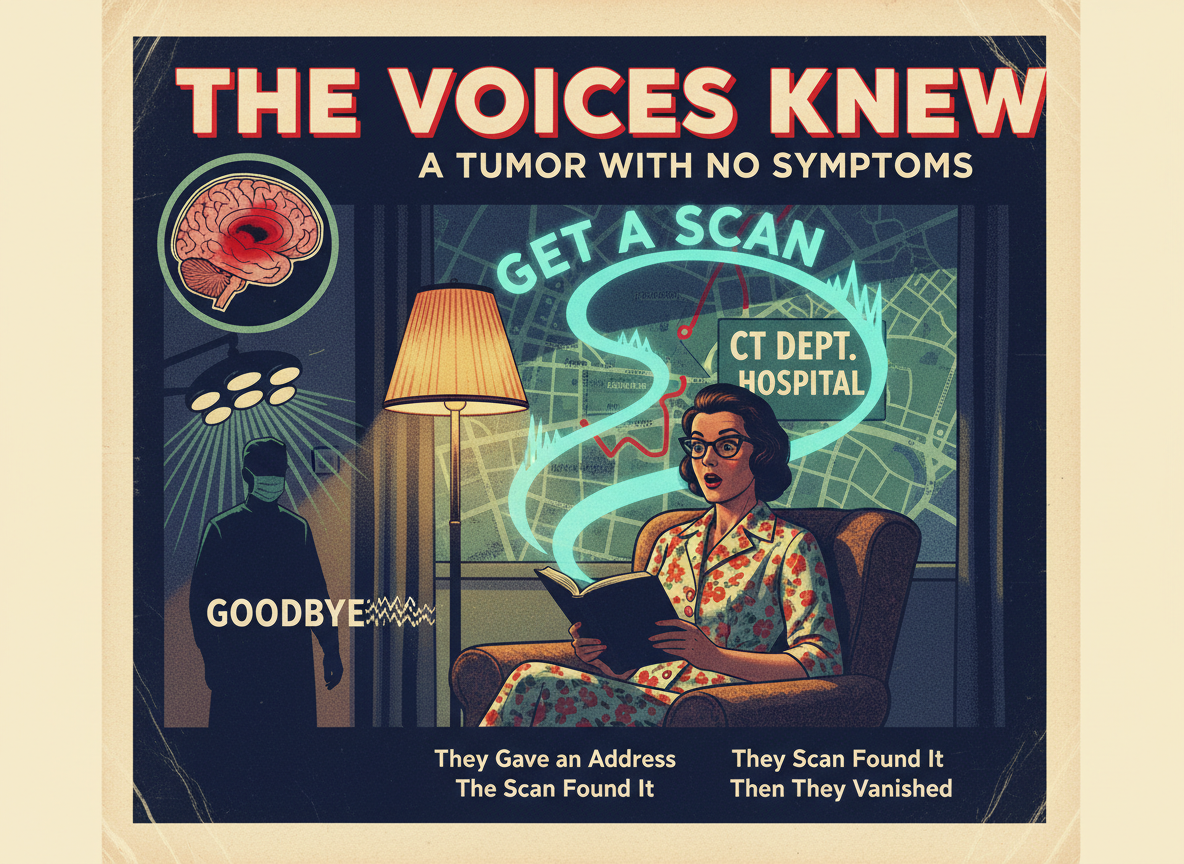
In the winter of 1984, a woman referred to in published medical literature as AB was sitting at home in London, reading a book, when a male voice inside her head introduced itself. “Please don’t be afraid,” it told her. “I know it must be shocking for you to hear me speaking to you like this, but this is the easiest way I could think of. My friend and I used to work at the Children’s Hospital, Great Ormond Street, and we would like to help you.” AB had no history of mental illness. She had no headaches. She had no neurological symptoms. She was a healthy woman in her early forties. The voice told her it had a friend, and together they wanted to help her. The case was published in the British Medical Journal by her psychiatrist, Dr. Ikechukwu Azuonye, and it resurfaced this week on Live Science and Unexplained Mysteries — a story so strange that it forces a genuine question about what knowledge is and where it can come from.
AB went to her doctor, who referred her to Dr. Azuonye’s psychiatric outpatient clinic. Azuonye diagnosed a functional hallucinatory psychosis and prescribed thioridazine, an antipsychotic. The voices faded. AB went on holiday.
Then the voices came back.
This time they were urgent. They told her she needed to return to England immediately because something was wrong and required treatment. By this point AB was also experiencing other delusional symptoms, and Azuonye was treating those as well. The voices went further: they gave her a specific address. Her husband drove her to it. The address was the computerized tomography department of a large London hospital.
At the entrance, the voices told her to go inside and ask for a brain scan. She had a tumor, they said, and her brain stem was inflamed.
The Scan Nobody Wanted to Order
Azuonye requested the scan. In his accompanying letter, he wrote that the purpose was to reassure his patient, because hallucinatory voices had told her she had a brain tumor and there were no clinical signs to support such a suspicion. The request was initially declined. There was no medical justification, the hospital told him, for such an expensive investigation.
After further negotiation, the scan was carried out. It revealed a left posterior frontal parafalcine mass extending through the falx to the right side. The diagnosis: a meningioma. A tumor measuring approximately 2.5 inches by 1.5 inches, with no symptoms. No headaches. No focal neurological deficits. Nothing that would have sent AB to a doctor on its own.
The voices, when Azuonye told AB about the findings, responded through her: they were “fully in agreement” with the decision to operate.
The Goodbye
Surgery was performed. The tumor was removed. As AB regained consciousness on the operating table, the voices spoke one final time: “We are pleased to have helped you. Goodbye.”
The voices did not return. AB was taken off thioridazine immediately after the operation. She recovered without complications.
Twelve years later, she called Dr. Azuonye’s office to wish him happy holidays. She told him she had been symptom-free since the surgery.
What Azuonye and Others Said About It
The standard medical explanations are worth laying out. One possibility: AB had unconsciously registered sensations from the growing tumor — pressure, vague discomfort — that her brain converted into an external-sounding voice. Another: she had somehow absorbed information about nearby hospitals and imaging departments without consciously registering it. Another: there had been a previous diagnosis elsewhere that she was concealing. Azuonye addressed all three in the published case report and found each unsatisfying given the specifics.
The voice did not simply say she was ill. It gave her an address. The address was the CT department of a specific hospital. The scan that address led to found the tumor. The voice then agreed to the surgery, and at the moment of recovery, signed off.
“It may well be the only case of someone whose brain tumor helped diagnose their own brain tumor,” IFLScience noted in a review of the case.
Dr. Azuonye himself, in later interviews, said he personally believed AB had been helped by “someone.” In his view, the world we experience is one of many worlds, and he had no difficulty accepting the possibility of non-physical assistance. He was, by that point, open to exactly such conclusions.
Whether you read this as a curious neurological coincidence, an extraordinary example of the brain’s hidden self-knowledge, or something else entirely is a question the case deliberately refuses to close.
Sources: Live Science — Diagnostic Dilemma: A Woman Heard Voices Telling Her She Had a Brain Tumor, and Scans Confirmed She Did (April 15, 2026) — Unexplained Mysteries — Voices Told Woman She Had a Brain Tumor, and It Turned Out That She Did (April 16, 2026) — BMJ — Azuonye, A Difficult Case: Diagnosis Made by Hallucinatory Voices (1997) — IFLScience — Woman Hallucinated Voices Telling Her to Get a Brain Scan. It Saved Her Life. — Rational Psychiatry — Guided by Voices (July 2024)
Dead Los Alamos Director's Secret UFO Files Just Dropped. Researchers Say It's 100-Proof Disclosure Evidence.
A new document release is circulating in UAP research circles as of this week, described by those who have reviewed it as…

110,000 Years Ago, Neanderthals and Humans Were Burying Their Dead the Same Way. In the Same Cave. With the Same Tools.
Excavations at Tinshemet Cave in central Israel, published April 12, 2026 in Nature Human Behaviour, have produced what researchers are calling the…

For 2,000 Years Nobody Could Read the Writing on the Walls of Teotihuacan. Two Researchers in Copenhagen Just Changed That.
Teotihuacan is one of the largest cities the ancient world ever produced. At its peak, around 400 CE, it housed more than…
An Oklahoma Woman Was Mauled by Something Nobody Can Identify. Four Surgeries Later, the DNA Results Still Aren't In.
On the morning of March 29, 2026, a 38-year-old mother named Alicia Maxey was found unconscious and badly injured near Blanco in…