Original Story
The FBI’s Portion of the UFO Files Has Alien Witness Accounts, Government Surveillance of a UFO Author, and a Roswell Memo That Was Never Fully Read.
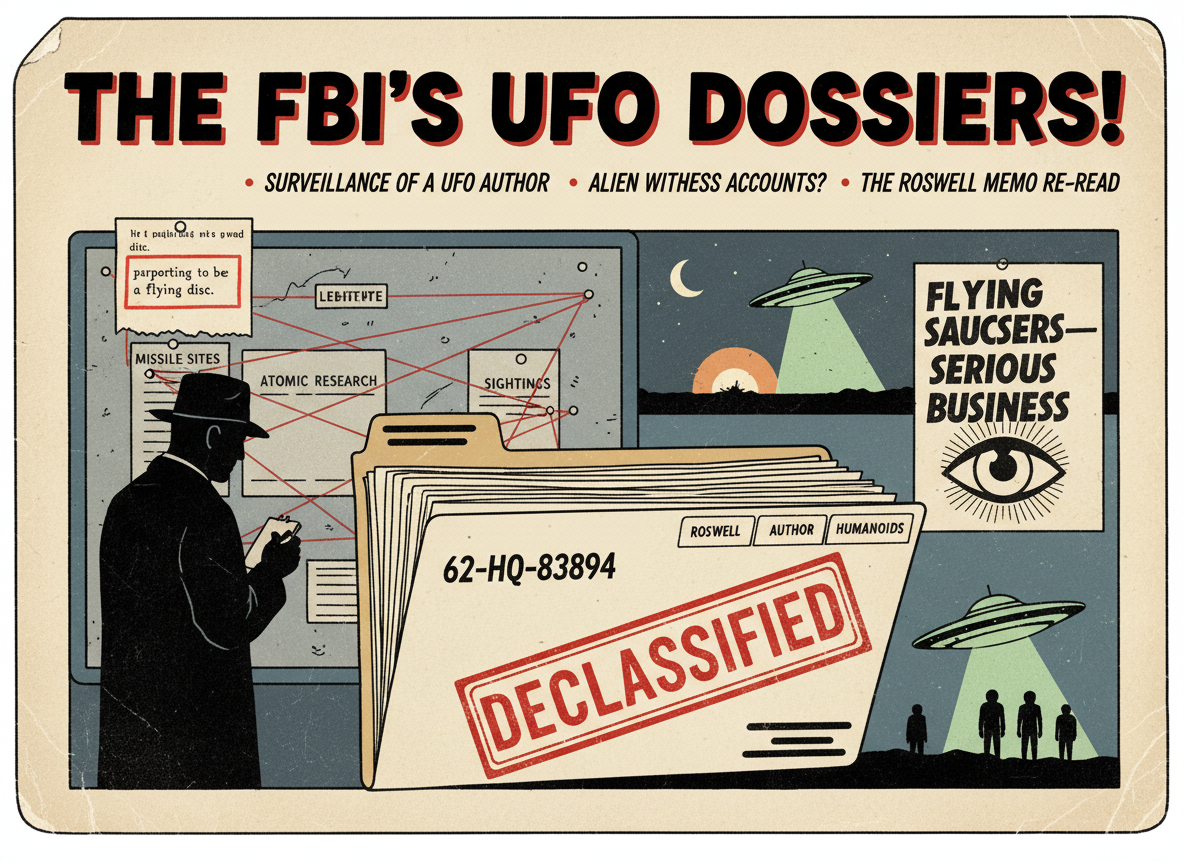
When the Pentagon released 162 declassified UAP records on May 8, 2026, 56 of them came from the FBI. Researchers began working through those documents within hours of the release going live, and what emerged over the following 24 hours was a specific picture of how the FBI engaged with the UFO phenomenon — not as a scientific question but as a domestic intelligence matter, tracking public perception of the topic, filing witness accounts into classified case files, and coordinating with Air Force officers on specific incidents including Roswell. The FBI file known as 62-HQ-83894, described in the release as newly declassified with “several newly declassified pages” and fewer redactions than previously available versions, is the anchor document for this angle. Some of what is in it has been available for years. But not all of it — and the pages that are newly visible are drawing significant attention.
The FBI first became involved in UFO investigations in 1947, within weeks of the first major post-war flying saucer incident at Roswell, New Mexico. An FBI agent in the Dallas field office filed a memo to FBI headquarters reporting that an Air Force major had called the office to inform it that “an object purporting to be a flying disc was recovered near Roswell, New Mexico.” The use of the word “purporting” is typically taken by researchers as the standard hedge of a mid-level government official relaying secondhand information. The memo, which has been part of the public record for years in redacted form, appears in the new release with fewer blackouts.
The Roswell memo is not the most unusual document in the FBI’s portion of the release. That distinction belongs to a 1966 internal memo discussing a book — Flying Saucers — Serious Business by journalist Frank Edwards — and what the bureau made of its impact on public awareness.
The Government Surveillance of a UFO Author
Frank Edwards was a journalist and broadcaster who had been fired from his radio position at WCFL Chicago in 1954 after he spoke out against the influence of the American Federation of Musicians on his programming. He subsequently became one of the most prominent popular writers on UFOs in the 1960s, culminating in Flying Saucers — Serious Business, published in 1966. The book was a bestseller.
The FBI memo reveals that the bureau was tracking the book’s impact on public awareness of UAP, noting that Edwards had significantly “increased the public’s awareness of the phenomenon.” The memo notes: “A number of photographs of the objects have been reproduced in the book, some reportedly taken by reputable persons. Many reported sightings are from atomic and missile research areas.”
The significance of this document goes beyond what it says about Frank Edwards. It shows that the FBI in 1966 was actively monitoring what civilian authors were writing about UFOs, tracking the book’s claims against internal intelligence, and noting — with apparent concern — that many sightings were concentrated near atomic and missile research facilities. This is a national security framing, not a scientific one. The question the bureau appears to have been asking is not whether UFOs are real, but whether public awareness of them was a security risk.
The 1966 Humanoid Accounts
Also in the FBI portion of the release: a 1966 memo containing eyewitness accounts of small humanoid figures described as three-and-a-half to four feet tall, wearing what witnesses called “space suits and helmets,” encountered near unidentified craft. The memo describes the 1965-1966 period as a surge year in UFO sightings and documents these specific accounts as part of a broader case file review.
Independent experts have urged caution about these accounts, noting they are anecdotal and unverified — witness descriptions filed into a government document do not constitute evidence that the events described occurred as reported. But the filing itself is significant. The FBI was not dismissing these accounts as obvious fabrications or misidentifications. They were preserving them in a classified case file. If the accounts were clearly explainable, they would not require a classified home.
What the FBI Documents Do Not Establish
It is worth being clear, as researchers reviewing the files have been: nothing in the FBI portion of the release constitutes evidence that the US government has confirmed contact with non-human intelligence, recovered extraterrestrial craft, or concealed physical proof of alien life. The documents are internal correspondence, eyewitness accounts, and intelligence assessments — the inputs to a conclusion, not the conclusion itself.
What they do establish is a decades-long pattern of serious, classified government engagement with the phenomenon, concentrated near exactly the locations — nuclear facilities, missile research areas, military test sites — that UAP researchers have been pointing to for years.
The FBI kept files. Those files had classified pages. Some of those pages are now visible. The picture they paint, across eight decades, is of a government that treated this subject with far more seriousness than it ever publicly admitted.
Sources: Unexplained Mysteries — New Details of UFO and Alien Encounters Emerge from FBI Files (May 9, 2026) — CBS News — Pentagon Begins Releasing New UFO Files (May 8, 2026) — Mail Online — FBI UFO Files Frank Edwards Flying Saucers Serious Business (May 9, 2026) — war.gov/UFO — Department of War UFO Declassified Files Portal (May 8, 2026)
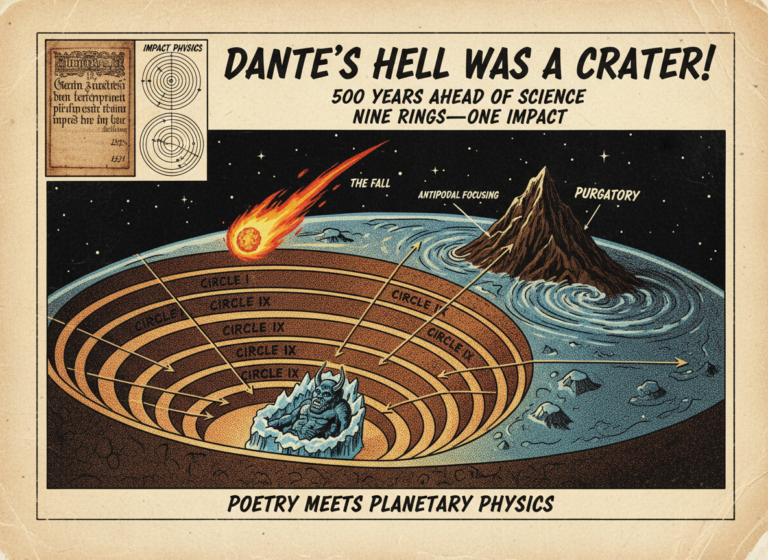
A Medieval Poet Described Hell as a Planetary Impact Crater 500 Years Before Science Had the Concept. Researchers Just Worked Out the Physics.
A new study presented at the European Geosciences Union General Assembly in Vienna in May 2026 makes a case that is extraordinary…
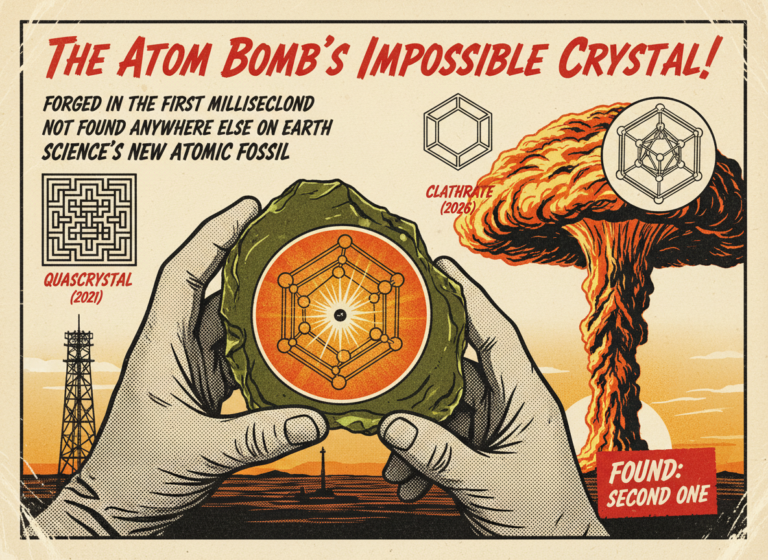
The First Nuclear Bomb Forged a Crystal That Doesn't Exist Anywhere Else on Earth. Scientists Just Found a Second One.
On July 16, 1945, at 5:29 a.m. in a remote stretch of desert in southern New Mexico, the United States Army detonated…
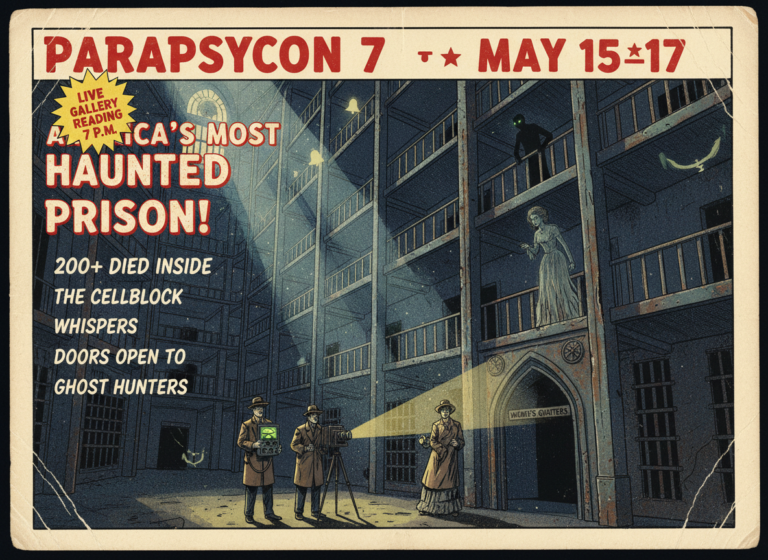
The Most Haunted Prison in America Opens Its Doors to Ghost Hunters Last Night. Over 200 People Died Inside.
The Ohio State Reformatory in Mansfield, Ohio, has been called the most haunted prison in America — and last night, May 14,…

A Neanderthal Had a Toothache 59,000 Years Ago. Someone Drilled It Out With a Stone Tool.
A tooth found in a Siberian cave just rewrote the history of medicine. Scientists confirmed on May 13, 2026, that a Neanderthal…