Original Story
They All Died in 1959. A New Theory Says a Soviet Rocket Did It.
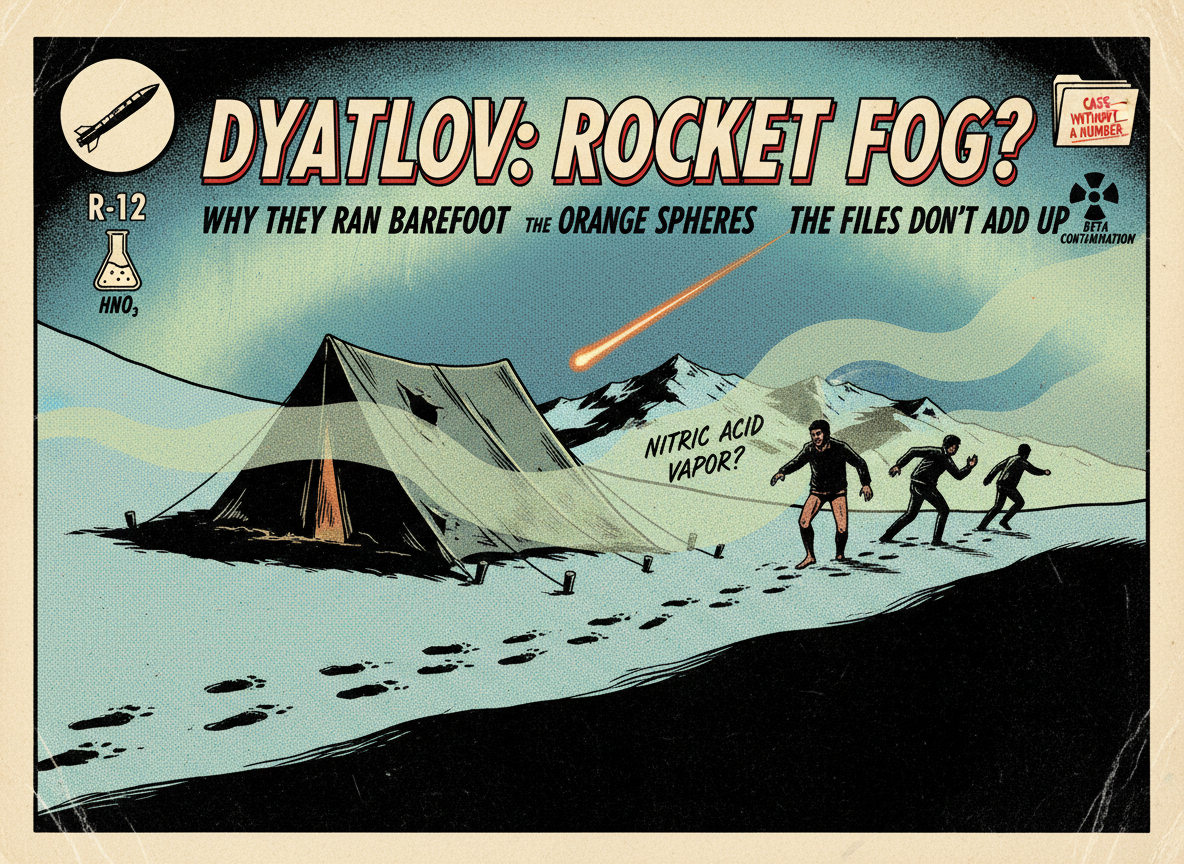
For 67 years, the Dyatlov Pass incident has refused to give up its secrets. Nine experienced Soviet hikers fled their tent in the middle of the night, half-dressed, in minus-40-degree cold, and died in ways that made no sense. A new theory published in early 2026 says a failed Soviet missile launch filled the area with nitric acid fog. A separate forensic review found problems with the original investigation documents. Neither explanation is fully proven. The mystery is not closed.
In February 1959, nine experienced hikers from the Ural Polytechnical Institute set out on a ski expedition through the northern Ural Mountains of Soviet Russia. They were led by 23-year-old engineering student Igor Dyatlov. All nine were trained, experienced, and well-equipped for the journey.
None of them came back.
When rescuers found the camp weeks later, they found a tent that had been cut open from the inside. Footprints led away from the tent into the snow, some made by bare feet, some by people wearing only socks. The hikers had left their gear, their food, their boots. They went out into minus-40-degree temperatures without adequate clothing and did not come back.
Their bodies were found scattered across the slope over a period of months. Six had died of hypothermia. Three had died from physical trauma so severe that Soviet investigators described it as comparable to a car crash. One woman was missing her tongue. Two had their eyes removed. Four had fractured ribs or skulls with no external injuries to show how the damage happened.
The Soviet investigation concluded the deaths were caused by a “compelling natural force.” The case was classified and sealed. It has been reopened and revisited dozens of times since.
In 2026, the mystery has two new threads pulling at it.
The Nitric Acid Theory
In March 2026, researchers put forward a new explanation that connects the deaths to a failed Soviet ballistic missile launch in the area.
The theory centers on the R-12, a liquid-fueled medium-range ballistic missile that the Soviet Union was actively testing during this period. The R-12 used nitric acid as an oxidizer. If a launch failed, or if a missile came apart in the atmosphere over the mountains, it could have released a cloud of nitric acid vapor that drifted across the hikers’ campsite on the slope of Kholat Syakhl, which locals translated as “Death Mountain.”
Nitric acid fog would not be visible. It would not be detectable by smell at low concentrations. But at sufficient density it would cause immediate and severe burning of the eyes, throat, and skin. It would force anyone it touched to flee immediately in whatever direction led away from it, without stopping to dress, without stopping to think. People exposed to nitric acid vapor do not calmly gather their belongings. They run.
Witnesses from nearby villages reported seeing glowing orange spheres in the sky around the time of the hikers’ deaths. Researchers backing this theory argue those spheres were the exhaust plumes of a launched or failing rocket, seen at altitude against the dark sky. Soviet military tests of this type were common in the area and are well-documented from other sources.
The theory would explain the frantic, unplanned exit from the tent. It would explain the deaths by exposure, because people who flee a toxic cloud in the dark do not necessarily find their way back before hypothermia sets in. It would also provide a reason for the Soviet government to classify the case, since acknowledging a failed missile test that killed civilian students would be politically explosive during the Cold War.
What it does not yet explain fully is the physical trauma. The chest and skull injuries on three of the hikers were severe enough that the original Soviet forensic examiner compared them to forces generated by a car accident. Nitric acid fog does not crush ribs or fracture skulls.
The Radioactive Clothing Problem
A separate forensic issue has been generating attention in early 2026 through renewed analysis of the original investigation documents, including a March 2026 review published at dyatlovpass.com titled “Case Without a Number.”
Several pieces of the hikers’ clothing tested positive for radioactive contamination during the original Soviet investigation. The specific items were the clothing of Rustem Slobodin, Yuri Krivonischenko, and Aleksandr Kolevatov. The contamination was beta radiation, meaning it came from radioactive isotopes, not simply background environmental radiation.
The standard explanation is that some of the hikers worked or studied in facilities that handled radioactive materials and may have carried contamination with them on the trip. Another possibility is fallout from Soviet atmospheric weapons tests, which were frequent in the Urals during this period.
But the 2026 forensic review raises a different problem. According to researchers who examined the procedural documents, several key forensic records from the original investigation show signs of irregularities. Typing errors, incorrect terminology, and procedural inconsistencies suggest that some documents may not have been prepared by the credentialed medical professionals whose names appear on them. If that is correct, the official forensic record of what happened to the hikers may be compromised, meaning the documents that everyone has been working from for 67 years may not accurately reflect what the original investigators actually found.
What Remains Unexplained
The most popular recent scientific theory before the rocket fog idea was the delayed slab avalanche hypothesis. In 2021, researchers Alexander Puzrin and Johan Gaume published a study in a peer-reviewed journal proposing that a specific type of snow avalanche called a slab avalanche, triggered after a delay by wind loading above the tent, could have caused the initial trauma and forced the hikers to flee. They followed up with video evidence gathered on expeditions to the pass showing that slab avalanches do occur in the area under similar conditions.
This explanation handles the internal injuries fairly well. A slab of snow hitting sleeping hikers at close range can generate enough force to cause chest and skull fractures without leaving visible external marks. It also explains the tent being cut from the inside: people trapped under snow would cut their way out.
What it does not fully account for is the radioactive clothing, the missing tongue and eyes, or the lead investigator’s personal belief, stated publicly in 1990 after the files were partially declassified, that the mysterious orange spheres in the sky had something to do with the deaths.
That investigator was Lev Ivanov. He ran the original 1959 inquiry. He said, three decades after the fact, that he had been ordered to close the case and that he personally believed the flying spheres were relevant to what happened.
No theory currently accounts for everything. Not the avalanche. Not the rocket fog. Not Soviet weapons testing. Each one explains some of the evidence and leaves other parts untouched.
For 67 years, that slope has kept its secret. Nine people walked up it and did not come back, and every explanation offered so far has failed to close all the questions they left behind.
Sources: Ancient Origins, The Dyatlov Pass Incident: New Forensic Perspectives, April 2026, Los Angeles Today, New Theory Emerges in Mysterious 1959 Dyatlov Pass Incident, March 8, 2026, dyatlovpass.com, Case Without a Number, March 24, 2026, Wikipedia, Dyatlov Pass Incident, Headcount Coffee, Dyatlov Pass Radiation: What Investigators Actually Found

A Medieval Poet Described Hell as a Planetary Impact Crater 500 Years Before Science Had the Concept. Researchers Just Worked Out the Physics.
A new study presented at the European Geosciences Union General Assembly in Vienna in May 2026 makes a case that is extraordinary…

The First Nuclear Bomb Forged a Crystal That Doesn't Exist Anywhere Else on Earth. Scientists Just Found a Second One.
On July 16, 1945, at 5:29 a.m. in a remote stretch of desert in southern New Mexico, the United States Army detonated…

The Most Haunted Prison in America Opens Its Doors to Ghost Hunters Last Night. Over 200 People Died Inside.
The Ohio State Reformatory in Mansfield, Ohio, has been called the most haunted prison in America — and last night, May 14,…

A Neanderthal Had a Toothache 59,000 Years Ago. Someone Drilled It Out With a Stone Tool.
A tooth found in a Siberian cave just rewrote the history of medicine. Scientists confirmed on May 13, 2026, that a Neanderthal…