Original Story
The Dire Wolves Are Breeding Age. Their DNA Came From a 72,000-Year-Old Bone in Idaho. And the Debate Over Whether They Are “Real” Has Not Stopped.
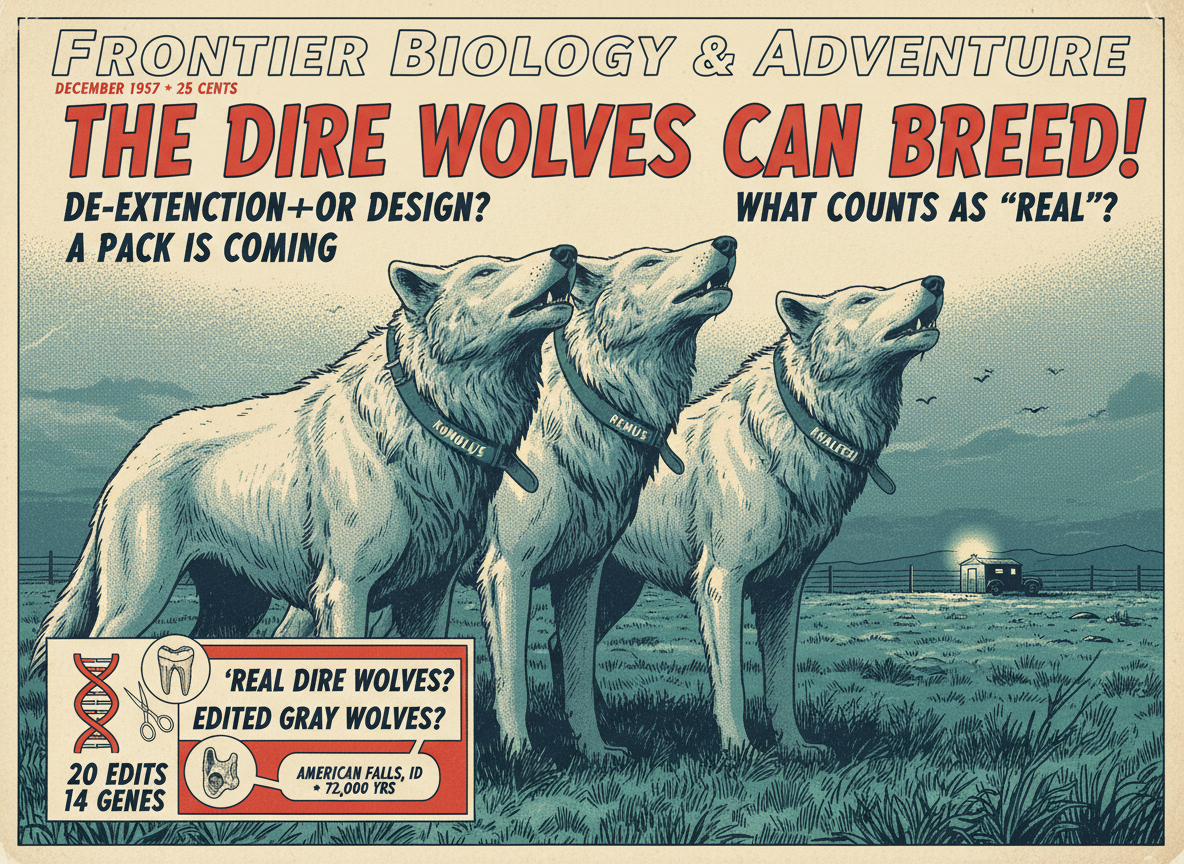
On May 8, 2026, Colossal Biosciences announced that its three genetically engineered dire wolf animals — Romulus, Remus, and Khaleesi — have now reached breeding age and that the company plans to expand the pack this year, initially through assisted reproduction before natural breeding begins. The three animals, born in late 2024 and early 2025, have been living on a 2,000-acre ecological preserve at an undisclosed location in the United States, eating deer, beef, and horse meat, learning to process whole carcasses, and growing into animals that are, by every visual account, extraordinarily striking. They are white-coated, large-bodied, powerful-shouldered, and they howl in a way that is different from a standard gray wolf. The debate about whether they are actually dire wolves has not reached a consensus. But they exist, they are healthy, and they are now old enough to have pups of their own.
The story of how Romulus, Remus, and Khaleesi came to be starts with two ancient bones.
Scientists at Colossal extracted ancient DNA from a 13,000-year-old tooth found at Sheridan Cave, a Pleistocene archaeological site in Wyandot County, Ohio, and a 72,000-year-old ear bone found in American Falls, Idaho. These two specimens, loaned by the museums that house them, provided the raw genetic material from which Colossal reconstructed what they described as approximately 91 percent of the dire wolf genome. The remaining gaps were filled by comparison with the gray wolf genome, the closest living relative of the dire wolf.
That reconstruction identified which specific genes needed to change in a gray wolf to produce the distinctive physical traits of the dire wolf. The answer was 20 edits across 14 genes. Using CRISPR-Cas9, Colossal modified gray wolf embryos to incorporate those changes. The edited embryos were implanted in surrogate dog mothers and delivered by caesarean section.
The 20 edits produced significant physical differences from standard gray wolves: white coat, larger head and jaw, more powerful shoulders, heavier body mass, longer legs, and a distinctive vocalization. Khaleesi, the female, and the two males Romulus and Remus are, by visual appearance, strikingly different from any gray wolf most people have seen.
What “Breeding Age” Means and What Comes Next
Matt James, Colossal’s chief animal officer, confirmed this week that the animals have reached breeding age and that the company intends to grow the pack. The initial expansion will not be through natural breeding between the existing three animals — the company wants to engineer two to four additional individuals first, specifically to introduce genetic diversity before allowing the pack to reproduce naturally. Otherwise, the entire current gene pool consists of three animals, which is dangerously narrow.
“The dire wolf pack is actually breeding-aged at this point,” James said. “But we will initially grow the pack through assisted reproduction while we create new, genetically diverse individuals.”
Colossal CEO Ben Lamm confirmed the animals are thriving: “The three dire wolves live on a 2,000-acre secure, expansive ecological preserve that allows us to monitor and manage them while providing them a semi-wild habitat to thrive in. We hope to have more dire wolf pups by the end of the year.”
Colossal also confirmed this week that it has added a sixth de-extinction target: the bluebuck antelope (Hippotragus leucophaeus), the first large African mammal driven to extinction in modern history, which disappeared around 1800 due to overhunting by European settlers. Current parallel projects include the woolly mammoth (targeting a live calf by late 2028, working with Asian elephants via 85 gene edits) and the thylacine, or Tasmanian tiger (working with the fat-tailed dunnart as a surrogate).
The “Are They Really Dire Wolves?” Question
The controversy over Colossal’s claim has not resolved since it first erupted in early 2025, when the animals were unveiled on the cover of Time Magazine.
Colossal’s own chief scientist Beth Shapiro acknowledged in a YouTube video that the animals are “grey wolves with 20 edits,” and that the term “dire wolves” applied to them is a colloquialism, not scientific terminology. The IUCN Species Survival Commission’s Canid Specialist Group officially declared the three animals are neither dire wolves nor proxies of dire wolves under their guidelines, and stated the project “does not contribute to conservation” because the animals have no ecological niche in the modern world. The megafauna they would have preyed upon — large native horses, camels, mammoths — are also extinct.
Independent scientists at Texas A&M and elsewhere have made a point that is technically precise but practically strange to absorb: what the CRISPR edits changed was not ancient dire wolf DNA inserted into a gray wolf — there is no mechanism to do that — but rather gray wolf DNA rewritten to match what the dire wolf genome specified. No ancient DNA is literally in these animals. Their cells are gray wolf cells, rewritten in 20 places, to express traits that resemble the extinct species.
George R.R. Martin, the author who named Game of Thrones’ dire wolves, was invited to see Romulus, Remus, and Khaleesi in person. He wrote: “Maybe I was remembering a past life, when I ran with a pack in the Ice Age. Whatever the reason, I have to say the rebirth of the direwolf has stirred me as no scientific news has since Neil Armstrong walked on the moon.”
Whether they are real dire wolves is a question for taxonomists and philosophers. They run on four legs, they howl at nothing visible, they do not approach humans, and they live on 2,000 acres. They are, in the most practical sense, something that has not existed on Earth in ten thousand years.
Sources: Modernity — De-Extinct Dire Wolves Ready to Breed; Bioscience Company Pushes Forward Multiple Projects (May 8, 2026) — Time Magazine — The Return of the Dire Wolf (March 2026) — Wikipedia — Colossal Biosciences Dire Wolf Project (updated May 2026) — ScienceDirect — Engineered Proxies and the Illusion of De-Extinction (2026) — The Battalion / Texas A&M — Dismantling the Dire Wolves (2025-2026) — Unexplained Mysteries — Colossal Biosciences Wants to Breed Its De-Extincted Dire Wolf Pups (May 10, 2026)
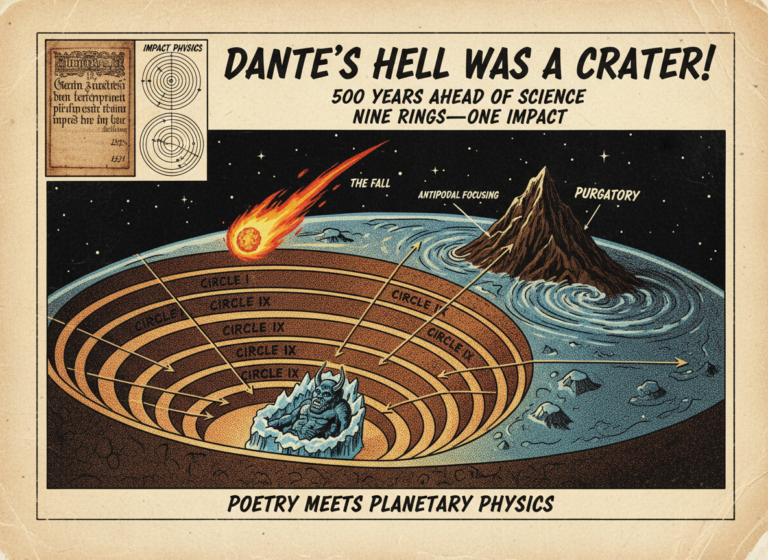
A Medieval Poet Described Hell as a Planetary Impact Crater 500 Years Before Science Had the Concept. Researchers Just Worked Out the Physics.
A new study presented at the European Geosciences Union General Assembly in Vienna in May 2026 makes a case that is extraordinary…

The First Nuclear Bomb Forged a Crystal That Doesn't Exist Anywhere Else on Earth. Scientists Just Found a Second One.
On July 16, 1945, at 5:29 a.m. in a remote stretch of desert in southern New Mexico, the United States Army detonated…

The Most Haunted Prison in America Opens Its Doors to Ghost Hunters Last Night. Over 200 People Died Inside.
The Ohio State Reformatory in Mansfield, Ohio, has been called the most haunted prison in America — and last night, May 14,…

A Neanderthal Had a Toothache 59,000 Years Ago. Someone Drilled It Out With a Stone Tool.
A tooth found in a Siberian cave just rewrote the history of medicine. Scientists confirmed on May 13, 2026, that a Neanderthal…