Original Story
Something Is Draining the Blood from Farm Animals in Brazil, and Nobody Can Catch It
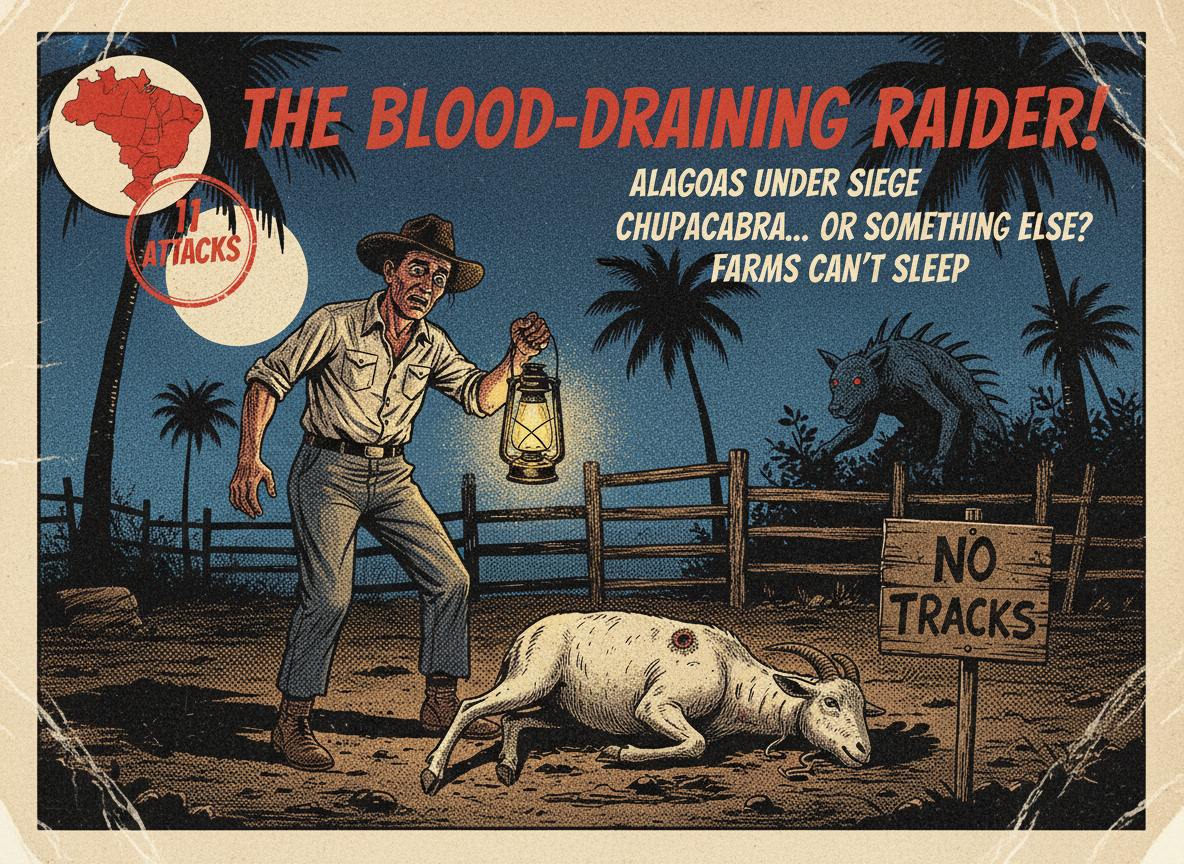
Since February 2026, a mystery predator in the Brazilian state of Alagoas has killed dozens of sheep, pigs, goats, and rabbits across at least 11 separate attacks. The animals are drained of blood. No tracks. No clear evidence of what kind of creature is responsible. Locals believe it is the chupacabra.
Ranchers in Alagoas, a state in northeastern Brazil, have had a bad year.
Since February 2026, something has been killing their animals. Not eating them, not carrying them off. Killing them and leaving the bodies behind, drained of blood, with small puncture wounds that local ranchers and investigators have struggled to explain. The attacks have continued through April, with at least 11 separate incidents recorded across multiple communities. The victims include sheep, pigs, goats, and rabbits.
Nobody has caught the creature. Nobody has clearly identified it. And a growing number of the people who live there believe what is happening is the work of the chupacabra, one of the most enduring and controversial cryptids in the Western Hemisphere.
What Has Been Happening in Alagoas
The first reports out of Alagoas surfaced in early April 2026, when ranchers who had been dealing with the attacks since February finally went public. By that point, multiple communities across the state had reported losses. The pattern was consistent: animals found dead, bodies largely intact but drained of blood, with small entry wounds that do not match the bite patterns of known regional predators.
Coast to Coast AM, which has been tracking the story since April 9, reported that by late April, two additional attacks had occurred since the story first broke, bringing the total to at least 11 incidents and adding more animals to the count.
Brazilian state wildlife officials have not confirmed the identity of the predator. No credible photograph or video of the creature in the act of attacking has been captured. The attacks have continued despite local awareness and attempts to protect livestock.
The exact number of animals killed has not been officially totaled across all incidents, but early reporting indicated dozens of animals were affected across the first nine attacks alone.
What Is the Chupacabra?
The chupacabra is one of the most famous cryptids in North and South America. Its name comes from Spanish and translates literally to “goat sucker,” a reference to the kind of attack it is most commonly associated with: livestock found dead and drained of blood.
The modern legend began in Puerto Rico in 1995. In March of that year, eight sheep were found dead with puncture wounds in the chest and no blood remaining in their bodies. A few months later, in August, an eyewitness in the town of Canóvanas reported seeing a creature that she described as reptilian, roughly the size of a small bear, with a row of spines along its back and large, dark eyes. In the months that followed, as many as 150 farm animals and pets were reportedly killed in the area.
Puerto Rican comedian Silverio Pérez came up with the name chupacabra after the first incidents, and it stuck.
Reports spread quickly after that. Argentina, Bolivia, Brazil, Chile, Mexico, and the United States all produced chupacabra attack accounts within a few years of the original Puerto Rico incidents. The descriptions, however, were wildly inconsistent. Some reports described the original alien-looking reptilian creature with spines. Others, particularly in the southwestern United States, described something closer to a hairless dog, mange-ridden and feral, with patchy skin and sharp teeth.
That inconsistency is one of the main reasons mainstream science is skeptical of the chupacabra as a single creature. In 2010, University of Michigan biologist Barry O’Connor concluded that the dog-like American versions of the creature were almost certainly coyotes infected with sarcoptic mange, a skin disease caused by parasites that causes severe hair loss, thickened skin, and behavioral changes. A sick, hairless coyote does look strange. A desperate, mange-ridden coyote might attack unfamiliar prey, like penned livestock, instead of wild animals.
Brazil has its own long history with the legend. Reports of animals killed in chupacabra-style attacks have appeared there repeatedly since the mid-1990s, particularly in rural agricultural regions.
Why This Case Is Hard to Dismiss
The skeptic’s standard answer for chupacabra cases is mange-infected canids, meaning sick dogs, coyotes, or similar animals. That explanation works reasonably well for cases in North America and for some South American incidents.
What it does not always explain is the blood-draining element.
Dogs and coyotes kill by biting and shaking. They puncture with their teeth and cause significant blood loss, but the blood loss typically comes from visible wounds and is not uniform across the body. A dog attack usually leaves visible trauma, torn flesh, and clear signs of consumption or at least attempted consumption.
The consistent reporting from Alagoas and similar cases elsewhere describes animals that are found largely physically intact except for small puncture wounds, with an unusual uniformity to how they appear drained. That is a different pattern from what you would expect a feral dog to leave behind.
This does not prove the chupacabra is real. It does mean that the blanket explanation of mange-infected dogs does not close every case.
As of late April 2026, the attacks in Alagoas are ongoing. State wildlife authorities have not publicly identified a suspect animal. Local ranchers are losing livestock and income. Whatever is responsible, it has not been caught.
The chupacabra legend is 30 years old and shows no signs of being resolved.
Sources: Coast to Coast AM, Mystery Creature Still Menacing Brazilian State, April 27, 2026, Coast to Coast AM via WJNO, Slew of Strange Animal Slayings Spark Chupacabra Speculation in Brazil, April 9, 2026, Wikipedia, Chupacabra, HowStuffWorks, Chupacabra Real or Fake?

A Medieval Poet Described Hell as a Planetary Impact Crater 500 Years Before Science Had the Concept. Researchers Just Worked Out the Physics.
A new study presented at the European Geosciences Union General Assembly in Vienna in May 2026 makes a case that is extraordinary…

The First Nuclear Bomb Forged a Crystal That Doesn't Exist Anywhere Else on Earth. Scientists Just Found a Second One.
On July 16, 1945, at 5:29 a.m. in a remote stretch of desert in southern New Mexico, the United States Army detonated…

The Most Haunted Prison in America Opens Its Doors to Ghost Hunters Last Night. Over 200 People Died Inside.
The Ohio State Reformatory in Mansfield, Ohio, has been called the most haunted prison in America — and last night, May 14,…

A Neanderthal Had a Toothache 59,000 Years Ago. Someone Drilled It Out With a Stone Tool.
A tooth found in a Siberian cave just rewrote the history of medicine. Scientists confirmed on May 13, 2026, that a Neanderthal…