Original Story
Astronomers Found an Atmosphere on a World So Small It Should Not Have One. It Changed the Rules.
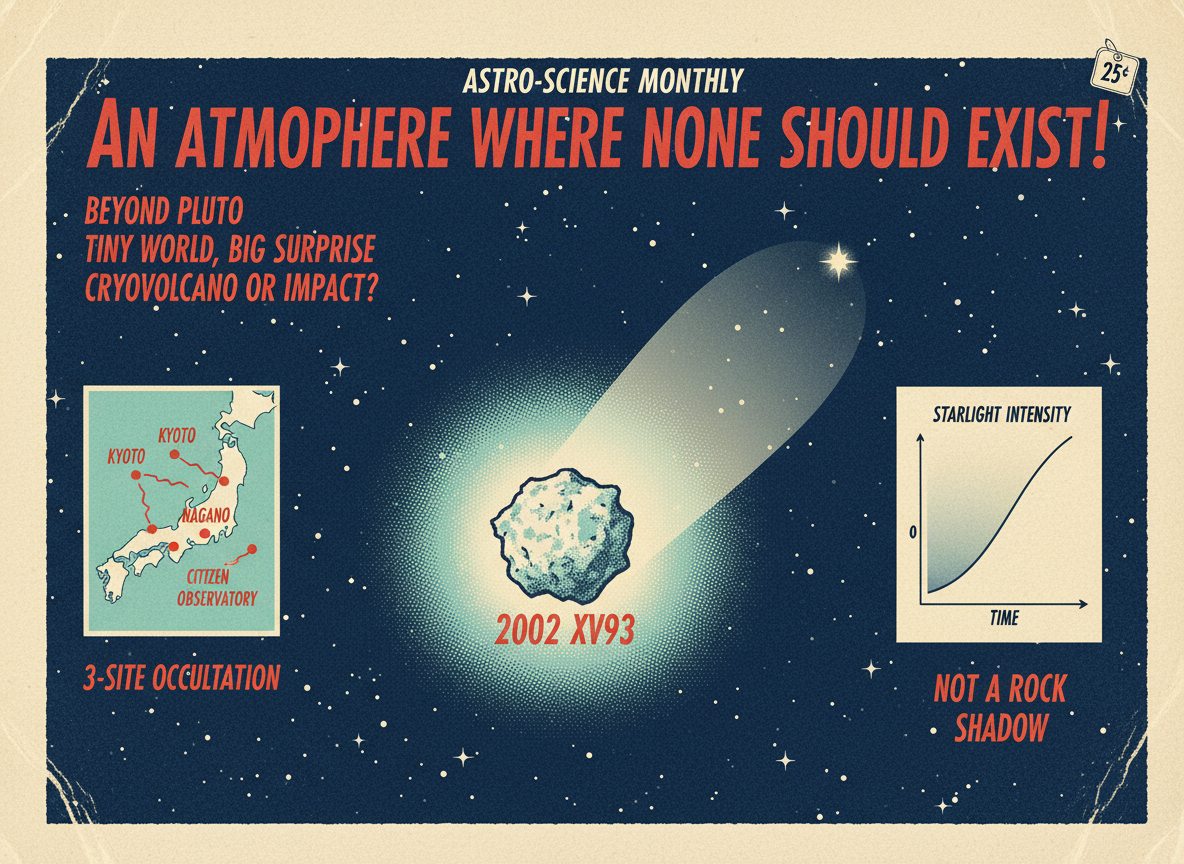
In January 2024, a team of professional and amateur astronomers spread across three sites in Japan had a brief window to watch a small, icy object in the outer solar system pass in front of a distant background star. The object — formally designated (612533) 2002 XV93, about 300 miles across — was expected to block the star’s light abruptly, the way a rock blocks a flashlight. Instead, the light faded gradually. Then it came back gradually. That gradual dimming and recovery is the signature of an atmosphere: the star’s light was being scattered and absorbed by a layer of gas surrounding the object before the solid surface itself blotted it out. An atmosphere should not be there. The object is far too small, and its gravity far too weak, to hold one. But it is. The study was published May 4, 2026, in Nature Astronomy, and astronomers are describing it as a discovery that rewrites the basic rules of what can exist in the outer solar system.
To understand why the discovery is significant, it helps to know what the outer solar system actually is and why it has been considered mostly inert.
Beyond Neptune, which orbits the sun at an average distance of about 2.8 billion miles, lies a vast region called the Kuiper Belt. It is populated by thousands of icy, rocky objects — remnants left over from the formation of the solar system about 4.5 billion years ago. These objects range in size from boulders to dwarf planets. Pluto, at roughly 1,477 miles across, is the largest and most famous. Below Pluto in the size hierarchy are dozens of smaller objects, many of which have been named and tracked but most of which have not been studied in any detail, because they are so far away and reflect so little sunlight that even powerful telescopes struggle to observe them.
The conventional wisdom has been that only objects with substantial mass — large enough to generate meaningful gravity — can hold an atmosphere. Pluto just barely qualifies: it has a thin atmosphere of nitrogen, methane, and carbon monoxide that forms when those compounds warm slightly during the closer parts of its elliptical orbit and sublimate from solid to gas. Below Pluto in the size hierarchy, even the next largest Kuiper Belt objects — Eris, Haumea, Makemake — show no evidence of atmospheres. The rule seemed clear: too small means no atmosphere.
2002 XV93 is about one fifth the diameter of Pluto. Under the established model, it should have no atmosphere at all. Its gravity is too weak to prevent gas from simply escaping into space.
How They Found It and What They Found
The technique used, called stellar occultation, is one of the oldest tools in planetary science. When a small, distant object passes precisely in front of a background star, scientists can infer the object’s size, shape, and any surrounding gas by the way the star’s light changes during the crossing. A solid surface with no atmosphere produces an abrupt on-off signal. A body with a thin atmosphere produces a gradual fade.
The team led by Ko Arimatsu of the National Astronomical Observatory of Japan used three separate telescope sites — in Kyoto, Nagano Prefecture, and a citizen science observatory — to observe the January 2024 occultation simultaneously. Multiple independent observation points are important because they allow researchers to rule out instrument-specific artifacts; if three different telescopes in three different locations all record the same gradual fade, the atmosphere is almost certainly real.
What they recorded was a consistent, gradual dimming of the starlight before the solid surface of 2002 XV93 crossed in front of the star. The data are consistent with a thin atmosphere roughly comparable to what you would find on a small moon or a comet’s temporary coma. The estimated pressure is extremely low — far below what any human could breathe — but it is detectable, and it appears to be global, surrounding the entire object.
What Could Be Making It
Two candidate explanations are proposed in the paper. The first is cryovolcanism: subsurface ice melting or sublimating due to internal heat and venting through fractures in the surface, releasing gases like methane, nitrogen, or carbon monoxide. This is the same mechanism that makes Pluto’s atmosphere possible, scaled down dramatically. If cryovolcanism is active on 2002 XV93, it would replenish the atmosphere continuously, potentially maintaining it for geological timescales.
The second is a more recent and dramatic event: impact by another Kuiper Belt object such as a comet. A significant collision could have blasted volatiles from below the surface, generating a temporary gaseous envelope that has not yet had time to dissipate. If this is the explanation, the atmosphere may exist for only a few hundred more years before escaping into space.
The James Webb Space Telescope has already observed 2002 XV93 and notably did not detect common surface ices — which may indicate unusual surface chemistry and adds another mystery to the picture.
Astronomer Scott Sheppard of the Carnegie Institution, commenting on the discovery, wrote: “This shows the Kuiper Belt is not a cold dead place, but is teeming with activity and has many of the building blocks for life.”
Sources: [Nature Astronomy — Arimatsu et al., Detection of an Atmosphere on a Trans-Neptunian Object Beyond Pluto (May 4, 2026). DOI: 10.1038/s41550-026-02846-1] — AP / US News — Astronomers Believe They’ve Detected an Atmosphere Around a Tiny, Icy World Beyond Pluto (May 4, 2026) — CNN — Thin Atmosphere Detected Around Distant Object Beyond Pluto (May 4, 2026) — ScienceAlert — Scientists Found an Impossible Atmosphere on a Tiny World Beyond Neptune (May 2026) — Phys.org — A Tiny World Beyond Neptune Has an Atmosphere That Shouldn’t Exist (May 4, 2026) — SpaceEyeNews — Tiny Atmosphere Found Around Distant Kuiper Belt Object (May 6, 2026) — Unexplained Mysteries — Atmosphere Discovered on Tiny World Beyond the Orbit of Neptune (May 5, 2026)
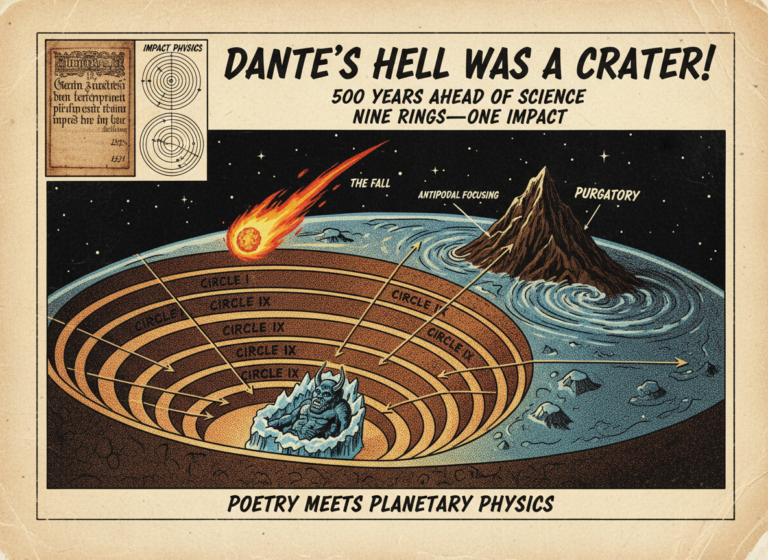
A Medieval Poet Described Hell as a Planetary Impact Crater 500 Years Before Science Had the Concept. Researchers Just Worked Out the Physics.
A new study presented at the European Geosciences Union General Assembly in Vienna in May 2026 makes a case that is extraordinary…

The First Nuclear Bomb Forged a Crystal That Doesn't Exist Anywhere Else on Earth. Scientists Just Found a Second One.
On July 16, 1945, at 5:29 a.m. in a remote stretch of desert in southern New Mexico, the United States Army detonated…

The Most Haunted Prison in America Opens Its Doors to Ghost Hunters Last Night. Over 200 People Died Inside.
The Ohio State Reformatory in Mansfield, Ohio, has been called the most haunted prison in America — and last night, May 14,…

A Neanderthal Had a Toothache 59,000 Years Ago. Someone Drilled It Out With a Stone Tool.
A tooth found in a Siberian cave just rewrote the history of medicine. Scientists confirmed on May 13, 2026, that a Neanderthal…