Original Story
A Butchering Site in China Just Got 20,000 Years Older. That Difference Changes Everything About Who Was Smart and When.

Lingjing is an archaeological site in Henan Province, central China, where scientists have been excavating for more than a decade. It was a place where an extinct human relative called Homo juluensis came to butcher deer and other large animals. Alongside the animal bones, excavators found stone tools — and not simple tools. The Lingjing artifacts show what archaeologists call centripetal flaking: a sophisticated multi-step technique that required the toolmaker to understand the internal structure of the stone they were working, predict how it would fracture under specific applied pressures, and execute a sequence of preparatory strikes before producing the final usable flake. For years, researchers estimated the site was no older than about 126,000 years. A new analysis published in the Journal of Human Evolution has pushed that date back 20,000 years to approximately 146,000 years ago — and that 20,000-year shift changes the entire story, because 146,000 years ago was the middle of a brutal ice age, not a warm and productive period.
The dating method that produced the new estimate was not conventional radiocarbon dating, which only works on organic material up to about 50,000 years old. At 146,000 years, a different approach was needed. The researchers used uranium-thorium dating on calcite crystals found growing inside a deer-like animal’s rib bone recovered from the site.
Calcite — the same mineral that forms stalactites and stalagmites — naturally incorporates trace amounts of uranium when it crystallizes. Uranium decays into thorium at a known, constant rate. By measuring the ratio of uranium to thorium in the crystals, researchers can calculate precisely how long ago the crystal formed. Since the crystals grew inside the bone while it was at the site, they provide an accurate age for when the bone was deposited there — and therefore for when the site was active.
“The calcite crystals inside the bone acted like a natural clock, allowing us to refine the age of the site,” said lead author Yuchao Zhao, assistant curator of East Asian archaeology at the Field Museum in Chicago.
What Makes the Tools Themselves Unusual
The centripetal flaking system — technically called a “prepared core” technology — was previously thought to be rare or absent in East Asia during the late Middle Pleistocene, the period between 300,000 and 120,000 years ago. In Europe and Africa, this kind of sophisticated tool-making was associated with Neanderthals and with archaic Homo sapiens populations. Finding it at Lingjing challenged the older assumption that East Asian populations lagged behind their western counterparts in cognitive development and tool sophistication.
“This was not casual flake production,” Zhao said, “but a technology that required planning, precision, and a deep understanding of stone properties and fracture mechanics. The underlying logic of this system — and the cognitive abilities it reflects — shows important similarities to Middle Paleolithic technologies often associated with Neanderthals in Europe and with human ancestors in Africa, suggesting that advanced technological thinking was not limited to western Eurasia.”
Now those tools are 20,000 years older than previously known, placing them firmly in the harsh environmental conditions of the ice age rather than in the warmer, more productive period that followed. The conventional assumption — that Homo juluensis at Lingjing developed this sophistication during a period of abundance and favorable climate — no longer holds. The tools were made when conditions were cold, resources were strained, and survival would have required exactly the kind of creative adaptation this technology reflects.
Who Homo Juluensis Was
Homo juluensis is not a species that most people have heard of, and with good reason: it was only formally proposed as a distinct species in the past several years, based on a collection of skull fragments recovered from Lingjing and nearby sites. The name comes from Julu, a county in Hebei Province near some of the key fossil sites.
Homo juluensis appears to have had a large brain by the standards of the period — comparable to or exceeding modern human brain size — combined with a physical appearance that blended features associated with archaic East Asian populations and features more commonly seen in Neanderthals from western Eurasia. This suggests either a close evolutionary relationship between eastern and western archaic human populations or, more likely, parallel evolution of similar physical traits in response to similar environmental pressures.
The species appears to have gone extinct roughly 50,000 years ago, overlapping in time with the arrival of anatomically modern humans into East Asia. What the relationship between these groups was — cooperation, competition, or simply coexistence in separate territories — is not yet established from the current evidence.
What is established is that 146,000 years ago, in the middle of an ice age in what is now central China, a cousin species of our own was sitting beside butchered deer carcasses with stone tools that required significant cognitive planning to make. Not because times were good. Because times were hard.
Sources: [Journal of Human Evolution — Zhao et al., Earliest Centripetal Flaking System in Eastern Eurasia Reveals Human Behavioral Complexity in Late Middle Pleistocene China (2026). DOI: 10.1016/j.jhevol.2026.103841] — Field Museum — Ice Age Butcher’s Tools Are a Sign of Ancient Humans’ Creativity During Hard Times (2026) — Phys.org — Ice Age Butcher’s Tools Are a Sign of Ancient Humans’ Creativity During Hard Times (May 7, 2026) — Ancient Origins — Ice Age Butcher’s Tools Reveal Ancient Human Creativity in Hard Times (May 2026) — Popular Science — An Extinct Human Species Made Surprisingly Creative Butchery Tools (May 2026) — ScienceDaily — Ice Age Humans in China Crafted Surprisingly Advanced Stone Tools 146,000 Years Ago (May 2026) — Unexplained Mysteries forum — Ice Age Butcher’s Tools Are a Sign of Ancient Humans’ Creativity During Hard Times (May 13, 2026)
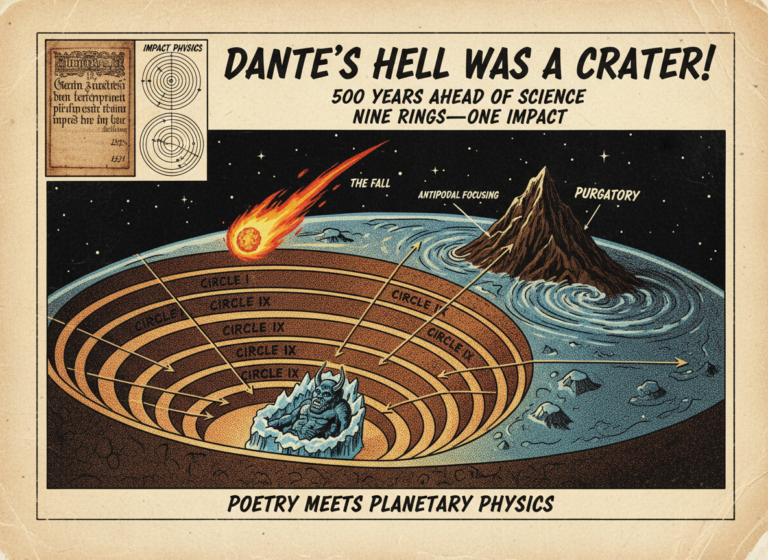
A Medieval Poet Described Hell as a Planetary Impact Crater 500 Years Before Science Had the Concept. Researchers Just Worked Out the Physics.
A new study presented at the European Geosciences Union General Assembly in Vienna in May 2026 makes a case that is extraordinary…

The First Nuclear Bomb Forged a Crystal That Doesn't Exist Anywhere Else on Earth. Scientists Just Found a Second One.
On July 16, 1945, at 5:29 a.m. in a remote stretch of desert in southern New Mexico, the United States Army detonated…

The Most Haunted Prison in America Opens Its Doors to Ghost Hunters Last Night. Over 200 People Died Inside.
The Ohio State Reformatory in Mansfield, Ohio, has been called the most haunted prison in America — and last night, May 14,…

A Neanderthal Had a Toothache 59,000 Years Ago. Someone Drilled It Out With a Stone Tool.
A tooth found in a Siberian cave just rewrote the history of medicine. Scientists confirmed on May 13, 2026, that a Neanderthal…