Original Story
74,000 Years Ago a Supervolcano Erupted and Almost Ended Humanity. New Research Says We Survived by Doing Something Unexpected.
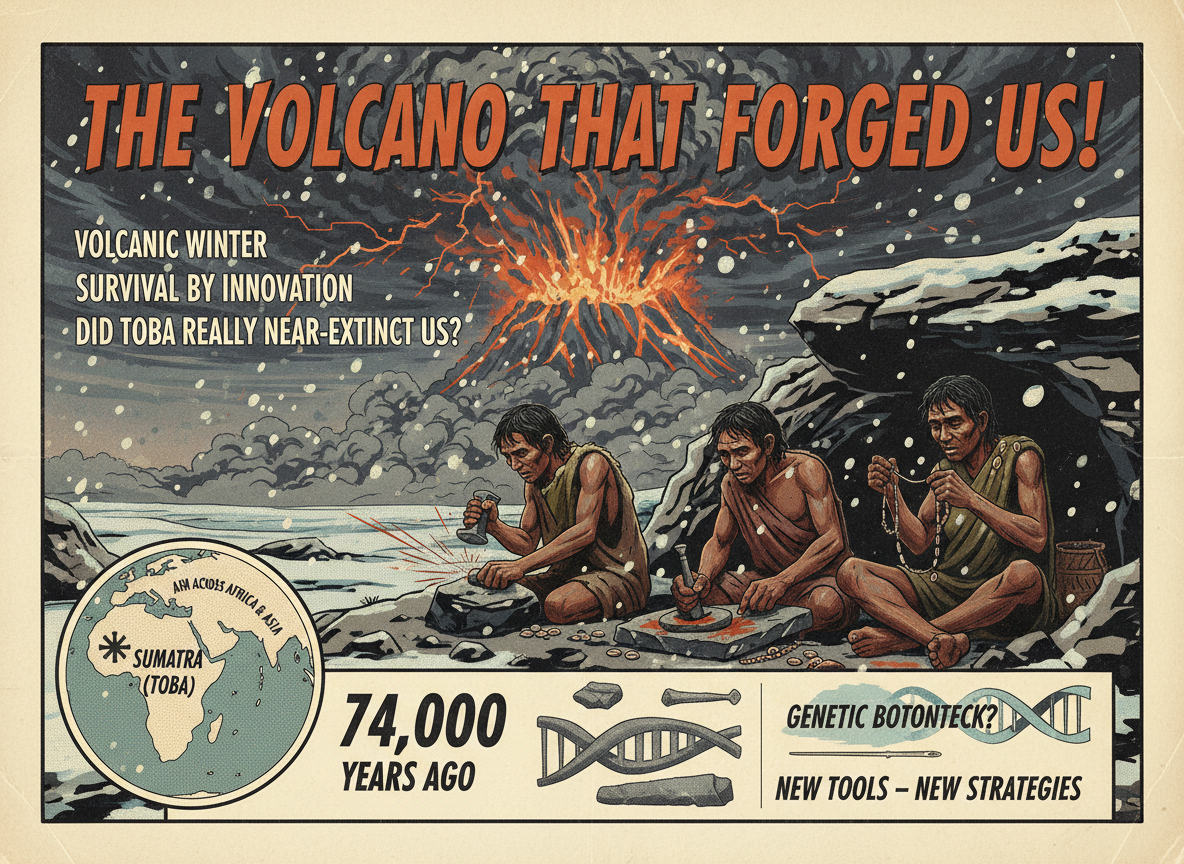
Seventy-four thousand years ago, a supervolcano in what is now Sumatra, Indonesia erupted in one of the largest volcanic events in the past 2.5 million years. The Toba eruption blasted so much ash and debris into the stratosphere that it partially blocked sunlight around the globe, triggering a volcanic winter that is estimated to have depressed temperatures for years, possibly longer. Some scientists have proposed that this event reduced the global human population to somewhere between one thousand and ten thousand breeding pairs — a near-extinction that left a genetic scar visible in human DNA today, in the form of unusually low genetic diversity across all eight billion living people. A new synthesis of archaeological evidence, published by The Conversation in May 2026 and drawing on a decade of excavation data from Africa and Asia, complicates and ultimately challenges the catastrophe picture in a specific way: some communities of early humans did not just survive the eruption. Directly afterward, they innovated. They made new tools, developed new strategies, and expanded their behavioral repertoire. The disaster may not have broken humanity. It may have made us.
The standard picture of the Toba catastrophe, as it is known in scientific literature, runs as follows. The eruption produced between 2,800 and 5,300 cubic kilometers of volcanic material — for comparison, the 1980 Mount St. Helens eruption produced about one cubic kilometer. The debris cloud was distributed globally. Ash layers from Toba have been found as far away as India, the Arabian Peninsula, and East Africa. Regions close to the eruption site were buried under meters of ash. The volcanic winter that followed reduced plant growth, disrupted food chains, and created cold, dry conditions across much of the populated world.
The genetic evidence for a bottleneck — a dramatic reduction in human population size around this time — is real and documented. Modern human DNA shows less genetic diversity than would be expected if human populations had been continuously large throughout prehistory. The bottleneck hypothesis proposes that we are all descended from a small group that survived a catastrophic reduction, and the timing of the bottleneck in the genetic record roughly corresponds to the Toba eruption.
What Archaeology Now Shows
The problem is that the catastrophe story does not match what is being found in the ground.
At archaeological sites in South Africa, researchers have found evidence of not a reduction but an expansion of behavioral complexity in the period following the Toba eruption. New symbolic behaviors — the use of ochre, the production of beads, the development of more complex lithic technologies — appear or intensify in the archaeological record around this time. In Ethiopia, similar patterns emerge. Tools become more diverse. Diets expand to include more varied food sources. The signature of increased cognitive and social flexibility is visible in the artifacts.
“Finding out that these stone tools were made during a harsh ice age tells a different story,” wrote Jayde Hirniak, a PhD candidate at Arizona State University’s Institute of Human Origins, in the synthesis piece. “Hard times can force us to adapt.”
Lead researcher Hirniak and colleagues believe the evidence supports a reinterpretation of the Toba event. Rather than a catastrophic near-extinction from which humanity barely crawled back, the eruption may have been a selective pressure that accelerated innovation. Groups that could adapt — by diversifying their diet, expanding their social networks, developing new tools, and changing their habitual behaviors — survived and reproduced. Groups that could not, did not. The humans who came through were, almost by definition, the most flexible and inventive ones.
The Genetic Bottleneck Problem
This does not resolve the genetic evidence for a bottleneck, and researchers are careful to say so. The question of whether the Toba eruption caused the bottleneck or whether some other factor — climate change, disease, or a combination of pressures over a longer period — is responsible remains genuinely open. The genetic data is real. The archaeological evidence of survived, thriving communities is also real. They appear to be in tension.
One possible reconciliation: the bottleneck may have occurred within specific populations, particularly those in regions closest to the eruption and most severely affected by the volcanic winter, while populations in less affected regions — parts of sub-Saharan Africa that experienced relatively mild cooling, for example — not only survived but expanded. The genetic bottleneck would then reflect the near-extinction of some populations, not all of them, with the surviving groups eventually providing most of the genetic ancestry of modern humans.
This is a less tidy narrative than either “we almost all died” or “we were fine.” It is probably closer to what actually happened. The volcano erupted. Some populations perished. Others, pushed into new conditions, pushed back — with new tools, new strategies, new ways of surviving. We are descended from the ones who adapted.
Sources: ScienceDaily — A Supervolcano Nearly Wiped Out Humanity 74,000 Years Ago, But Humans Did Something Incredible (May 11, 2026) — [The Conversation — Jayde Hirniak, Arizona State University (May 2026)] — TheCollector — Mount Toba: Did a Supervolcano Almost Wipe Out the Human Species? (2024) — Atlas Obscura — How Indonesia’s Toba Volcano Changed Human Evolution (August 2025) — Futura-Sciences — 74,000 Years Ago a Supervolcano Rocked Earth and May Have Changed Humanity’s Fate (2025) — Unexplained Mysteries forum — 74,000 Years Ago Humanity Was Almost Wiped Out by a Super Volcano (May 13, 2026)
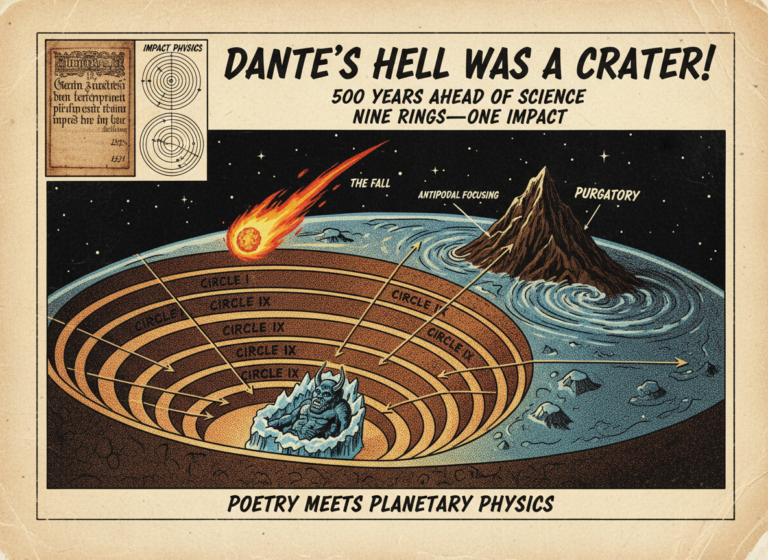
A Medieval Poet Described Hell as a Planetary Impact Crater 500 Years Before Science Had the Concept. Researchers Just Worked Out the Physics.
A new study presented at the European Geosciences Union General Assembly in Vienna in May 2026 makes a case that is extraordinary…
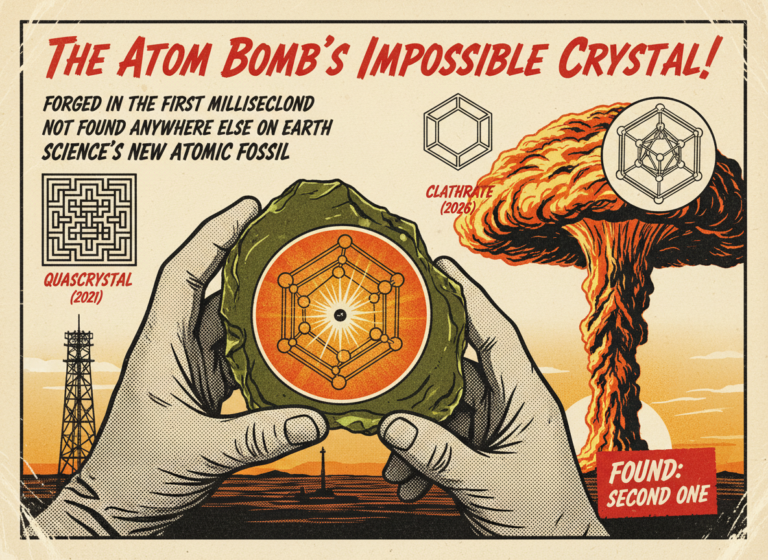
The First Nuclear Bomb Forged a Crystal That Doesn't Exist Anywhere Else on Earth. Scientists Just Found a Second One.
On July 16, 1945, at 5:29 a.m. in a remote stretch of desert in southern New Mexico, the United States Army detonated…
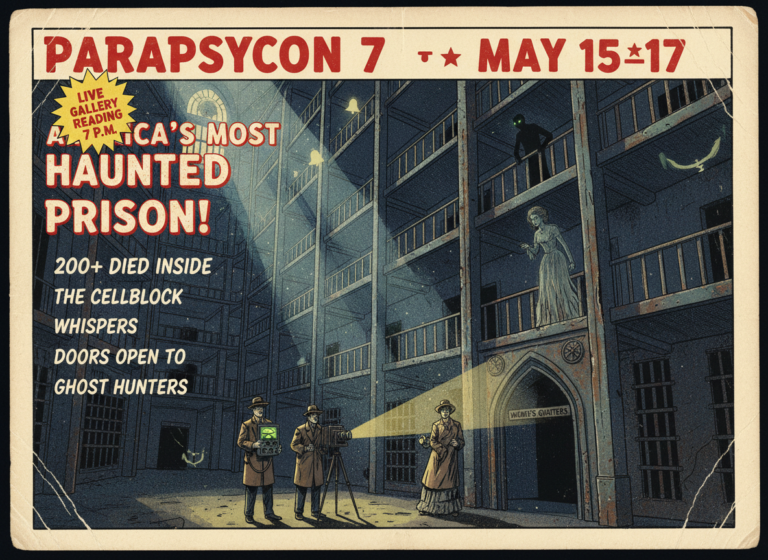
The Most Haunted Prison in America Opens Its Doors to Ghost Hunters Last Night. Over 200 People Died Inside.
The Ohio State Reformatory in Mansfield, Ohio, has been called the most haunted prison in America — and last night, May 14,…
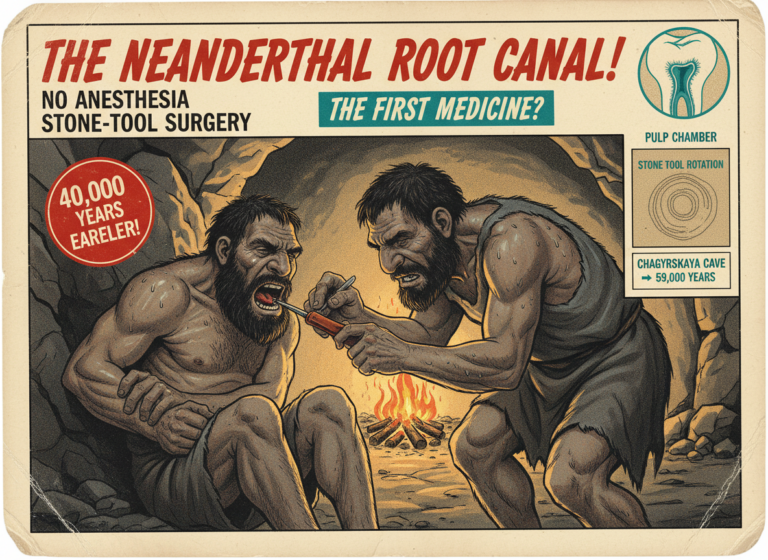
A Neanderthal Had a Toothache 59,000 Years Ago. Someone Drilled It Out With a Stone Tool.
A tooth found in a Siberian cave just rewrote the history of medicine. Scientists confirmed on May 13, 2026, that a Neanderthal…