Original Story
A Green Carpet of Seaweed Is Killing Animals on French Beaches. It Has Been Doing This for Decades and the Government Has Not Stopped It.
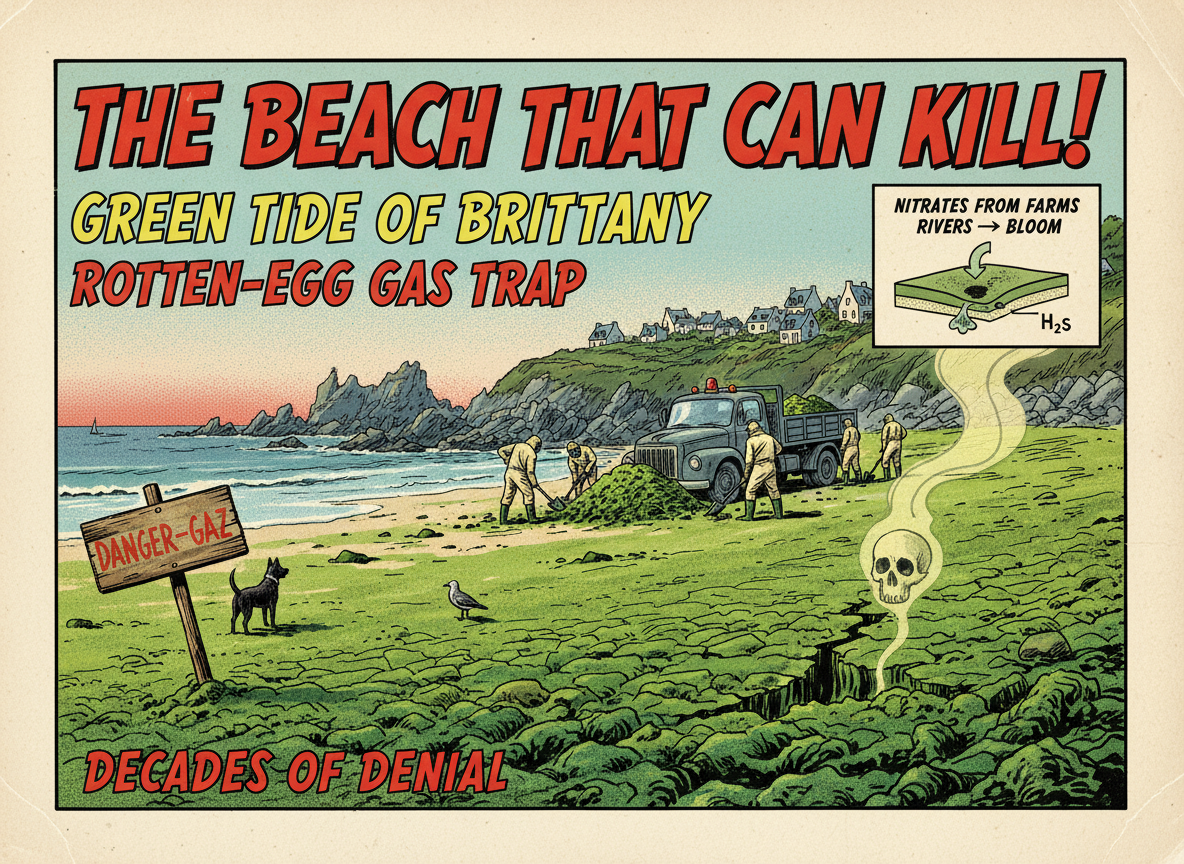
Every summer, thick blankets of bright green algae wash up and accumulate on beaches along the Breton coast of northwestern France — a region famous for its dramatic rocky coastline and tourism industry. When the algae dries, it develops a stiff crust on its surface that looks like discolored sand. Underneath that crust, the decomposing seaweed generates pockets of hydrogen sulfide gas. Hydrogen sulfide is a colorless gas with a strong smell of rotten eggs. It is also, at sufficient concentrations, rapidly lethal. The gas can cause loss of consciousness within seconds and cardiac arrest within minutes. Dogs that have trotted across the wrong stretch of beach have dropped dead. Wild boars that have grazed on seaweed-covered mud flats have been found dead in groups of fifteen. A horse collapsed on a beach and died. People have died too, though the French government spent years resisting formal acknowledgment that the seaweed was responsible. The Guardian published a major investigation in May 2026 revisiting the full history of what coastal communities in Brittany have called, for years, France’s official cover-up.
The seaweed responsible is Ulva, commonly called sea lettuce — a genus of bright green algae native to the Breton coast. Two specific species, Ulva armoricana and Ulva rotundata, grow on the rocks of the intertidal zone. They have always been present. What changed in the 1970s and accelerated through the 1980s and 1990s was the scale.
The culprit, according to environmental scientists and the European Commission, is nitrogen. Brittany is one of France’s most intensive agricultural regions, producing large quantities of pork, poultry, and dairy. The operations generate significant nitrate-rich runoff that flows from farmland into rivers and then into coastal waters. Nitrogen is an excellent fertilizer. In the ocean, it feeds algae. Ulva responded by blooming in quantities that now, each summer, cover beaches in mats up to a foot deep.
The issue gained sustained public attention in 2009 when a horse collapsed and died on a beach in Brittany after inhaling gas from the seaweed. The following year, a man employed to remove the algae died, and investigators found elevated hydrogen sulfide levels in the area where he collapsed. Environmental campaigner André Ollivro, a former gas technician who has studied the seaweed problem for years, described the danger in stark terms: the gas trapped under the dried crust “could kill you in seconds.” He estimated that around 20 people die on Brittany’s coast each year from causes officially attributed to drowning or tides, and raised the question of how many may have been incapacitated by hydrogen sulfide before being swept away.
The Cover-Up Allegations
The Guardian’s May 2026 investigation follows years of reporting by investigative journalist Inès Léraud, who documented the full story in a comic book-format investigation titled Algues Vertes, l’Histoire Interdite — Green Algae, The Forbidden History. The book chronicles what Léraud describes as sustained official resistance to acknowledging the seaweed’s lethality.
In the background of the official resistance is an organization with a translated name roughly equivalent to the Scientific and Technical Institute for the Environment and Health, or ISTE — a group that published materials casting doubt on the role of intensive agriculture in driving the algal blooms. ISTE’s funding came from multiple major French food corporations. Its public position aligned with the agriculture industry’s interests in avoiding regulatory pressure. Environmental researchers who challenged those positions found their findings countered by an industry-funded scientific body.
At least three confirmed human deaths have been linked to hydrogen sulfide from the seaweed, along with dozens of documented animal fatalities — the horse, the wild boars, numerous dogs. The precise number of human deaths potentially related to the phenomenon remains disputed, because the connection between beachside deaths and seaweed gas is difficult to establish without specific autopsies that were not always conducted at the time.
Why the Seaweed Keeps Coming Back
Limiting the algae means limiting the nitrogen. Limiting the nitrogen means limiting the agricultural runoff. The European Commission has issued fines against France over its nitrogen levels. The French government has implemented programs intended to reduce nitrate flows into coastal waterways. Environmental groups say these measures have been insufficient.
The blooms continue. Each summer, beaches in parts of Brittany are closed. The crust forms. The gas accumulates underneath it. Dogs and wild animals that do not know what they are stepping on find out.
André Ollivro’s description of the crust breaking underfoot — its color blending into the sand, its surface giving way to the gas pocket below — is the image the story keeps returning to. From a distance, on a summer day, it looks like a beach. Up close, walking across it, it is something else entirely.
Sources: The Guardian — ‘I Couldn’t Breathe’: France’s Killer Seaweed Investigation (May 2026) — Above the Norm News — Toxic Green Algae Is Turning Parts of France’s Coastline Dangerous (May 12, 2026) — France 24 — Sea of Sludge: Toxic Algae Swamps Brittany’s Beaches — Hakai Magazine — France’s Deadly Seaweed (February 2020) — Unexplained Mysteries — Killer Seaweed Causes Spate of Deaths Along French Coastline (May 12, 2026)

A Medieval Poet Described Hell as a Planetary Impact Crater 500 Years Before Science Had the Concept. Researchers Just Worked Out the Physics.
A new study presented at the European Geosciences Union General Assembly in Vienna in May 2026 makes a case that is extraordinary…

The First Nuclear Bomb Forged a Crystal That Doesn't Exist Anywhere Else on Earth. Scientists Just Found a Second One.
On July 16, 1945, at 5:29 a.m. in a remote stretch of desert in southern New Mexico, the United States Army detonated…

The Most Haunted Prison in America Opens Its Doors to Ghost Hunters Last Night. Over 200 People Died Inside.
The Ohio State Reformatory in Mansfield, Ohio, has been called the most haunted prison in America — and last night, May 14,…

A Neanderthal Had a Toothache 59,000 Years Ago. Someone Drilled It Out With a Stone Tool.
A tooth found in a Siberian cave just rewrote the history of medicine. Scientists confirmed on May 13, 2026, that a Neanderthal…