Original Story
Sleeping Dog Is Out Today. It Contains Los Alamos Files From a Dead Man’s Safe. Here Is What the Film Claims.
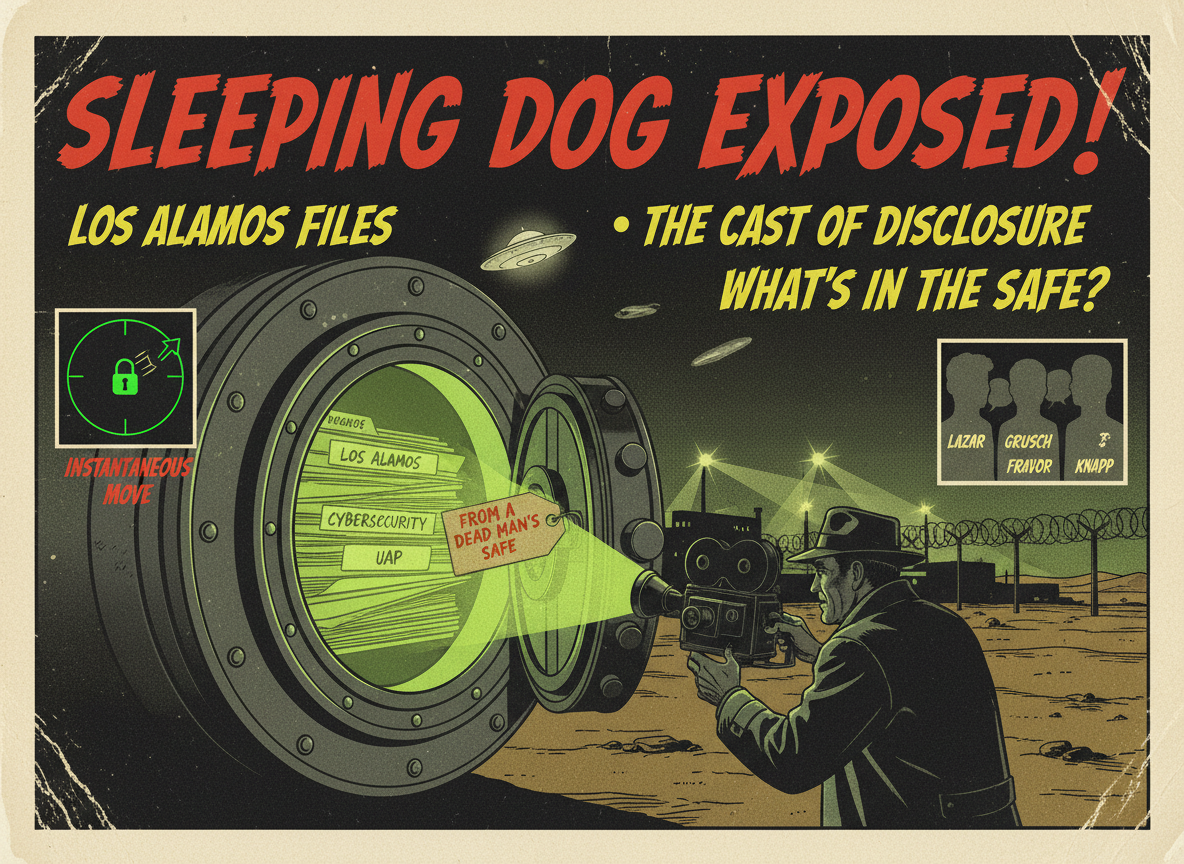
Jeremy Corbell’s documentary Sleeping Dog released in US theaters and on digital platforms today, May 12, 2026, directed by Michael Lazovsky. The film has been in production for years, was kept entirely secret during the final phase of development, and features one of the most significant casts ever assembled for a UAP documentary: Bob Lazar, David Grusch, Commander David Fravor, and journalist George Knapp. The material at the film’s center is a collection of files that Corbell received from the son of a recently deceased senior cybersecurity official at Los Alamos National Laboratory — files the son recognized as significant and potentially dangerous after his father’s death, and decided to bring to Corbell rather than leave in the official record. Corbell has described making the film as the most difficult thing he has ever allowed people to see. It is releasing today, four days after the US government published its first public batch of declassified UAP records at war.gov/UFO. The timing was not planned. It is nonetheless extraordinary.
To understand why the Los Alamos angle matters here specifically, it helps to have the full context of what Los Alamos is and what has been happening to the people who worked there.
Los Alamos National Laboratory is America’s primary nuclear weapons design facility, operating under the National Nuclear Security Administration in northern New Mexico. It was founded as part of the Manhattan Project in 1943. It designed the first atomic bomb. Today it researches nuclear weapons stockpile maintenance, high-energy physics, materials science, and advanced propulsion applications. Its personnel carry among the highest security clearances in the US government.
In 2025, two people connected to Los Alamos disappeared. Anthony Chavez, a former LANL employee, walked away from his home and was not found. Melissa Casias, an active LANL administrative employee with reported security clearance, was last seen walking along a New Mexico highway under circumstances described as bizarre. They were part of the broader pattern of eleven nuclear and aerospace research-connected individuals who died or disappeared between 2023 and 2026 — a pattern that the White House formally acknowledged as a federal investigation in April 2026, with the FBI conducting what Karoline Leavitt described as a “holistic review of all the cases together.”
A senior cybersecurity official at this specific laboratory, in this specific period, dying and leaving files that his son believed were significant enough to reach Jeremy Corbell — that is the material in Sleeping Dog.
The Cast and What They Represent
Bob Lazar first appeared publicly in 1989, when George Knapp arranged a television interview in Las Vegas in which Lazar claimed he had worked at a facility near Area 51 called S-4 and been employed to reverse-engineer propulsion systems from recovered non-human craft. The US government denied his employment records existed. Subsequent investigation by Knapp confirmed ancillary elements of Lazar’s account, including his employment at Los Alamos, which was confirmed via a phonebook entry and payment records. His core claims have never been officially confirmed or definitively debunked.
David Grusch testified before the House Oversight Committee in July 2023, under oath and with congressional immunity protections, that the US government maintains a covert legacy program that holds recovered UAP craft of non-human origin. He described the program as operating outside congressional oversight, keeping the knowledge from elected officials including presidents. The Defense Department denied his specific allegations without rebutting them in detail.
Commander David Fravor was the commanding officer of a Navy fighter squadron that encountered the Tic-Tac UAP during a training exercise off the San Diego coast in November 2004. He has testified before Congress that he observed an object with no wings, no exhaust, no visible propulsion signature, and flight characteristics inconsistent with any known aircraft. His account is corroborated by other pilots, by ship radar records, and by the three UAP videos — Gimbal, Go Fast, and FLIR1 — that were declassified in 2017 and 2020.
George Knapp has been the primary investigative journalist on UAP and specifically on Bob Lazar for more than three decades. He co-hosts the Weaponized podcast with Corbell.
What Corbell Has Said About the Film
In a Fox News appearance on May 3, days before the government file release, Corbell told Peter Doocy that UAP footage shows instantaneous motion with no detectable acceleration period — changing position without any measurable physics of transition — and that no military on Earth, American, Russian, or Chinese, can replicate what is shown. He described a Reaper drone that achieved a weapons-grade targeting lock on a UAP, which then instantly moved out of the lock’s field.
Director Michael Lazovsky, who entered the project as an outsider to the UAP community, described his experience: “I was shocked. Not only by Jeremy Corbell’s investigative journey — but by the extent to which he has influenced public transparency, and the remarkable level of engagement he receives on a daily basis by intelligence agencies.”
Sleeping Dog is out today. The government’s first UAP file batch dropped four days ago. The next tranche is weeks away. And a documentary built around files from a dead cybersecurity official at America’s premier nuclear weapons laboratory is now available for anyone to watch.
Sources: Hollywood Reporter — Sleeping Dog: Documentary About UFO Researcher Jeremy Corbell Gets Release (March 27, 2026) — Sleeping Dog Official Website — sleepingdogmovie.com (May 2026) — The Vetted Show — Jeremy Corbell Drops UFO Bombshell: Sleeping Dog Documentary Details (April 2026) — Fox News — UFO Expert Warns Mystery Craft Are Outmaneuvering US Military (May 4, 2026) — CelebBabyLaundry — Sleeping Dog: Everything We Know About The UFO Documentary (May 3, 2026)
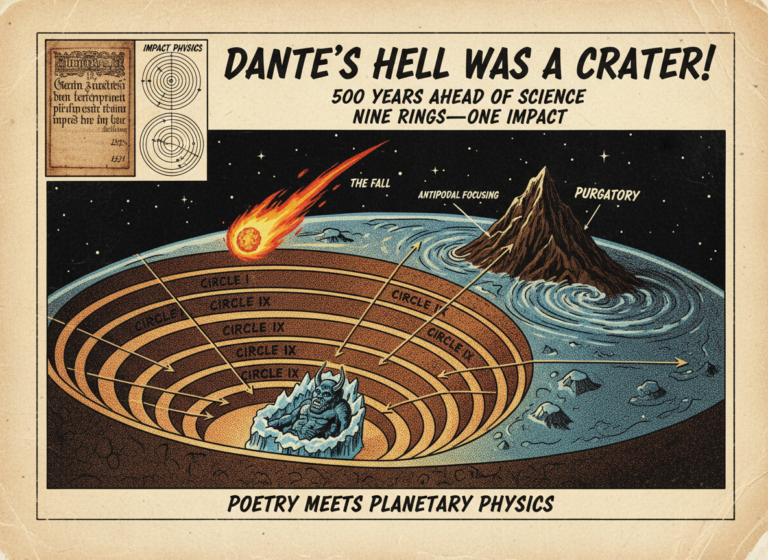
A Medieval Poet Described Hell as a Planetary Impact Crater 500 Years Before Science Had the Concept. Researchers Just Worked Out the Physics.
A new study presented at the European Geosciences Union General Assembly in Vienna in May 2026 makes a case that is extraordinary…

The First Nuclear Bomb Forged a Crystal That Doesn't Exist Anywhere Else on Earth. Scientists Just Found a Second One.
On July 16, 1945, at 5:29 a.m. in a remote stretch of desert in southern New Mexico, the United States Army detonated…
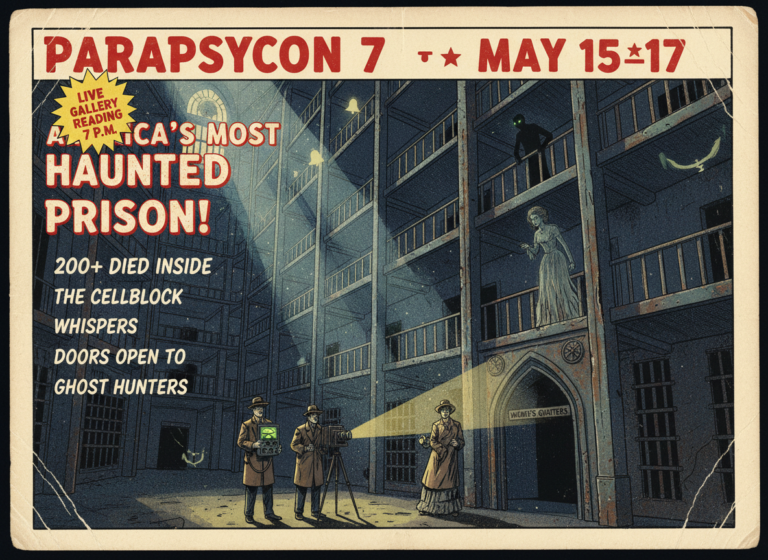
The Most Haunted Prison in America Opens Its Doors to Ghost Hunters Last Night. Over 200 People Died Inside.
The Ohio State Reformatory in Mansfield, Ohio, has been called the most haunted prison in America — and last night, May 14,…

A Neanderthal Had a Toothache 59,000 Years Ago. Someone Drilled It Out With a Stone Tool.
A tooth found in a Siberian cave just rewrote the history of medicine. Scientists confirmed on May 13, 2026, that a Neanderthal…