Original Story
110,000 Years Ago, Neanderthals and Humans Were Burying Their Dead the Same Way. In the Same Cave. With the Same Tools.
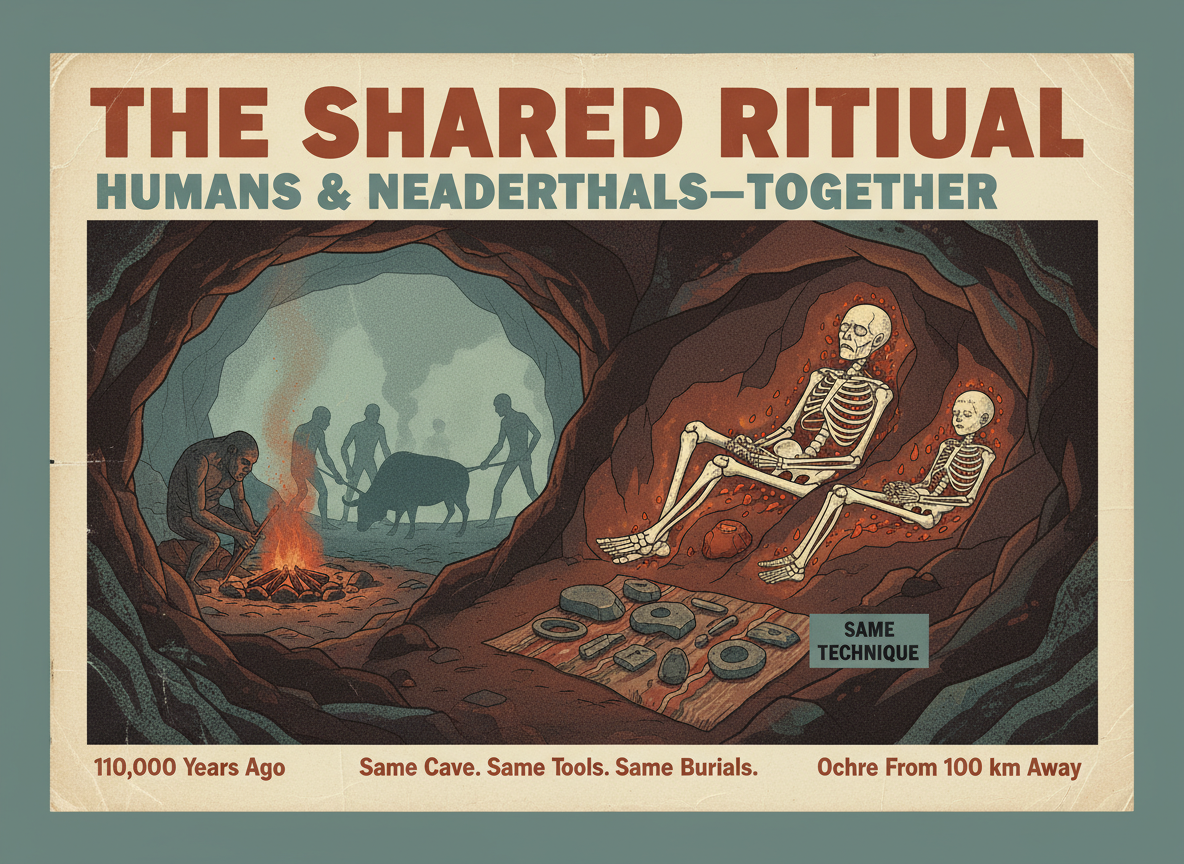
Excavations at Tinshemet Cave in central Israel, published April 12, 2026 in Nature Human Behaviour, have produced what researchers are calling the most significant hominin discovery in the Levant in fifty years. The cave contains the physical remains of both Homo sapiens and Neanderthal-like hominins, dated to approximately 100,000 to 130,000 years ago. It also contains five formal burials, an astonishing quantity of red ochre pigment, stone tools made with an identical technique across both species, and evidence of shared hunting strategies for large, dangerous prey. The picture that emerges is not one of two separate species occupying overlapping territory. It is one of two species living, hunting, burying their dead, and apparently practicing shared rituals as a single cultural complex.
The cave sits in the hills of central Israel, roughly ten kilometers from the open-air site of Nesher Ramla and about 100 meters above the valley floor. Excavations began in 2017, led by Professor Yossi Zaidner of the Hebrew University of Jerusalem, Professor Israel Hershkovitz of Tel Aviv University, and Dr. Marion Prévost of the Hebrew University of Jerusalem.
The first thing that distinguished Tinshemet from other Levantine Middle Paleolithic sites was the burial cluster. Five human burials, including two fully articulated skeletons, were found within the cave. One was an adult, designated Tinshemet 2. One was a child, Tinshemet 1. Both were placed in the same position: lying on the right side, curled in a fetal posture, arms drawn toward the face. This was not a coincidence of body positioning. It was a ritual. And the same ritual posture appears at two other sites in the region, Skhul Cave and Qafzeh Cave, dated to the same period, where the skeletal remains are anatomically distinct — meaning different populations of hominins were performing the same burial rite.
Chris Stringer, paleoanthropologist at the Natural History Museum in London and one of the world’s leading authorities on human evolution, told Live Science: “The discoveries at Tinshemet Cave are probably going to be the most important finds in the region from the last 50 years.”
The Ochre
More than 7,500 fragments of ochre, a red iron-oxide pigment, were recovered from the cave. Analysis suggests much of it was transported from sources roughly 100 kilometers away. It was not local. Someone carried it to this cave across a significant distance. Some pieces were heat-treated, a process that intensifies the color of the mineral. In one burial, a large red ochre lump was found placed between the legs of the deceased.
The same placement of ochre with burials appears at Qafzeh and Skhul. Different caves. Different populations. Same ritual.
Researchers believe the ochre was used for body decoration, possibly as a way of expressing social identity or distinguishing between groups during a period of intensified contact.
The Tools and the Hunt
The stone tools at Tinshemet were made using the centripetal Levallois method, a sophisticated multi-step technique requiring foresight, fine motor skill, and the kind of knowledge transfer that implies active teaching across generations. This is not a technique people independently reinvent. It is taught. At Tinshemet, both Homo sapiens and Neanderthal-like hominins were using it.
The faunal remains tell the same story. The Tinshemet inhabitants were hunting aurochs, wild horses, and deer, large and dangerous game that requires coordinated group effort to bring down. You do not kill an aurochs alone. Based on the fossil evidence, the team doing it likely included both human lineages.
Professor Zaidner describes the cave as “a melting pot” — a place where different Homo populations came together, shared techniques, shared rituals, and over time became culturally indistinguishable even as they remained anatomically distinct. Some individuals at the site show mixed anatomical features of both modern humans and Neanderthals, which Zaidner says suggests actual hybridization: “These are actually hybrids that are using the same culture.”
What It Rewrites
The dominant narrative of the Neanderthal-human relationship has long been one of competition, displacement, or at best peaceful avoidance. The evidence from Tinshemet does not support that narrative. It supports the opposite: that contact between these groups was the driver of cultural complexity, not conflict. Formal burial practices — which first appear in Israel 110,000 years ago, earlier than anywhere else on Earth — may have emerged precisely from the social intensity of two species living in close proximity, sharing rituals, and developing what Zaidner calls “a uniform behavioral set across Homo groups.”
The burials in Tinshemet Cave are the oldest formal burials ever found, anywhere. And they appear to have been performed, at the same site, by two different species of human.
Sources: Nature Human Behaviour — Zaidner et al., Evidence from Tinshemet Cave in Israel Suggests Behavioural Uniformity Across Homo Groups in the Levantine Mid-Middle Palaeolithic (April 12, 2026) — ScienceDaily — 110,000-Year-Old Discovery Rewrites Human History: Neanderthals and Homo sapiens Worked Together (April 16, 2026) — Ancient Origins — Discovery Shows Neanderthal and Homo sapiens Worked Together (April 16, 2026) — ZME Science — A Hundred Thousand Years Ago, Humans and Neanderthals Built a Shared Culture in This Cave (April 15, 2026) — Live Science — Neanderthals, Modern Humans and a Mysterious Human Lineage Mingled in Caves in Ancient Israel (April 2026) — Sunday Guardian Live — A 110,000-Year-Old Discovery in Israel That Rewrites Human History (April 14, 2026)
Dead Los Alamos Director's Secret UFO Files Just Dropped. Researchers Say It's 100-Proof Disclosure Evidence.
A new document release is circulating in UAP research circles as of this week, described by those who have reviewed it as…

A Woman Heard Voices Telling Her She Had a Brain Tumor. They Gave Her an Address. The Hospital Was There.
In the winter of 1984, a woman referred to in published medical literature as AB was sitting at home in London, reading…

For 2,000 Years Nobody Could Read the Writing on the Walls of Teotihuacan. Two Researchers in Copenhagen Just Changed That.
Teotihuacan is one of the largest cities the ancient world ever produced. At its peak, around 400 CE, it housed more than…
An Oklahoma Woman Was Mauled by Something Nobody Can Identify. Four Surgeries Later, the DNA Results Still Aren't In.
On the morning of March 29, 2026, a 38-year-old mother named Alicia Maxey was found unconscious and badly injured near Blanco in…