Original Story
An Italian Radar Engineer Says There Is a Second Sphinx Buried at Giza, and the Evidence Is Not Nothing
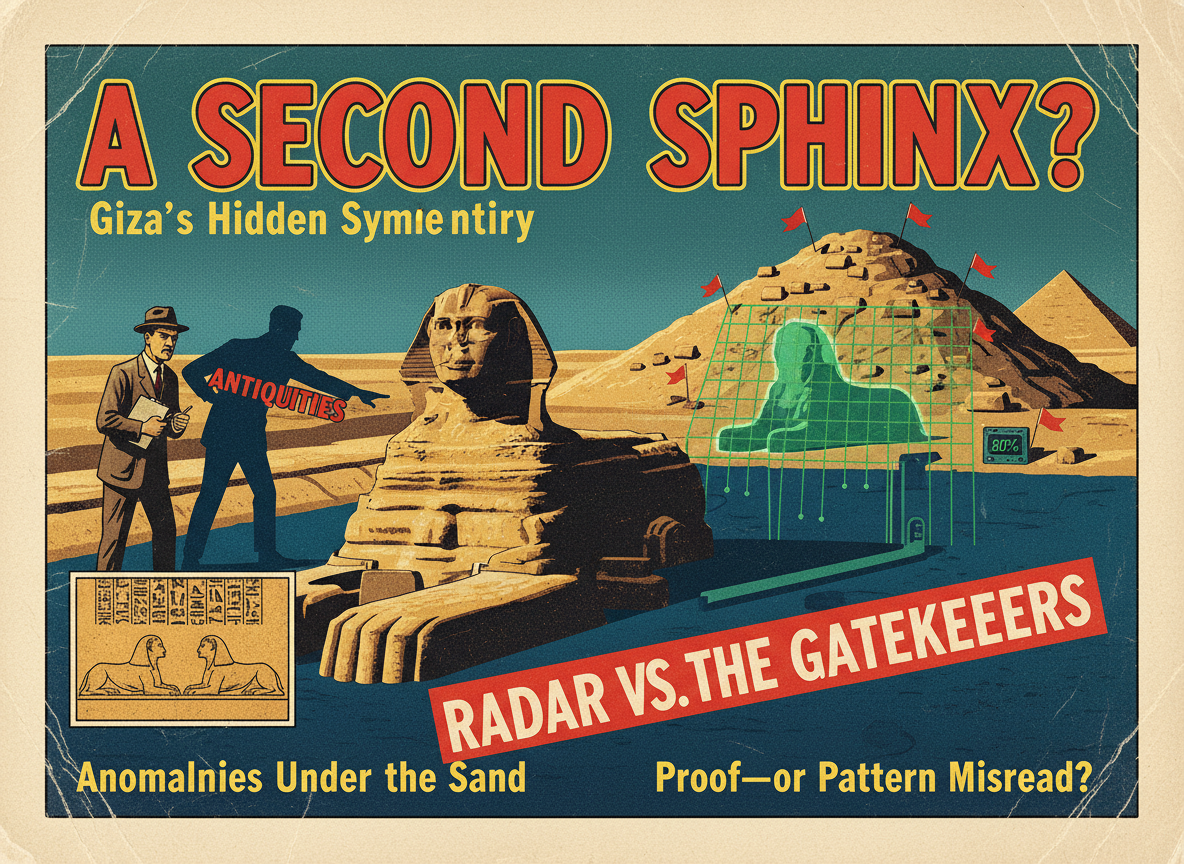
Filippo Biondi and his team used satellite-based Synthetic Aperture Radar to scan the Giza Plateau and say they found a buried structure matching the Sphinx’s profile beneath a 108-foot mound. They are 80 percent confident. Egypt’s former antiquities minister calls it fabrication. The Dream Stele carved 3,400 years ago may have been trying to tell us something the whole time.
There is a mound of hardened sand sitting on the Giza Plateau that most visitors walk past without a second look. It is not far from the Great Sphinx. It is not dramatic to the eye. It rises about 108 feet from the surrounding plateau surface, and for most of the last century it has been treated as geological background, one of the unremarkable landforms that frame one of the world’s most remarkable archaeological sites.
Filippo Biondi, a radar engineer at the University of Strathclyde, thinks something is under it.
On March 26, 2026, Biondi appeared on the Matt Beall Limitless podcast and described what he and his collaborators, researcher Corrado Malanga and colleague Armando Mei, believe their satellite radar scanning has revealed: a buried structure that mirrors the profile of the Great Sphinx, positioned at what the team describes as a geometrically precise location relative to the known monuments. And beneath that, something larger.
“Down underneath the Giza Plateau,” Biondi said, “there is something very huge that we are measuring. There is an underground megastructure.”
He put his confidence in the second Sphinx specifically at approximately 80 percent. He said the team was “very confident to announce this.”
The claim went viral almost immediately. It drew tens of millions of views across social media, generated front-page treatment from the Daily Mail, and triggered a response from the global Egyptological community that ranged from dismissal to measured skepticism to outright condemnation. Zahi Hawass, Egypt’s former minister of antiquities and the most prominent public face of Egyptian archaeology, called the underground megastructure claims “fabrications” and said the area has been studied and excavated extensively without any such discovery.
He is not wrong that Giza has been extensively studied. He may not be entirely right that it holds no more surprises.
What the Radar Actually Found
The Khafre Research Project, as Biondi’s team has named their effort, is built on Synthetic Aperture Radar technology, specifically a satellite-based variant known as SAR tomography. In 2022, Biondi and Malanga published a paper in the peer-reviewed journal Remote Sensing describing a method for using SAR combined with background seismic motion to reconstruct internal and subsurface structures in the Great Pyramid of Giza. That paper did not announce a second Sphinx. It established the scanning methodology that the team is now deploying more broadly across the plateau.
SAR works by bouncing radar signals off surfaces and analyzing the returned data to construct three-dimensional images. When applied to ground-penetrating work, the technology reads variations in soil density, rock composition, and material boundaries to detect anomalies that differ from the surrounding medium. The scan is, in principle, capable of detecting buried structures if those structures are made of materially different stone or soil than what surrounds them.
The Great Sphinx sits in a shallow depression below the surrounding plateau level, which is itself an unusual feature. The mound Biondi is pointing to rises rather than sinks, but the team argues this is consistent with a buried monument being covered by accumulated sand and hardened over millennia rather than carved directly into bedrock in the manner of the original.
Biondi described the data as showing “vertical shafts and horizontal passages” beneath the mound, features consistent in his reading with what has been documented beneath the known Sphinx. He also described what he called “100 percent geometric correlation” between the known monuments and the location of the suspected twin, meaning that lines drawn from the existing pyramids and Sphinx converge on the mound in a way that would be consistent with deliberate ancient design.
“There is an incredible symmetry between the first and the second,” Biondi said. “We are finding precise geometrical correlation, 100 percent of correlation, in this symmetry.”
The Dream Stele Clue
The technological argument has a symbolic companion that predates radar by approximately three and a half thousand years.
Between the front paws of the Great Sphinx stands the Dream Stele, a granite slab erected by Pharaoh Thutmose IV around 1400 BC. The stele records a dream in which the young Thutmose, before becoming pharaoh, fell asleep near the Sphinx and received a vision. The Sphinx spoke to him, promising him the throne in exchange for clearing the sand that had buried its body up to the neck. Thutmose cleared the sand, became pharaoh, and erected the stele to commemorate the event.
That much is established ancient history.
What has attracted the attention of fringe researchers for decades, and what Biondi’s team has now explicitly cited as symbolic evidence for their claim, is the imagery carved into the stele itself. Two sphinx-like figures are depicted, one on each side of the central relief. Mainstream Egyptologists have generally interpreted this as stylistic and symmetrical, a conventional artistic device rather than a literal representation of two physical monuments. But the fringe interpretation, as old as the modern alternative history movement, has always been that the paired imagery was not decoration. It was documentation.
The presence of that stele, erected by a pharaoh who clearly knew where both the Sphinx and a second related structure stood, is the kind of coincidence that the history of ancient Egyptian architecture suggests should not be dismissed entirely.
The Science Has Critics, Including Insiders
The mainstream response to Biondi’s claims has been sharp, but not universally dismissive in the same direction.
Hawass, who spent decades as the dominant voice in Egyptian archaeology and who has seen dozens of fringe Giza theories come and go, deployed language he has used before: “fabrications,” “no scientific foundation,” “people with no expertise in ancient Egyptian civilization.” He noted that the area around the pyramids and Sphinx has been subjected to extensive study and excavation over generations without yielding anything resembling a second monument.
Radar specialist Lawrence Conyers, cited by AFP, raised a more technical objection. “Radar waves gradually attenuate in the ground,” Conyers explained, a statement that points to a core limitation of SAR-based deep scanning: the further below the surface the target, the weaker and more ambiguous the return signal becomes. At the depths Biondi is claiming, roughly 50 meters below the plateau surface in some descriptions, the confidence level of any radar-based interpretation drops substantially.
More striking is the response from within the research team itself. According to fact-checking by Newsweek and independent researchers, some collaborators on the radar project have publicly disputed the interpretation of the data, saying that the scanning results show subsurface anomalies but do not support the specific conclusion that those anomalies represent a second Sphinx. This is not Hawass calling Biondi wrong. This is people who looked at the same data and reached a different conclusion.
National Geographic reported that SAR technology has not been independently verified for the kind of ultra-deep detection being claimed at Giza, a point that applies specifically to whether the 2022 Remote Sensing paper’s methodology can be reliably extended from internal pyramid structure analysis to detecting entirely buried external monuments 50 meters underground.
Biondi has not publicly addressed the internal dissent in detail. He has maintained his 80 percent confidence claim and stated that additional verification work is ongoing.
What Is Actually Under Giza
The question of what lies beneath the Giza Plateau is genuinely open in ways that go beyond fringe speculation.
Ground-penetrating radar surveys of the Sphinx enclosure conducted in the 1990s by researchers including the American team of John Anthony West and Robert Schoch identified anomalies below the surface that were interpreted as possible chambers. Those findings were never followed up with excavation, partly because Egyptian authorities declined to permit it, and partly because the interpretations of the radar data were themselves disputed.
The “Hall of Records” theory, associated with both Edgar Cayce’s readings and with a broader alternative history tradition, proposes that a hidden archive of pre-dynastic knowledge lies somewhere beneath the Giza Plateau. That theory has no confirmed archaeological support. It has also never been disproven by excavation, because the excavation that would resolve it has not been permitted.
More recently, in 2025, separate researchers announced findings suggesting a “vast city” of structures beneath the Khafre pyramid complex, a claim that drew both significant media attention and immediate academic pushback. The announcement was made before peer review and has not been formally published in an accepted archaeological journal.
What this pattern suggests is not that a second Sphinx definitely exists under that mound. It is that the Giza Plateau is a site where subsurface anomalies are consistently being detected by multiple research teams using multiple technologies, where the mainstream archaeological community has consistently explained those anomalies as natural formations or misread data, and where ground truth excavation, the one method that would actually resolve the debate, remains essentially unavailable to independent researchers.
Biondi’s team is not the first to claim something extraordinary is under Giza. They are the latest. And they come with published peer-reviewed methodology behind their scanning approach, which does not prove their specific claim but does distinguish them from pure speculation.
Where the Story Stands
As of April 2026, no excavation has taken place. No peer-reviewed study has validated the second Sphinx claim specifically. Egyptian authorities have not approved, acknowledged, or announced any such discovery. The claim originated on a podcast and was amplified by tabloid media before the academic community had any opportunity to respond.
All of that is true and worth stating plainly.
It is also true that the Dream Stele shows two sphinx figures and has done so for 3,400 years. It is true that the mound Biondi is pointing to exists, is positioned where he says it is positioned, and has not been excavated. It is true that the 2022 Remote Sensing paper establishing his methodology was published in a peer-reviewed journal. It is true that SAR scans have detected subsurface anomalies at the location in question, even if experts disagree about what those anomalies represent.
The Giza Plateau has been yielding surprises for a long time. The most recent before this one was the discovery in 2023 of a previously unknown tunnel beneath the Temple of Taposiris Magna, adding to the picture of an underground landscape at Egypt’s ancient sites that is more complex than the surface suggests.
Whether the mound beside the Great Sphinx is covering a companion monument that the ancient Egyptians knew about, carved, buried, and memorialized on a slab of granite placed between its twin’s paws, is a question that radar alone will not answer. It requires a shovel. And permission to use it.
For now, the controversy continues without one.
Sources: Ancient Origins, Controversy Rages Over Second Sphinx Claim at Giza, Newsweek, Fact Check: Is a Second Sphinx Buried Beneath Pyramids of Giza?, The Daily Galaxy, Scientists Found a Second Sphinx Buried Deep Beneath Egypt’s Giza Sands, LADbible, Researchers Discover Second Sphinx in Egypt as Scans Unearth Underground Megastructure, Euro Weekly News, Radar Scans Spark Debate Over Possible Second Sphinx Beneath Giza Plateau, GB News, Archaeology Breakthrough: Second Sphinx Emerges from Sand Beneath Egypt’s Great Pyramids, Unexplained Mysteries, Researchers Allegedly Find Second Sphinx Beneath the Giza Plateau, Vice, What Archaeologists Found While Searching for a Buried Second Sphinx in Egypt
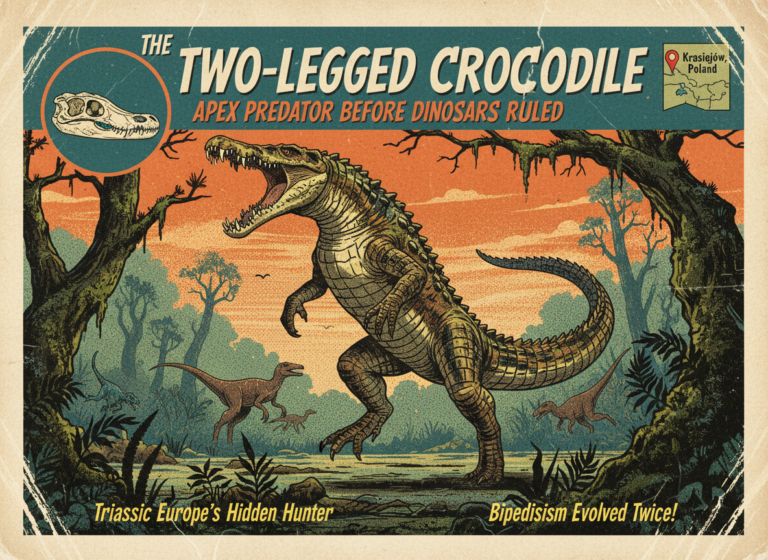
Scientists Found a Crocodile Relative That Walked on Two Legs. It Was the Apex Predator of Its Time, and Nobody Knew It Existed.
A newly described prehistoric species — Proexochokefalos steineri — has been identified from fossils found in what is now Poland. It lived…
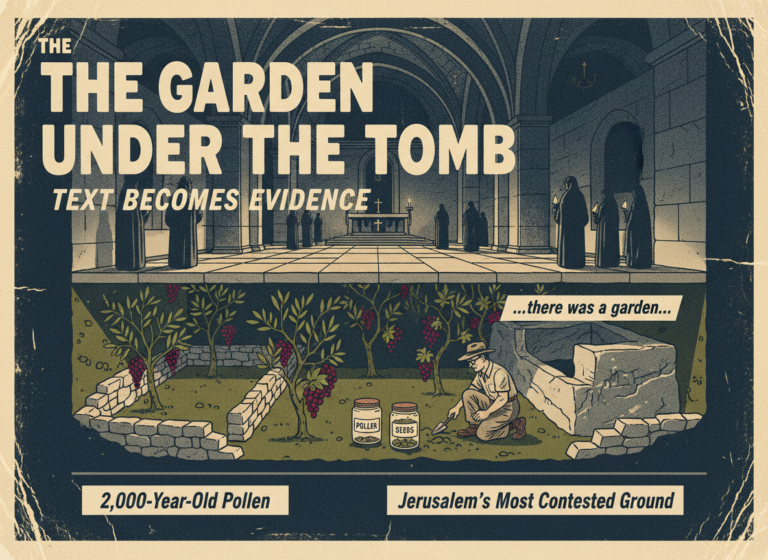
Archaeologists Just Found a 2,000-Year-Old Garden Under the Church Built Over Jesus's Tomb. The Gospel of John Said It Would Be There.
An archaeological excavation running since 2022 beneath the floor of the Church of the Holy Sepulchre in Jerusalem has uncovered something no…

Kacey Musgraves Watched Three Orbs Follow Her Plane for 45 Minutes. The Pilots Had Seen Them Every Night.
On the evening of April 9, 2026, Grammy Award-winning country artist Kacey Musgraves was on a private flight from Fort Worth, Texas…
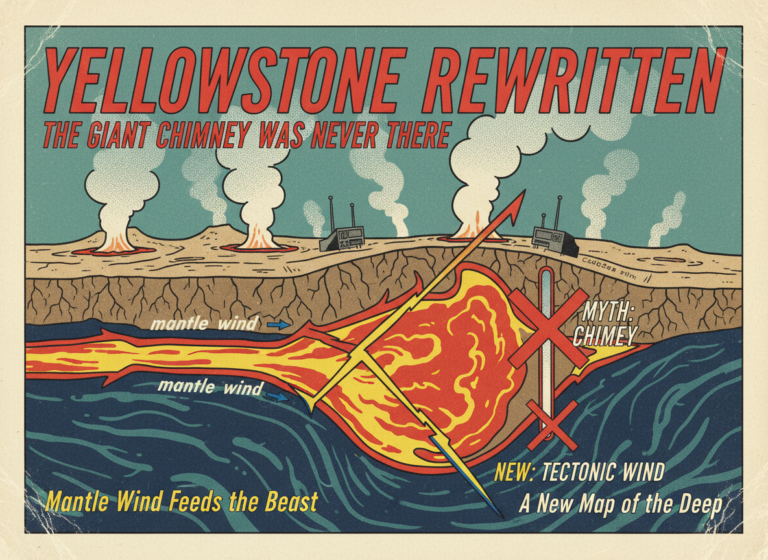
Scientists Just Rewrote How Yellowstone's Supervolcano Works. The Giant Chimney Was Never There.
For decades, the standard model of Yellowstone held that the supervolcano was fed by a deep mantle plume — a column of…