Original Story
Scientists Just Rewrote How Yellowstone’s Supervolcano Works. The Giant Chimney Was Never There.
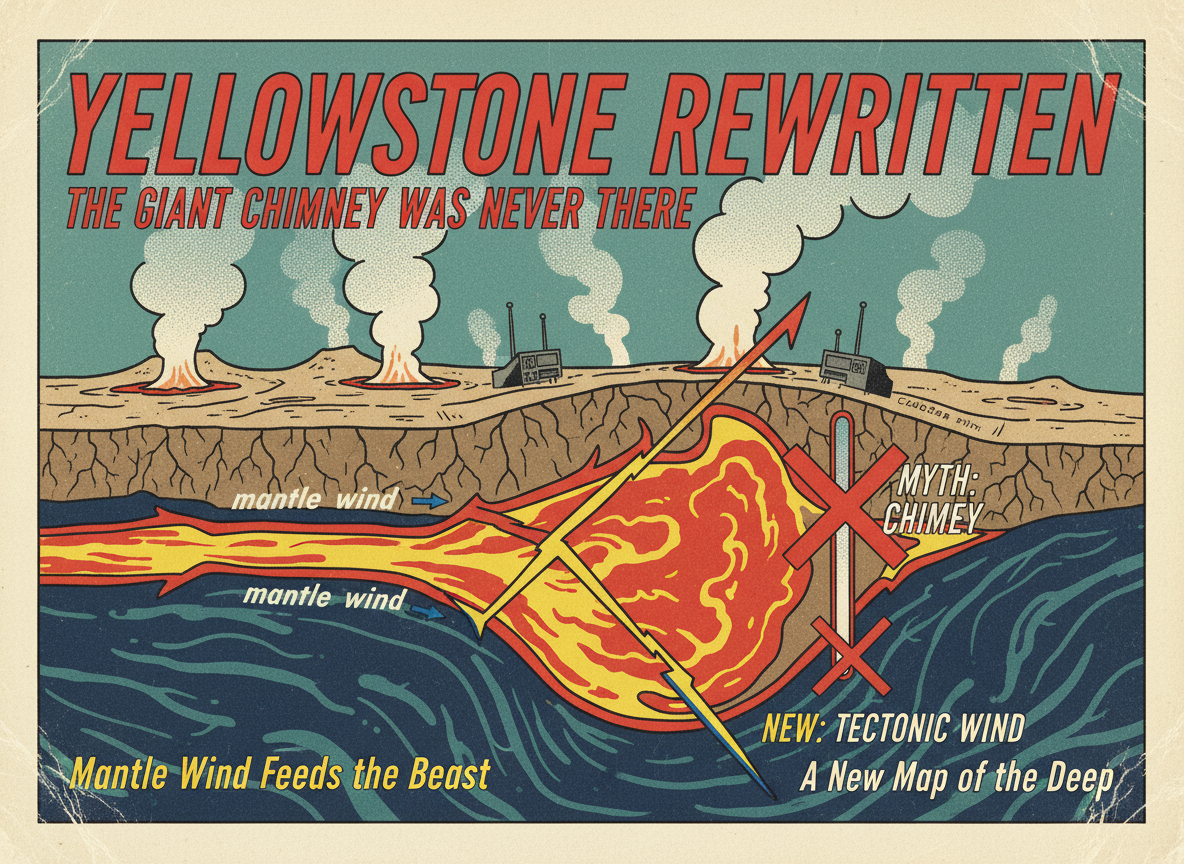
For decades, the standard model of Yellowstone held that the supervolcano was fed by a deep mantle plume — a column of superheated material rising nearly vertically from thousands of kilometers below the surface, like a giant chimney pumping heat through the continental crust. A new study published in the journal Science on April 10, 2026, by researchers from the Institute of Geology and Geophysics of the Chinese Academy of Sciences and the University of Illinois, dismantles that model. Yellowstone is not fed by a deep vertical plume. It is fed by a sideways flow of hot mantle material driven by tectonic forces — a “mantle wind” driven by a piece of ancient sunken ocean floor — which then rises through a diagonal, tectonic crack in the continental lithosphere rather than a vertical chimney. The implications extend beyond Yellowstone to every known supervolcano on Earth.
The traditional deep mantle plume model of Yellowstone always had a problem: Yellowstone is in the middle of a continent. Most volcanic systems are found where tectonic plates meet — at subduction zones where one plate dives beneath another, or at mid-ocean ridges where plates pull apart. Yellowstone is nowhere near a plate boundary. For decades, the explanation for this anomaly was a hotspot plume: a stationary column of deep, superheated material rising from the core-mantle boundary, punching up through the continental plate like a blowtorch held under a moving piece of glass. The trail of calderas across Idaho and Wyoming was understood as the North American plate moving over this stationary heat source.
The new study, led by first author Cao Zebin and corresponding author Liu Lijun, used a three-dimensional geodynamic model integrating seismic, electrical, and geological observation data to simulate the present-day Yellowstone system. What the model produces is something considerably more complex — and in some ways more alarming — than the old chimney.
What Is Actually Down There
Beneath Yellowstone, there is no straight chimney. There is a tilted, southwest-dipping system of magma mush — a term describing partially molten rock mixed with solid crystals, more like a sponge soaked in lava than the roiling liquid chamber of popular imagination — that extends diagonally through the entire lithosphere and connects to the upper asthenosphere, the soft, viscous layer just below the rigid tectonic plate.
The heat and magma that feed this system do not come from deep in the Earth. They come from a sideways flow. The Farallon Plate — a section of ancient Pacific ocean floor that began subducting beneath North America millions of years ago and is now sinking through the deep mantle beneath the eastern United States — is still moving. As it sinks, it drags asthenospheric material from the west coast region toward the east in what the researchers describe as a mantle wind. This eastward flow of hot, partially molten material moves beneath the continent and, when it encounters the structural conditions beneath Yellowstone, is squeezed upward through a tectonic crack that tearing forces in the lithosphere have opened at an angle.
The magma that eventually reaches Yellowstone’s surface reservoirs has taken a lateral journey, not a vertical one. The tilted structure seen in seismic imaging — which previous researchers struggled to explain in the context of a vertical plume — is a direct consequence of this diagonal pathway.
Why This Matters Beyond Yellowstone
The researchers note that similar tilted, translithospheric magma mush systems have been identified at other supervolcanoes worldwide. If the mechanism is broadly applicable, it suggests that the eruption physics of supervolcanoes generally — including how magma accumulates, what triggers a supereruption, and what warning signals precede one — may need to be reconsidered.
Yellowstone itself last erupted on a super scale approximately 630,000 years ago, producing the 30-by-45-mile caldera that the park now sits within. The researchers do not believe a supereruption is imminent; the system shows no signs of moving toward eruption. But their model does improve understanding of how magma mush systems persist for hundreds of thousands of years between eruptions, and what physical processes sustain them — which is precisely the kind of knowledge that makes monitoring more effective.
The chimney model was elegant. The tectonic wind model is stranger, and the evidence for it is now published in one of the world’s most rigorous scientific journals.
Sources: Science — Cao et al., Tectonic Origin of Yellowstone’s Translithospheric Magma Plumbing System (April 10, 2026) — Gizmodo — Yellowstone’s Dreaded Supervolcano Has an Unexpected Power Source, Study Says (April 9, 2026) — Phys.org — Yellowstone’s Magma Plumbing Mainly Shaped by Tectonic Forces, Not Deep Mantle Plume (April 10, 2026) — Phys.org — Yellowstone’s Magma Source May Be Closer Than Thought (April 10, 2026) — Xinhua — New Study Reveals Hidden Forces Behind Yellowstone Supervolcano (April 10, 2026) — The Brighter Side of News — The Hidden Mantle Flow Shaping Yellowstone’s Supervolcano (April 13, 2026) — Chinese Academy of Sciences — Beneath Yellowstone: How a Supervolcano Is Born (April 2026)
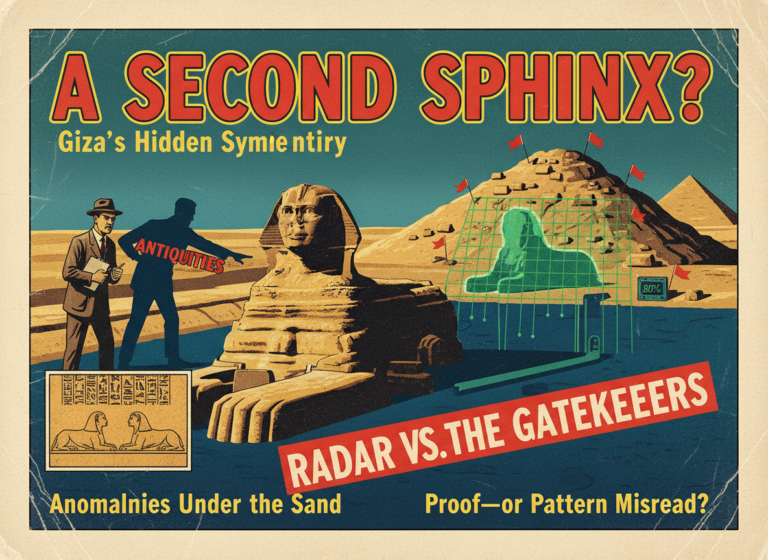
An Italian Radar Engineer Says There Is a Second Sphinx Buried at Giza, and the Evidence Is Not Nothing
Filippo Biondi and his team used satellite-based Synthetic Aperture Radar to scan the Giza Plateau and say they found a buried structure…

Scientists Found a Crocodile Relative That Walked on Two Legs. It Was the Apex Predator of Its Time, and Nobody Knew It Existed.
A newly described prehistoric species — Proexochokefalos steineri — has been identified from fossils found in what is now Poland. It lived…

Archaeologists Just Found a 2,000-Year-Old Garden Under the Church Built Over Jesus's Tomb. The Gospel of John Said It Would Be There.
An archaeological excavation running since 2022 beneath the floor of the Church of the Holy Sepulchre in Jerusalem has uncovered something no…

Kacey Musgraves Watched Three Orbs Follow Her Plane for 45 Minutes. The Pilots Had Seen Them Every Night.
On the evening of April 9, 2026, Grammy Award-winning country artist Kacey Musgraves was on a private flight from Fort Worth, Texas…