Original Story
Scientists Found a Crocodile Relative That Walked on Two Legs. It Was the Apex Predator of Its Time, and Nobody Knew It Existed.
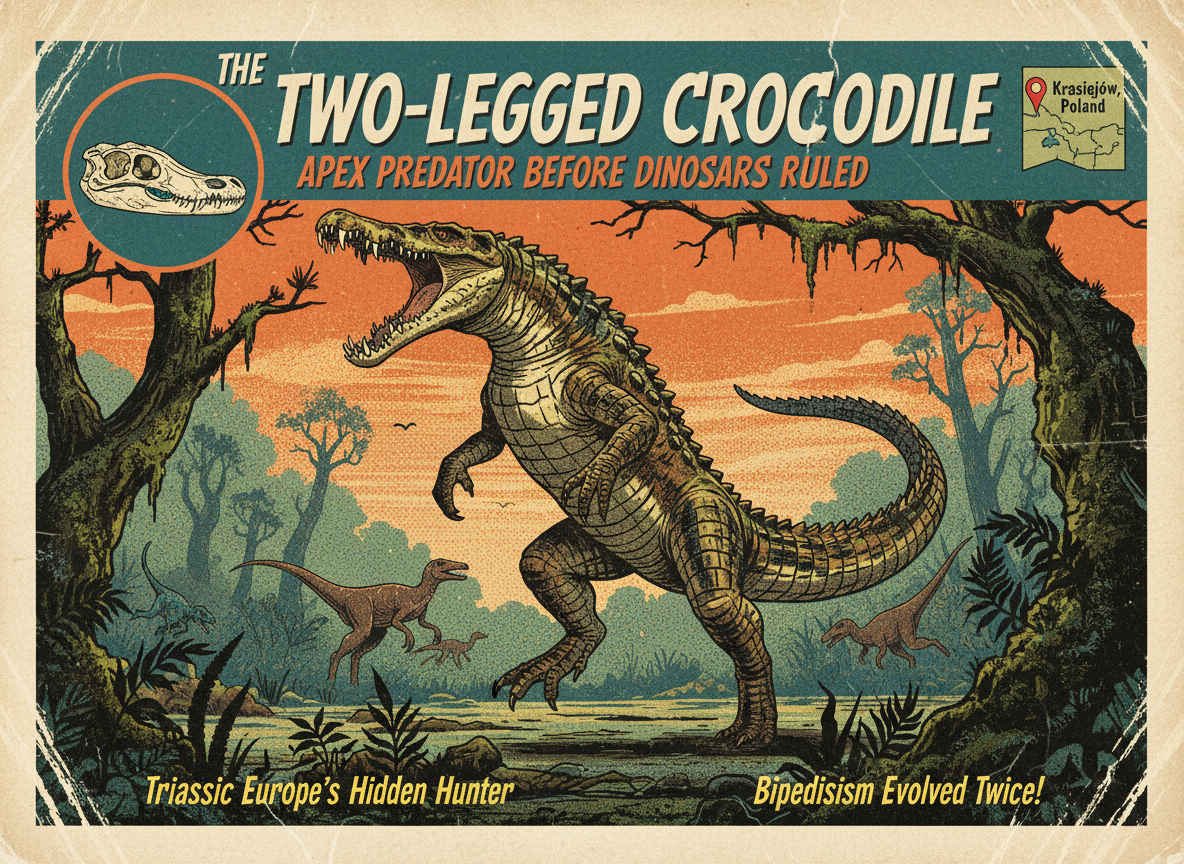
A newly described prehistoric species — Proexochokefalos steineri — has been identified from fossils found in what is now Poland. It lived approximately 237 million years ago, during the early Late Triassic, and it walked on two legs. This makes it a bipedal crocodylomorph, a member of the broader evolutionary group that eventually gave rise to modern crocodilians, at a time when bipedalism among large predators was far more common than it would become. The animal stood at what researchers estimate was a significant height for its era and appears to have been an apex predator in its environment, competing directly with early dinosaurs. Its discovery is reshaping understanding of how the ancient crocodile lineage evolved and of the competitive landscape that shaped the earliest dinosaurs.
The order of events in the Triassic is counterintuitive to most people who learned paleontology through a dinosaur-first lens. Dinosaurs did not simply appear and dominate. They emerged into a world already occupied by sophisticated, highly mobile, often bipedal archosaurs — the broader category of reptiles that includes both the crocodile line and the dinosaur line. For tens of millions of years, these two lineages competed on roughly equal terms, in some environments with the crocodile-line animals holding the dominant predator roles.
Proexochokefalos steineri is a new entry in that competitive picture. The fossil was recovered from the Krasiejów site in southern Poland, one of the most productive Late Triassic fossil locations in Europe, where excavations have been producing significant archosaur material for years. The new species belongs to the loricatans — a group within the pseudosuchia (the crocodile evolutionary branch) — and shows clear adaptations for an upright, bipedal posture rather than the sprawling, belly-close-to-ground stance of modern crocodilians.
What Made It Different
Modern crocodilians are semi-aquatic ambush predators with a sprawling limb posture inherited from a long period of evolutionary conservatism. They are extraordinarily successful in their ecological niche but represent a narrowed version of what the crocodile lineage was capable of producing. In the Triassic, croc-line archosaurs were far more diverse: some were herbivores, some were armored quadrupeds, and some, including the new Polish species, were fast-moving bipedal predators.
The bipedal posture implied by Proexochokefalos steineri’s anatomy is significant for what it tells us about locomotion in the early archosaur radiation. It means that upright bipedalism evolved independently multiple times across the archosaur family tree — not just in the dinosaur lineage, where it is most famously represented, but in the crocodile lineage as well. The famous question of why dinosaurs came to dominate the Triassic and Jurassic while the croc-line archosaurs retreated into their modern conservative form is partly answered by extinction events — but the diversity of the croc line before those events is something paleontology has consistently underestimated.
The species name honors the site’s lead excavator. Its genus name references the distinctive morphology of the skull region that allowed researchers to differentiate it from related species already known from the Krasiejów assemblage.
The Competitive World It Inhabited
The Krasiejów site dates to approximately 237 to 227 million years ago — a period when dinosaurs were just beginning to diversify from their own origins in South America and were still relatively small and marginal in many ecosystems. The early Late Triassic world was dominated by pseudosuchian archosaurs in many regions, with dinosaurs emerging as significant players only gradually. Proexochokefalos steineri was living during this transition period, competing in ecosystems where the evolutionary outcome was not yet decided.
The fact that a bipedal croc-line predator of this apparent size existed in Europe during this period adds a new piece to the picture of why early dinosaurs had such a constrained initial ecological footprint — they were not filling an empty world. They were attempting to carve out space in ecosystems already occupied by animals every bit as capable and mobile as themselves, including this newly discovered two-legged relative of the animals that today lie in the mud of river banks waiting for something to come close to the water’s edge.
Sources: Unexplained Mysteries forum — Scientists Discover Bizarre Crocodile Relative That Walked on Two Legs (April 14, 2026) — [ScienceDaily — New bipedal crocodylomorph from the Late Triassic of Poland (April 2026)] — [Journal of Vertebrate Paleontology — Proexochokefalos steineri, a new loricatan archosaur from the Krasiejów site (April 2026)]

An Italian Radar Engineer Says There Is a Second Sphinx Buried at Giza, and the Evidence Is Not Nothing
Filippo Biondi and his team used satellite-based Synthetic Aperture Radar to scan the Giza Plateau and say they found a buried structure…

Archaeologists Just Found a 2,000-Year-Old Garden Under the Church Built Over Jesus's Tomb. The Gospel of John Said It Would Be There.
An archaeological excavation running since 2022 beneath the floor of the Church of the Holy Sepulchre in Jerusalem has uncovered something no…

Kacey Musgraves Watched Three Orbs Follow Her Plane for 45 Minutes. The Pilots Had Seen Them Every Night.
On the evening of April 9, 2026, Grammy Award-winning country artist Kacey Musgraves was on a private flight from Fort Worth, Texas…
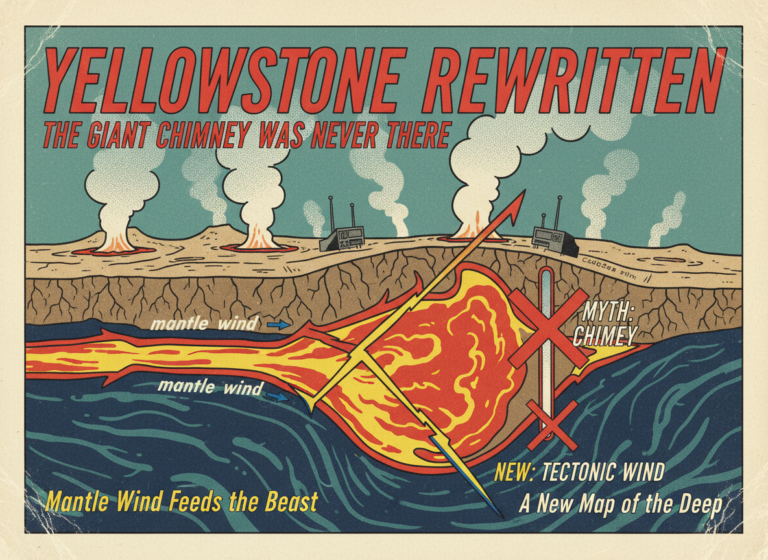
Scientists Just Rewrote How Yellowstone's Supervolcano Works. The Giant Chimney Was Never There.
For decades, the standard model of Yellowstone held that the supervolcano was fed by a deep mantle plume — a column of…