Original Story
Wright-Patterson Was Always the Other Roswell — Now a Missing General Is Making People Remember Why
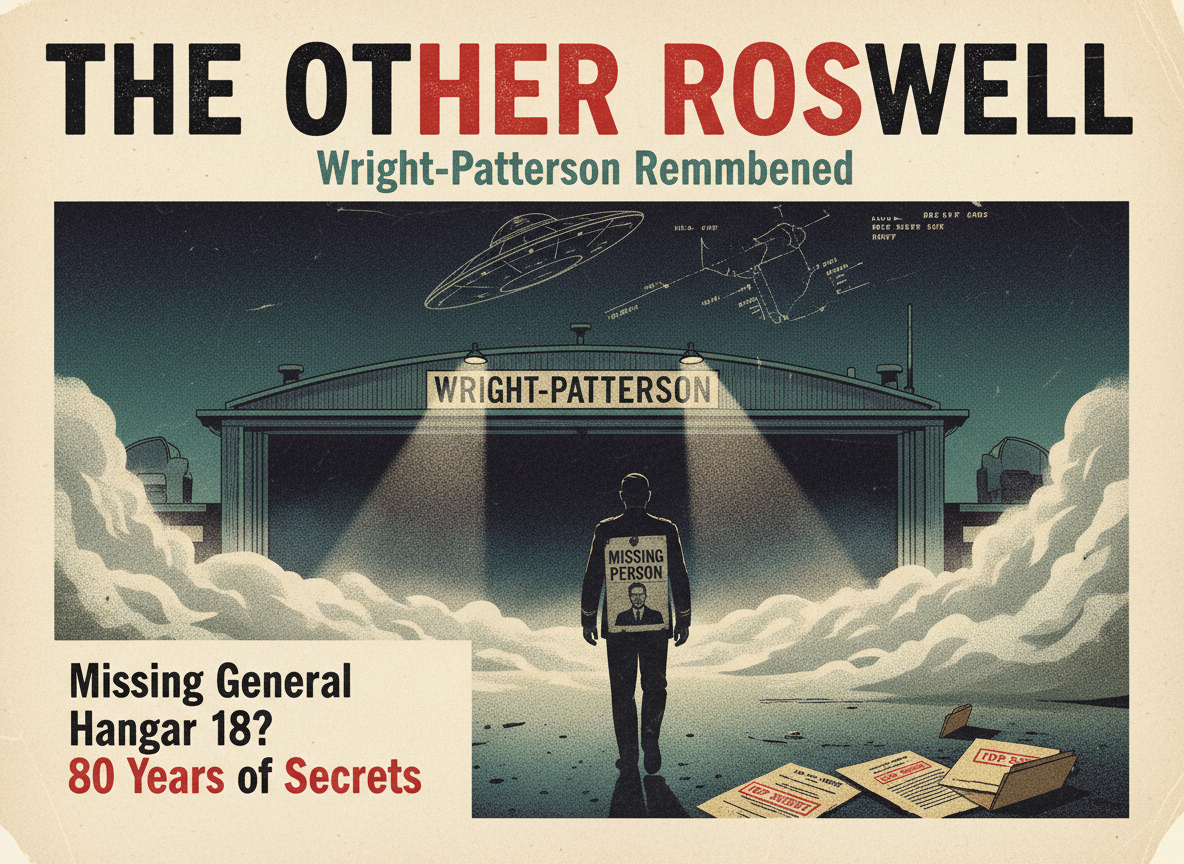
CNN just ran a deep-dive on the base the fringe community has been watching for 80 years. The timing, given what happened to Neil McCasland, is not an accident.
There is a building at Wright-Patterson Air Force Base in Dayton, Ohio, that people with clearances will not discuss. Hangar 18 — as it is known in the research community, though the designation is disputed and the physical structure itself is subject to debate — has accumulated more classified mythology than almost any other address in American military history. The reason is simple: whatever fell out of the sky near Roswell, New Mexico, in July 1947, the fringe community has believed for decades that some of it ended up here.
CNN ran a full-length feature on Wright-Patterson this week, timed — whether deliberately or not — to the ongoing disappearance of retired Major General William Neil McCasland, 68, who vanished from his Albuquerque home shortly after President Trump’s February announcement of a UAP files release directive. The piece traces the base’s documented history as the central node in the U.S. military’s investigation of unidentified aerial phenomena, from Project Sign in 1947 through Project Blue Book and into the modern AARO era.
What Wright-Patterson Actually Was
The base’s role in UAP research is not fringe speculation — it is documented history. Project Blue Book, the Air Force’s official 20-year investigation into UFO reports, was headquartered there. The base housed the Foreign Technology Division, which analyzed captured and recovered aerospace hardware from adversarial nations. It was the destination point for physical evidence from significant military encounters going back to the postwar period.
McCasland himself commanded the Air Force Research Laboratory at Wright-Patterson, giving him direct authority over the facility’s most sensitive programs. His name appeared in the 2016 Podesta email leak in connection with UAP research. He has never spoken publicly about what he may or may not know. And now he is gone.
The Part CNN Didn’t Linger On
The CNN piece is careful and appropriately balanced. It notes that authorities have stated there is no evidence linking McCasland’s disappearance to his UAP research connections. It includes skeptical voices. It presents the Roswell-to-Wright-Patterson pipeline as one theory among several.
What the piece does not fully reckon with is the specificity of McCasland’s position. He was not a general with a peripheral relationship to UAP programs. He ran the laboratory that, according to multiple researchers, would have been the institutional home for any reverse-engineering work the Air Force was conducting. The All-domain Anomaly Resolution Office has now catalogued over 2,400 UAP cases. The base at the center of the institutional history of that entire investigation just lost its most prominent living alumnus to an unexplained disappearance.
The fringe community has known about Wright-Patterson for eight decades. Right now, that history feels less like mythology and more like context.
Kennedy Pushed Hard on Dimona. Then He Was Killed. The Documents Are Real — the Question Is What They Mean.
The JFK-Dimona thread is back in the feed today via Conspiracy Unearthed. The documented history of what Kennedy was actually doing about…
Life's Instruction Manual Was Found on an Asteroid — And It Didn't Come From Earth
Researchers at Hokkaido University have confirmed that samples from the asteroid Ryugu contain all five nucleobases — the molecular letters of DNA…
The Man Who Builds Autonomous Fighter Jets Says UFOs Probably Come From the Past — and He's Thought About the Physics
Palmer Luckey founded Oculus, sold it to Facebook for $2 billion, then built Anduril Industries — one of the most significant autonomous…
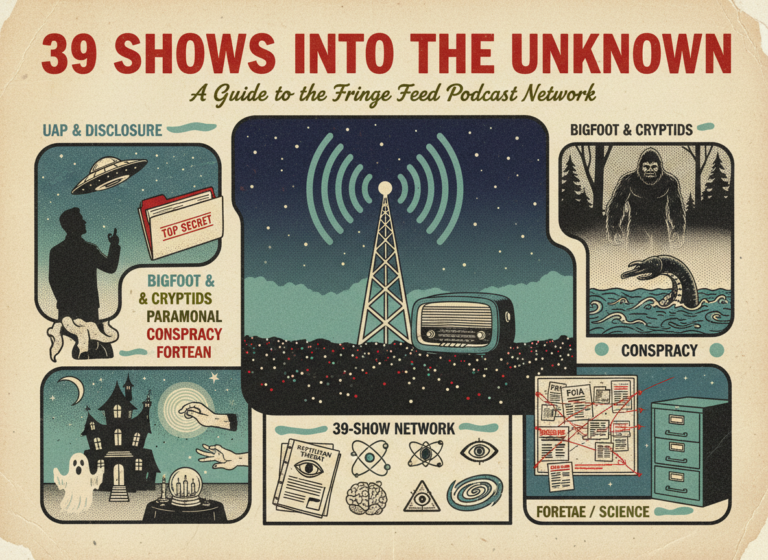
39 Shows in the Directory — Your Guide to the Fringe Feed Podcast Index
The Fringe Feed indexes 39 active fringe podcast shows across six categories. 🛸 If You're Here for UAP and Disclosure UFO Chronicles…