Original Story
A Frozen Wolf Puppy Had Woolly Rhinoceros Meat in Its Stomach. Scientists Just Sequenced the Rhino’s Full Genome From It.
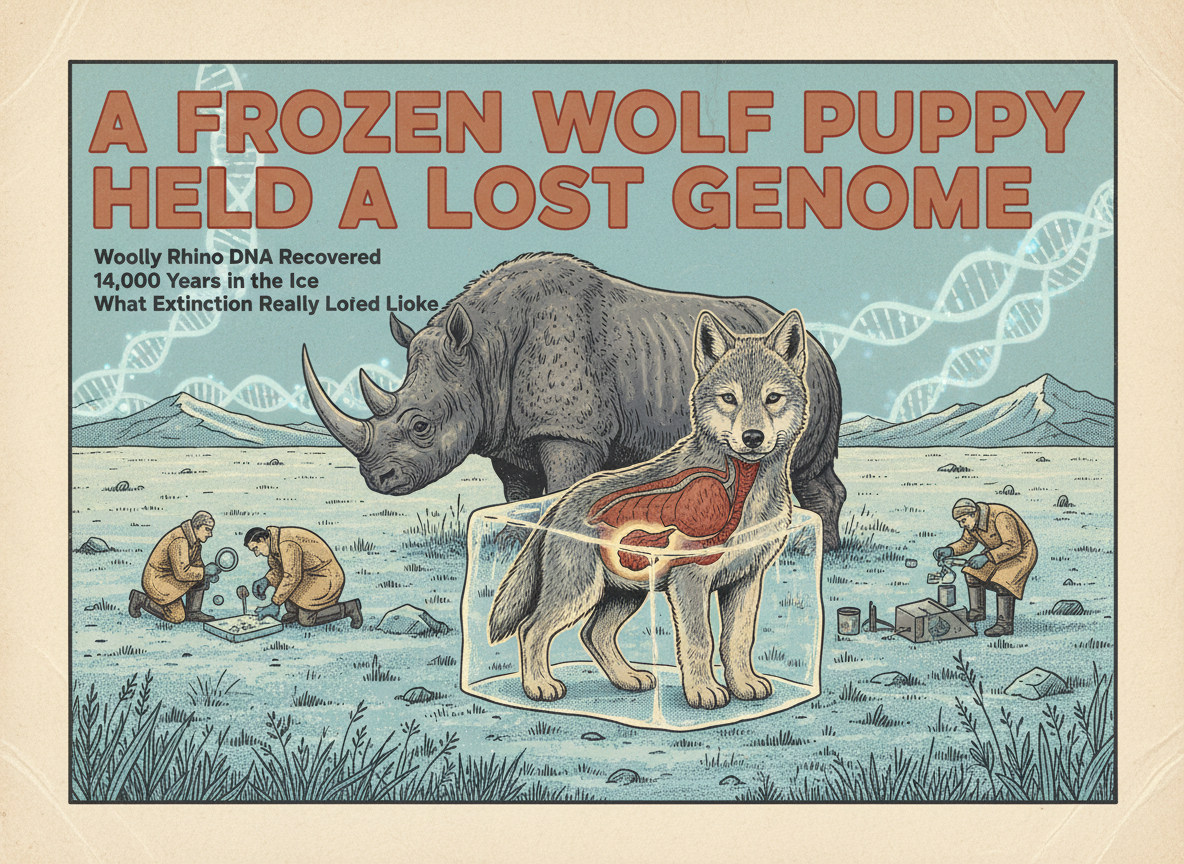
A mummified wolf pup pulled from Siberian permafrost in 2011 had a fragment of woolly rhinoceros tissue in its stomach with the hair still attached. The tissue had not fully digested when the den collapsed and buried the animal alive 14,000 years ago. Researchers at the Centre for Palaeogenetics in Stockholm just sequenced the woolly rhino’s complete genome from that stomach fragment — the first time an Ice Age animal’s full genome has been recovered from inside the gut of another animal. What the genome reveals about why the woolly rhino went extinct lands differently than expected.
The Tumat puppies were found in 2011 and 2015 near the Siberian village of Tumat, in the remote northeast of Russia. They are believed to be littermates. Both are still covered in parchment-like skin with large patches of dark brown fur. One permanently bares its teeth. Mammoth ivory hunters found them entombed in permafrost, preserved in exquisite detail from a world that ended 14,000 years ago.
When scientists autopsied the first puppy, known as Tumat-1, they found something inside it: a small, grayish chunk of meat covered in strands of golden hair. The tissue had barely been digested. The wolf pup had just eaten when its den collapsed and buried it alive. There had not been time for the stomach acids to penetrate the flesh.
DNA analysis confirmed the meal was woolly rhinoceros.
What the Genome Shows
The research, published in Genome Biology and Evolution and conducted by scientists at Stockholm University’s SciLifeLab Ancient DNA Unit, represents the first time a complete genome has been sequenced from an animal found inside the gut of another. Lead author Sólveig Guðjónsdóttir called it “really exciting, but also very challenging,” noting the risk of wolf DNA contaminating the rhino sample during analysis.
They extracted the full genetic code from the 14,000-year-old stomach fragment and compared it with two other woolly rhino genomes from Siberian permafrost dated to 18,000 and 49,000 years ago respectively. The comparison allowed the team to trace changes in the species’ genetic diversity across the final stretch of its existence.
The result was unexpected. The woolly rhinoceros genome showed no signs of genetic deterioration approaching extinction. No meaningful inbreeding. No accumulation of harmful mutations. No shrinking population bottleneck of the kind that typically precedes a species’ collapse.
The woolly rhinoceros was not failing genetically when it disappeared. Its population appears to have been stable and relatively large until very close to the end.
What That Means for Extinction Theory
If the woolly rhino’s genetics were healthy right up to its disappearance around 14,000 years ago, then whatever killed it arrived quickly and came from outside the species. The evidence points to the rapid warming at the end of the last Ice Age as the most probable cause. Some researchers also argue that human hunting contributed during the same climatic window, when warming conditions may have simultaneously supported larger human populations with better access to the animals.
The wolf pup that ate the rhinoceros flesh died at the same moment the Ice Age was ending. Its den collapsed. Both animals were sealed into permafrost. One inside the other. For 14,000 years the world changed above them: ice retreated, seas rose, Doggerland drowned, the megafauna disappeared. Then ivory hunters found the den and pulled them out.
“Permafrost mummies give a spectacular view into the past,” said coauthor Camilo Chacón-Duque. “Usually palaeontologists and archaeologists can only recover bones, but here we can better understand how these animals looked and lived.”
The rhinoceros in the wolf’s stomach is one of the most recent individuals in the woolly rhino’s fossil record. Its genome may be the last detailed portrait the species left behind.
Sources: Discover Wildlife — Ice Age wolf pulled from Siberian permafrost — CNN — New DNA analysis reveals an ice age wolf’s last meal — National Geographic — Researchers recover a woolly rhino genome from inside a frozen wolf’s stomach — Genome Biology and Evolution (2026)

A Bronze Age Spanish Treasure Sat in a Museum for 60 Years. Two Pieces of It Were Made from a Meteorite. Nobody Knew.
The Treasure of Villena — 66 objects found in 1963 near Alicante, Spain, dating to between 1400 and 1200 BCE — includes…
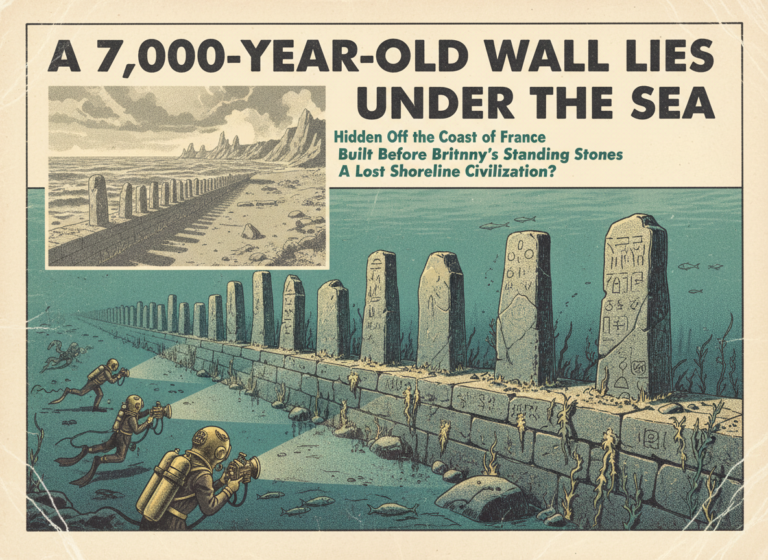
There Is a 7,000-Year-Old Stone Wall Sitting on the Ocean Floor off the Coast of France. Nobody Knew It Was There Until 2017.
A 120-meter granite wall built approximately 7,000 years ago has been confirmed beneath nine meters of water off the western tip of…
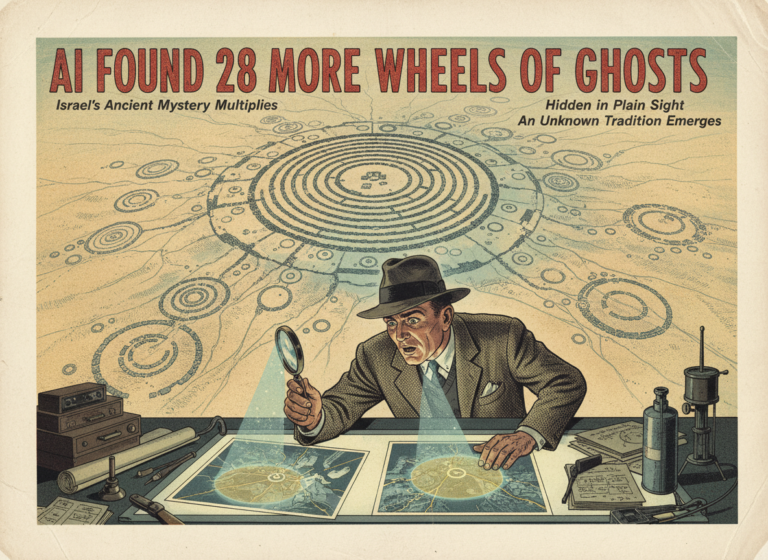
Israel's "Wheel of Ghosts" Has Been a Mystery Since 1968. AI Just Found 28 More of Them Hidden in Plain Sight.
Rujm el-Hiri — the Wheel of Ghosts — is a massive stone structure in the Golan Heights built from 40,000 tons of…
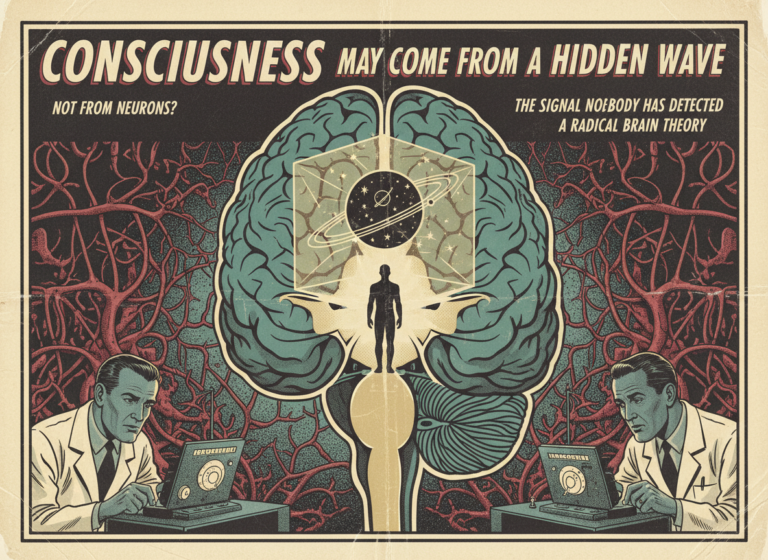
A New Theory Says Consciousness Is Not Produced by Neurons. It Comes from a Hidden Wave in the Brain That Has Never Been Detected.
A peer-reviewed paper published in Frontiers in Psychology in early 2026 proposes that conscious experience does not arise from neural computation at…